THE METROPOLITAN MUSEUM OF ART
Modern art – monument or mockery?
When Rachel Whiteread’s sculpture Monument (Plate I) was installed on the empty fourth plinth in London’s Trafalgar Square on 4 June 2001, the response reported in, and offered by, British national newspapers the next day was entirely predictable. Like the two previous temporary incumbents of this site (works by contemporary artists Mark Wallinger and Bill Woodrow), Monument – a clear resin cast of the plinth itself, inverted and set on top of it – was immediately pilloried: condemned as ‘banal’, ‘gimmicky’, and ‘meaningless’ by the Daily Mail, and disparagingly likened to a fish tank and a bathroom cubicle by members of the public, according to the Times. Some newspapers also quoted the supportive – but also vague and defensive – comments of members of the cultural establishment. The then Culture Secretary Chris Smith, Director of Tate Modern Lars Nittve, and the Tate’s Director of Programmes Sandy Nairne praised Monument variously as ‘beautiful’, ‘intelligent’, and ‘dazzling’ in its simplicity and conceptual clarity. They made no effort, though, to answer the condemnations. Nor did they point to the meanings about monuments and their purposes that Whiteread’s piece had provocatively suggested by echoing and inverting the plinth itself.
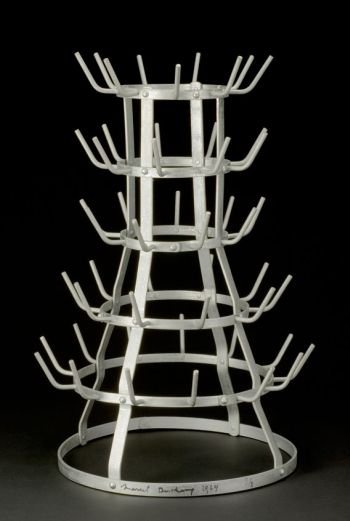
Such a mismatch between the public’s language of ridicule and establishment apologetics has, of course, been characteristic of the relation between modern art and its popular audience for longer now than anyone can remember. Recent instances such as Tracey Emin’s My Bed and Gavin Turk’s bin bags merely reprise the ‘scandals’ of previous generations, of which the fuss over the Tate’s purchase in 1976 of Carl André’s stack of firebricks entitled Equivalent VIII (1966) – or, to go further back, Marcel Duchamp’s submission of a urinal to a New York sculpture exhibition in 1918 – are perhaps the most notorious. Yet judging by the growth in the number of visitors to exhibitions and museums of modern art, its popularity has never been greater. Between 1996 and 2000 the number of visitors to the Tate’s annual Turner Prize exhibition, for instance, more than doubled, while a Matisse-Picasso exhibition broke Tate’s records, and the opening of Tate Modern itself in May 2000 was the big success story of the millennium year. New art museums and galleries are opening everywhere to much acclaim, and with equally impressive visitor numbers.
Why this contradiction? Why on the one hand is there such bewilderment at, even contempt for, every latest publicly unveiled example of ‘modern art’, and on the other such a growing interest in the subject and the experience of it? These questions are central to these papers the primary purpose of which is to interrogate the idea of modern art – to explore why this art was made, what it means, and what makes it modern. And they lead on to others. Not all art that’s been made in the last hundred years or so is accepted as modern.
We need to explore the complex question of how the art that is selected as such, and that has until the late 20th century been defined as ‘modernist’, relates to the dynamic cultural, social, economic, and political changes in the Western world that have been experienced as ‘modernity’ for the last 150 years. What has made a work of art qualify as modernist (or fail to)? According to whom, and just how has this selection been made? Does it continue to be so (what’s the relation between modern and contemporary art)? And whose modernity does it represent, or respond to? Finally, the buzzword ‘postmodernism’: what does this mean for art? Is ‘postmodernist’ art no longer modern, or just no longer modernist – in either case, why, and what does this claim mean, both for art and for the idea of ‘the modern’?
As soon as we begin to explore this set of questions, one thing immediately becomes clear: the public’s bewilderment at modern art has been a constant throughout the last 150 years – ever since ‘avant-garde’ artists started to challenge traditional art practices in a self-conscious and radical way. Indeed the two terms are almost interchangeable: ‘modern art’ is, by definition, ‘avant-garde’ in its qualities, aspirations, and associations, while what ‘the avant-garde’ makes is, necessarily, ‘modern art’. This connection, then, is crucial, and it is therefore worth taking, as our starting point for this exploration, the question of the origins and meaning of ‘the avant-garde’. The first aspect of this term that we might notice is the way, in common usage, it slips between adjective and noun – as in the italicized sentence above, in which the adjective ‘avant-garde’ refers to qualities, and the noun ‘the avant-garde’ to a notional community of self-consciously aesthetically radical artists.
Distinguishing between these two will help us to understand the term better, because historically (to put it most simply) the adjective preceded the noun. That is to say, the qualities and aspirations of art that we call ‘avant-garde’ – art that sought to say something new in its time, to acknowledge the implications of new visual media, to stake a claim for aesthetic autonomy, or to challenge prevailing values – emerged, in the mid-19th century, before there were enough aesthetically radical artists to make up a community. That community itself emerged around the turn of the 20th century, and this is the moment when the word ‘avant-garde’ first became associated with new art, by its critics and supporters alike. The community quickly became a frame of reference for that art, its very existence influencing, in ways we shall examine, the forms that it took and what its meanings were taken to be.
The reasons why some artists began to have ‘avant-garde’ aspirations in the mid-19th century are complex. Summarizing broadly, we can say that the development of capitalism in modern Western societies over the course of that century, and the steady encroachment of commercial values upon all aspects of the cultural practices of those societies, provoked some artists to seek to escape the conventions, the commodification, and the complacencies of an ‘establishment’ art in which those values were inscribed. Writers such as Baudelaire and Flaubert, and painters such as Manet, found their very existence as members of a materialistic, status-seeking bourgeoisie problematic – their distaste for such values not only isolating them from existing social and artistic institutions but also generating a deeply felt sense of psychic alienation. This double alienation, it has been argued, was the well-spring of avant-gardism. Yet there were other factors. It is no coincidence that these three individuals were French, for while
Yet the alienation the avant-garde felt was not a one-way experience. Fundamental to the bewilderment that underpins much public response to modern art is a suspicion of its sincerity, of the viewer being ‘conned’ or being found wanting – of this art being made by artists hungry for notoriety and sold through dealers whose main interest is in making money – a suspicion that is only heightened by revelations of the role of conspicuous art dealers and/or collectors such as Charles Saatchi in its promotion and display. And it is no coincidence either that the modern art market that emerged around the turn of the 20th century did so alongside avant-garde art and the avant-garde formation, indeed as a major support of both, or that this market should have been led by venture capitalists. The motors for its emergence, however, were not central to the growth of Western capitalism itself: individualism and the rage for the new. Artistic individualism, in particular, was a quality increasingly cherished as bureaucratic and commercial structures and relations came to govern more and more areas of social life; artistic creativity became emblematic of higher values – ‘the soul of a soulless society’, to adapt Marx’s epithet on religion – even for the bourgeoisie who were the chief architects of that society; and ‘genius’ became its supreme accolade. This development was registered in the market for modern art, in a shift in the attention of that market, after the mid-19th century, away from finished canvases (exhibited in their thousands at annual public exhibitions) to artistic careers in themselves: in the mid-1860s the Parisian dealer Durand-Ruel bought the entire contents of painter Theodore Rousseau’s studio – preparatory sketches, studies for paintings, and all, since even such jottings were the traces of that artist’s creativity. The more idiosyncratic (or ‘avant-garde’) the work produced, perhaps the more unfettered that creativity and the individualism it expressed; at least the possibility was worth betting on, for Durand-Ruel’s investment turned out eventually to be shrewd, and he was followed quite soon by increasing numbers of dealers and collectors who sought out and backed promising unknowns, thereby demonstrating not only their faith in genius but also their own individual discernment in recognizing it. Such were the activities and interests through which a cultural space was created for Picasso – the typical modern artist of genius – eventually to fill. Somebody had to, after all, as I shall argue later.
From the start of the 20th century, then, the notion and the community of the ‘avant-garde’ artist sustained art practices whose self-conscious transgressions of prevailing assumptions of what was aesthetically, morally, or politically acceptable were at the same time a guarantor of the individualism that was fundamental to modern Western ideology. In their different ways, artists such as Van Gogh, Picasso, and, later, Jackson Pollock enacted the individualism that all aspired to, plumbing those depths of human subjectivity that were beyond the reach of capitalist social relations – confirming what the philosopher Herbert Marcuse called the ‘affirmative’ character of culture in general, by at once consoling us for, and making good, the limitations of these relations. It has been this self-image as heroic explorers of the boundaries, the new and the overlooked aspects of human experience, on behalf of everyone that has characterized the avant-gardism of modern artists (and has fuelled the explicitly oppositional politics of many). But it has also placed them, and the art they have produced, in a triple paradox. First, because the starting point for many of these explorations has been a questioning of the materials, conventions, and skills of art practice itself. This questioning has been conducted via a range of gestures that has run from the iconoclastic, such as Picasso’s use of newspaper and wallpaper, old tin cans, and other junk to make his collages and sculptures; through the provocative, as in Pollock’s abandonment of paintbrushes, oils, and painterly dexterity for the crudeness of household enamel poured straight from the tin; or Warhol’s deadpan adoption, in his soup can prints and brillo box sculptures, of the impersonal techniques of advertisement billboards and packaging; to the blatantly challenging, such as Duchamp’s nomination of a urinal (and, more recently and exotically, Hirst’s nomination of a dead shark) as a work of art. And this questioning has posed an affront to established values, unerringly alienating that ‘everyone’ in whose name it was, purportedly, undertaken. Indeed, in the case of the surrealists, this paradox was posed in its extreme form, since such affront was precisely what a surrealist image or gesture was intended to achieve: for it was only through the ‘convulsive beauty’ of their shocking, irrational actions or juxtapositions that the complacent tyranny of ‘reason’ could be challenged – and the floodgates opened to those unconscious drives whose acknowledgement and assimilation alone could make modern human beings whole.
A second paradox: in the case of the surrealists and other self-consciously ‘avant-garde’ groups, the esoteric nature of the ideas and knowledge to which they often appealed, and the ‘difficulty’ of the images and objects they made – the resistance of an abstract painting by Mondrian, say, or a minimalist object by Morris to any easy interpretation; their refusal to offer any obvious ‘meaning’ – carried inescapable associations of a cultural elitism that fatally undercut any claims to populism the artists themselves might have mounted. It is true that much avant-gardist behaviour was public in character. The issuing of manifestos, which was one of its most notorious and influential innovations, and the mounting of provocative exhibitions (the Dada and surrealist artists excelled inthis) were aggressive promotional strategies aimed at the general public. Marinetti’s ‘Founding Manifesto of Futurism’ was published in February 1909 on the front page, no less, of Le Figaro, one of Paris’s leading daily papers of the time. But its real audience was private, and restricted. Those who had access to the meanings of its art were inevitably few, and they came largely from the milieux within which this art was generated. Moreover, while the network of modern art’s aficionados grew steadily through the 20th century, so too did its aloofness and exclusivity, for the investment of such patrons was as much in that art’s association with qualities of independence of taste and individualism, as in its future monetary value. As the American mid-20th-century critic Clement Greenberg put it, avant-garde art was, from its first appearance, connected to its patrons by ‘an umbilical cord of gold’. How this relationship (and the ways in which artists negotiated it) shaped the character of modern art – and whether it will continue to do so – are questions we shall explore later.
A third paradox is that the self-image of the modern artist as cultural hero, acting on behalf of society to guarantee our individualism and renew its means of expression, is one whose gendered character has excluded one half of that society from its own ranks. As art historian Carol Duncan observed 30 years ago, the behaviour, art practices, and creations of early 20th-century vanguard artists were grounded in a widespread culture of
masculinism: from the prevalence of the female nude as subject in painting and sculpture, via the socially regressive sexual relations that typified a ‘bohemian’ lifestyle in which women were mistresses and muses but rarely equals, to the aggressively attention-seeking, self-promoting tactics that the furtherance of an avant-garde career entailed, ‘modern art’ and the modern artist were so defined as to exclude women artists. There were exceptions, of course, but not many, and the century-long struggle of women to win equality with, and independence from, men in modern Western societies was also waged to some effect – but not much, as we shall see – in the arena of modern art, over the next 50 years. The efforts of the women’s movement in the USA and Europe in the 1970s and thereafter have, however, gained considerable ground for women in the art world, and (thanks in part to the work of Duncan and other feminist historians and critics, such as Linda Nochlin in the USA and Griselda Pollock in Britain) the work of women artists past and present is now becoming more visible. How that greater visibility has altered, if at all, the self- and public image of the modern artist is another question to return to.
Inseparable from the individualism of the modern artist has also, of course, been ‘his’ originality: as with the term ‘avant-garde’, to be modern, art has to be original in some respect. Over the century and a half since the emergence of modern art this originality, and the drive for it, have, however, been at once an expression of the independence of what has come to be called modernist art from establishment or mainstream culture – indeed, for many, of its opposition to that culture – and one of the main motors of cultural ‘Modernization’ in Western capitalist societies. It is, again, no coincidence that the decade before the First World War saw the consolidation both of the formation of the avant-garde and of the advertising industry in most of these societies. French art critic Camille Mauclair explicitly linked the two in a 1909 essay, charging the ‘prejudice of novelty’ for many of modernity’s ills, and finding the same use of promotional hyperbole in the marketing of new art and new appliances. He might have mentioned too the growing two-way traffic, between art and advertising, in new visual techniques and languages, such as photomontage and graphic design; certainly a decade later these crossovers were commonplace, and avant-garde artists across Europe, from Sonia Delaunay in Paris to Alexandr Rodchenko in Moscow, worked simultaneously in both fields.
Yet if modern art and modern consumer products were both marketed by similar means, this was initially much more successful in the latter case than in the former. In the 30 years from 1900 that saw revolutions in the technologies of the design and production of consumer goods, and in the means of creation of demand for them, avant-garde art remained on the cultural margins; its unorthodoxies remained beyond the pale of mainstream taste. This too was soon to change, however. The social base of modern art began to broaden at about the same time as its cultural headquarters moved across the Atlantic, from
The foundation in 1929 of the Museum of Modern Art in New York, largely with Rockefeller money, was the fairly modest first indicator of this broadening, and the steady growth in that institution’s cultural assets, prestige, and influence over the subsequent three-quarters of a century has both registered the gradual assimilation of modern art into the leisure – and, more recently, entertainment – industries of Western societies, and provided a model for other museums in many of these. In recent years ‘modern’ art has not just come in from the cold, but – as the proliferation of those museums and the rise in their attendance figures that I noted earlier testify, and the celebrity status bestowed on individual artists (such as, for now, Tracey Emin) underlines – it has been fully assimilated into what the cultural critic Guy Debord called ‘the society of the spectacle’.
Perhaps, though, I should say ‘reassimilated’. Because, as I noted, ‘modern art’ began partly as a reaction against that very collapse of arts values into spectacle and commerce that characterized 19th century academicism. Perhaps the founding moment of modern art was the 1863 Salon des Refusés in Paris, when a selection of the paintings that had been rejected by that year’s jury for the official exhibition, or Salon, of new ‘establishment’ art was allowed an alternative Salon of its own – and the public, of course, a clear licence to indulge in uproarious and ribald ridicule of ‘bad’ art. The ‘star’ of this alternative exhibition, drawing by all accounts bigger crowds and more mockery than any other exhibit, was Edouard Manet’s Le Déjeuner sur l’Herbe [The Picnic Luncheon]. Exploring why it was, and what this implies for the assumptions of its first viewers about art and their relation to it, will help to clarify the qualities that made (and perhaps still make) art ‘modern’. First, we can imagine how the contemporaneity of the scene – the modern clothes of the men, the familiar picnic ingredients – might have seemed to those viewers to ‘send up’, even as it situated itself within, the tradition of such men-with-nude-women paintings. Even though old masters such as (say) Giorgione or Raphael, whose works in the Louvre might have been familiar to this audience, also painted their male figures in contemporary dress, that dress was no longer contemporary for these mid-19th-century Parisian viewers, for whom such paintings carried the aura of old master art, and to attempt to ‘update’ the tradition in this way might have seemed nonsensical, and suggested incompetence on Manet’s part. Equally disconcerting, perhaps, was the woman’s gaze: directed out of the picture and at the viewer, it both ruptures the illusion of the scene she is in, and addresses (and thus accentuates) the subjectivity ofthe viewer. This fatally undercuts any narrative conviction that the scene might have carried, leaving that viewer both more self-conscious and uncertain about what the picture ‘means’ – and when we notice the little goldfinch hovering at the top centre of the picture, the assumption that the leading male figure’s pointing finger is a gesture related to what he is (presumably) saying is countered by the possibility that he is instead holding this finger out for the bird to perch on. Absurd though it is, this ridiculous alternative is enough to collapse still further the narrative conviction, and correspondingly to heighten the sense that the painting mocks both old master art and its audience. And as if such undermining of conventions of pictorial staging and narrative weren’t enough, the absence of convincing modelling of the figures (of the nude woman in particular, who seems inappropriately flat and bright, as in a flash photograph), and the inconsistencies of scale and perspective between the foreground group and the woman in the background, call attention to the materiality of the painted surface, and to the devices and conventions of illusionism itself. For a mid-19th-century audience, this too would have signified incompetence on Manet’s part; yet troublingly for such an audience, there’s sufficient evidence of competence to unsettle this assumption – and to heighten still further the sense of mockery.
Le Déjeuner sur l’Herbe managed to call into question all of the assumptions that underpinned the enjoyment of art by its Parisian public in 1863; or to put it another way, it failed to meet the established criteria for an acceptable picture, in ways that were either laughable or offensive. No wonder it was ridiculed by its first audience. But from our perspective, those assumptions and criteria are not so certain as they were: in a world whose visual culture is no longer dominated by painted images, in which the cultural hierarchy that placed pictures at its apex is under siege, if not fatally undermined, by the diversions of an endlessly expanding range of commercial popular visual media, it seems reasonable to propose, as Le Déjeuner sur l’Herbe seems to, that the specificities of painting – as a medium, as a practice, as a visual experience – need to be taken into account in any representation of the visible world that it offers. For Manet perhaps first, but for generations of artists after him, the recognition that a picture was not a window onto that world but a constructed image of it, one that used devices and conventions of representation whose meanings were no longer as secure as they were once thought to be, would be the prerequisite of any attempt to say, in paint, something worth saying about the modern world – of any work, that is, that laid claim to the term ‘modernist’.
Which brings us, perhaps, back to Rachel Whiteread and her Monument. It’s possible to see the comments of the Daily Mail and the members of the public it quoted as standing in the same relation to this sculpture as Manet’s audience stood to the Déjeuner sur l’Herbe. We could see them, that is, as bringing to their interpretations of the work assumptions about what a monument should look like, that Monument fails to meet – and which, like Manet’s painting, it calls into question on a number of levels, by putting ‘monumentality’ itself into the equation. But this would be to assume, in turn, that nothing has changed since Manet. I think it has, and that things are more complex than this equivalence between then and now would suggest.
- Professor Doctor Natasha Staller