VIDEO

Can you help me to understand the thoughts and feelings associated with my loved one’s illness?
It can certainly be difficult for someone who has not experienced anorexia to understand the thoughts and feelings associated with the illness.
While every person with an eating disorder is different and experiences their own unique set of emotional challenges, some common themes have been reported.
The first of these themes may come as no surprise: People with anorexia think a great deal about food. In fact, most anorexia patients report that thoughts about food, weight-control, and body image are an all-encompassing preoccupation. “If I was not thinking about my food and weight, I don’t know what else I would think about. It’s all that I do all day,” a patient recently confessed to me. It was not the first time someone had expressed this sentiment.
More than just counting calories, weighing one, and avoiding so-called “bad” foods, weight control can become a measuring stick for life and success. A “good” day is when one restricts eating to an acceptable degree; a “bad” day is when one has consumed more than their daily “allotment of calories.” Likewise, some patients use body image as their compass.
Thus, a “good” day is when clothes fit loosely and the stomach appears flat; a “bad” day is feeling bloated or having the stomach protrude. Personal identity and self-worth become intertwined with weight and appearance. Weight gain may be experienced as a personal failure with accompanying feelings of guilt and shame. In contrast, being the “thinnest one” in a room full of people may be experienced as virtue and victory. While it may indeed be hard to understand the extent to which anorexic thoughts preoccupy a patient’s life, it may be helpful to learn of some associated patterns.
Your loved one may:
• Count calories at every meal
• Plan what they will eat far in advance
• Be attentive to bodily sensations, such as feeling bloated or full
• Be overly concerned with other’s evaluations of them
• Compare themselves to others
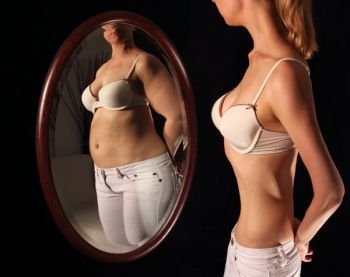
• Feel fat, even when they are not
• Use weight control as a measure of personal success or failure
• Experience compliments as reinforcements for their weight control efforts
• Divide foods into “good” and “bad” categories and rate themselves as “good” or “bad” if these foods are consumed
• Pursue perfection through weight control
• Be overly sensitive to remarks about personal appearance
• Deny their own need for food and nourishment
• Plan ways to purge food or compensate for food consumption (e.g., exercise)
• Experience persistent, incessant negative self-evaluation (e.g., “you’re fat!” “You have no willpower!” “You’re a failure!”)
While this list is illustrative of the kinds of thoughts that preoccupy a person with anorexia, the ironic thing is that the issues that may underlie anorexia symptoms often have very little to do with food. In reality, the preoccupations associated with anorexia can sometimes serve as a distraction from and a complex means of coping with, deeper psychological pain or turmoil. Take Jeanie, for example: Jeanie is a 19-year-old gymnast who dreamed of competing at the highest levels of her sport. She began her training at age four and was considered a “natural” by her parents and coaches. Jeanie loved going to classes and later to training-practice, often showing her enthusiasm by dancing around the equipment in between routines, her favorite songs playing on the radio in the background.
Tragedy struck Jeanie’s life when she was 11 years old. She and her family was bike riding on a familiar road near their home when an out-of-control driver struck the bike that her brother was riding and he was killed. Jeanie recalls the event as “the day that my light went out inside.” Jeanie and her family were understandably distraught for many months. Her parents, however, continued to take Jeanie to practices and attend her meets without interruption.
They felt it would not be fair to stop Jeanie from enjoying her gymnastics and admittedly found it “therapeutic” to cheer Jeanie on to do her best. Jeanie began to feel the pressure of competing in a completely new way. It was no longer a fun way to spend her time. Instead, Jeanie threw herself deeper into training, not only for herself and her team, but also “in order to help me and my family heal.” Jeanie thought that by becoming the best gymnast on the team, she could erase the pain she and her parents were experiencing.
As Jeanie’s body began to change with puberty, she became increasingly concerned about gaining weight. She says she felt pressure to “not let anything get out of balance” in her life, and her weight was one of those “things.” Jeanie began restricting her food intake, yet all the while maintained a rigorous training schedule. Eventually, Jeanie was diagnosed with anorexia nervosa and admitted to the hospital for complications related to malnutrition. As Jeanie’s story illustrates, for some patients, anorexia symptoms provide an emotional anesthetic, numbing feelings and offering retreat into a “safe” world constructed by the illness.
I remember the feeling that no matter what I did, it was never good enough. I could get straight A’s in school, but I considered myself stupid and unworthy. I could win a national championship in running, set a national age group record, and win a prestigious race, but I still couldn’t feel good about myself or like myself. I was greatly embarrassed by any recognition of my accomplishments, feeling like I really didn’t deserve it. If I won a race or set a record, it was just a lucky moment in time or a sort of accident, and I would then try to do better next time.
I was constantly and ravenously hungry, yet believed I didn’t deserve to eat, and was afraid to eat. Even though it wasn’t working, it seemed that striving to be a good athlete and being very thin might somehow relieve my extreme feeling of unworthiness and self hate. I imagined that anyone who met me would automatically dislike me as much as I did. It was a tortuously lonely existence, so I put all of my thoughts and efforts into being a good runner and being as thin as possible.
These were synonymous for me; being a good runner and being as thin as possible. I didn’t believe you could have one without the other. The resulting starvation and exhaustion often blocked the feelings of loneliness, self hate, and despair.
Sarah shares:
Anorexia was a horrible, life-consuming experience. Sometimes I still don’t understand the thoughts and feelings I had during my illness. At any given time, I was calculating the number of calories I had taken in during the day and the amount I needed to run to cancel out these calories. But as my doctor tells me to this day, “Anorexia is not about fat, food, or figure. It’s about feelings.” As much as I never believed him when I was in the midst of the disorder, he was right. I used anorexia as a mechanism to cover up feelings I didn’t even know I had, to distract myself from bigger issues that were at hand in my life.
The issues that may underlie anorexia symptoms often have very little to do with food.