VIDEO
EpiPen Adrenaline Autoinjector
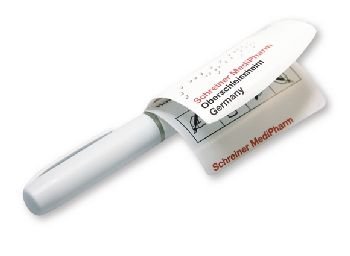
Insulin Injectors
My son has trouble giving him injections and has asked me if he can use an injector. What type of injector should he use?
With insulin pens and thin diameter disposable needles injections are rarely a problem if the correct technique is used. Most people find injectors more trouble than they are worth, and they are something extra to carry around, but they may help people like your son who are going through a difficult patch.
Injectors work on a similar principle of pushing the needle very quickly through the skin, whilst hiding the needle from view. As well as offering fast needle penetration, the Auto-Injector also automatically delivers the insulin at speed with a conventional syringe. Its disadvantages are that it is rather noisy and over-sized. This injector is not available on prescription. If your son uses an insulin pen, Novo Nordisk has introduced a device called PenMate, which slips over the NovoPen 3 and inserts the needle into the skin automatically, whilst hiding it from view.
What is the ‘jet’ injector?
This is a needle-free injector, which works by firing liquid, such as insulin, through the skin from very high pressure jets. It is not entirely painless, is bulky, expensive, not available on the NHS, and has not yet been proved to be harmless when multiple injections are given. As with needles, potential problems of bruising can occur. These injectors are no longer marketed in the
Practical aspects of syringes, needles, and bottles
When I was discharged from hospital with newly diagnosed diabetes I was given a few disposable syringes and needles for my injections. How do I obtain more?
Disposable insulin syringes and pen needles are available free on prescription. Your GP will supply you with a prescription for any make of insulin syringe and/or insulin pen needles that you choose and they can then be obtained free from the chemist.
What is the best way of disposing of insulin syringes and needles?
There is a device available called the BD Safe-Clip which cuts the needle off the top of the syringe or insulin pen and retains it in the device. Once the needle is clipped off, put the used syringe or pen needle hub into a rigid sealable container along with your lancets and follow your local council guidelines for safe disposal of medical waste. Some local authorities provide special containers and a collection service for people who are treated with insulin; however, there is no national policy. The BD Safe-Clip is available free on prescription from your doctor.
I have heard that disposable syringes and needles can be reused. How many times can they be reused and how can they be kept clean in between injections?
While disposable syringes and pen needles are designed to be used only once, some people do reuse them. However, reusing needles causes them to become blunt, and they twist and bend. The tiny point on the end can also break off and remain embedded in the subcutaneous tissue. Needles have a fine coating of lubricant on them so they glide in and out of the skin, and reusing them removes this lubricant and may cause a painful injection. So there are many reasons why it is logical to use each needle once only. If you decide to reuse them, keep the syringe dry and in a clean place with the protective cover placed over the needle.
There is a bewildering array of syringes and needles on the market. Which are the best types to use?
In this country there are three sizes of syringe to be used with U100 insulin (this is the standard strength of insulin in the
• The more commonly used, the 0.5 ml syringe, marked with 50 single divisions for those taking not more than 50 units of insulin in one injection;
• The 1 ml syringe, marked up to 100 units in 2 unit divisions for those taking more than 50 units of insulin in one injection; and
• The 0.3 ml syringe, more specifically designed for children or those taking less than 30 units of insulin in one injection.
All these syringes are marked with the word INSULIN on the side of the syringe and graduated in units of insulin. No other type should be used when an insulin injection is given.
Note that one division on the 0.3 ml and 0.5 ml syringes is equal to 1 unit of insulin, while on the 1 ml syringe one division is equal to 2 units of insulin.
The most popular syringe is the BD syringe which comes complete with a fixed Micro-Fine+ 12.7 mm needle, but there are several other makes available.
What length of needle should I use on my insulin pen?
There are several lengths of needle available today ranging from 5 mm to 12.7 mm. The general rule is to use the 5 or 6 mm needle for children and thin to normal weight adults without a lifted skin fold; the 8 mm for normal weight adults with a lifted skin fold, and the 12 or 12.7 mm needle for overweight adults also with a lifted skin fold. Ask your healthcare professional for the needle length and injection technique the most appropriate for you.
I am partially sighted. What syringes are available for people like me, or for people who are blind? Are there any gadgets that would help me with my injections?
Most visually impaired people would be advised to use an insulin pen but, if you wish to use a syringe, BD and Sherwood can supply magnifiers that clip over their plastic syringes, which may make the marks easier to read. An insulin pen is probably then best choice for people like you who are visually impaired. It is quite easy to use once the technique has been mastered, and offers a good choice of insulin regimens. This should be discussed with your physician or diabetes specialist nurse Novo Nordisk has introduced a device called Innolet that might well suit you. It is a disposable insulin pen with a large clock-like dial, audible clicks accompanying each unit dialed, and which is easy to hold as it has a large grip.
Where should I keep my supplies of insulin?
Stores of insulin should ideally be kept in a refrigerator, but not in the freezer or freezing compartment. The ideal storage temperature is between 2° and 8°C. Below 0°C insulin is destroyed, and from 30°C upwards, insulin activity progressively decreases. If you do not have a fridge, then insulin may be stored for about a month at room temperature but keep it away from direct heat such as radiators and strong sunlight. Many people prefer to keep their insulin bottle and/or their insulin pen in current use at room temperature as it may make the injection more comfortable (cold insulin increases the pain of the injection).
Should I wipe the top of the insulin bottle with spirit before drawing up the required dose?
Although some clinics teach people to clean the tops of the insulin bottles, we do not think that it is necessary.