VIDEO
What is schizoaffective disorder?

What is the difference between bipolar disorder, schizophrenia, and schizoaffective disorder?
Strictly speaking, bipolar disorder is classified as a mood disorder and schizophrenia as a psychotic disorder.
Schizoaffective disorder is considered primarily a psychotic disorder, but with a concurrent mood disorder. All three conditions may be diagnosed in one individual over the course of his or her illness at different points in time because of the overlap of many of the symptoms. For many disorders listed in the DSM-IVTR, there is an overlap of symptoms, and many conditions can be diagnosed concurrently (e.g., a depressive disorder and an anxiety disorder), which is known as comorbidity.
Although there are many conditions that people can have simultaneously, some conditions have as a criterion a specific exclusion of the concurrent diagnosis of another condition. Historically, individuals who have actually suffered from bipolar disorder have sometimes been inaccurately diagnosed with schizophrenia.
Symptoms can be similar between these conditions, but the prognosis can be quite different, so an accurate diagnosis is important. The treatment was once vastly different, but with the advent of atypical antipsychotics, treatment options often overlap as well, so medication history is not an adequate means for determining a person’s past psychiatric diagnoses.
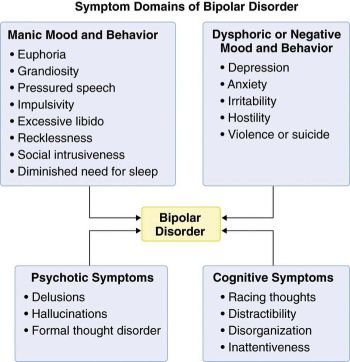
Despite the overlap in symptoms, particularly for the manic episode of bipolar disorder, the three conditions in question cannot be diagnosed concurrently, according to the DSM-IV-TR. The symptoms for schizophrenia include the following:
• Delusions
• Hallucinations
• Disorganized speech
• Disorganized behavior
• Negative symptoms (affective flattening, alogia, avolition)
Any of these symptoms can be present if psychotic during a manic episode. As such, to diagnose schizophrenia, there must be the exclusion of either schizoaffective disorder or a mood disorder (such as bipolar disorder) with psychotic features. Schizoaffective disorder is defined by the presence of a major depressive or manic episode (or mixed) concurrent with symptoms of schizophrenia as noted above.
In addition, there needs to have been at least a twoweek period of delusions or hallucinations in the absence of prominent mood symptoms. Thus, schizoaffective disorder often is more easily diagnosed over the course of an illness rather than at a specific point in time. An accurate history would certainly be needed to do so, and this can often be difficult to obtain, especially during an acute phase of any of these illnesses.
Terms:
Affective flattening – a dulling of one’s facial and emotional response to external stimuli.
Alogia – the inability to speak due to mental incapacity.
Avolition – a psychological state characterized by a general lack of desire, motivation, and persistence.