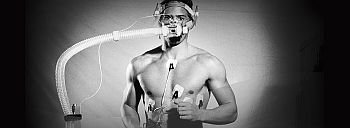
Exercise Physiologist Demonstrating VO2 Max Testing
What is rating of perceived exertion?
The rating of perceived exertion (RPE) scale has become a useful tool for athletes to use in determining their exercise intensity. It is a relatively easy and convenient method to help athletes rate how hard they are working during exercise. RPE is based on a scale that
is often referred to as the Borg scale. The scale has a numerical value attached to it, increasing by 1 unit starting at 6 and ending at 20. A rating of 6 (no exertion at all) would be given by someone relaxing, whereas a rating of 20 (maximal exertion) could be given by an athlete at the end of a hard sprint. The Borg scale can be an effective tool in helping athletes to select exercise intensity without having to use a heart rate monitor. Research has demonstrated clearly that intensity is the most important exercise variable when it comes to developing higher levels of cardio respiratory fitness.
Borg Scale
6 No exertion at all
7 Very, very light
8
9 Very light
10
11 Fairly light
12
13 Somewhat hard
14
15 Hard
16
17 Very hard
18
19 Very, very hard
20 Maximal
Can an athlete benefit from using a heart rate monitor?
Many athletes demand a more scientific approach to their training. One instrument that has become increasingly popular among recreational as well as elite athletes is the heart rate monitor. Heart rate monitors are wireless devices that consist of a transmitter (strapped around the chest) and a watch-like receiver (worn around the wrist). Heart rate monitors are easy to use and can be purchased relatively inexpensively.
The benefits of using heart rate monitors are numerous:
1. Helps to quantify the athlete’s training
2. Provides feedback on the body’s response to the stress of training/competition
3. Allows athletes to make adjustments to their training intensity
4. Ensures continued improvement in cardiovascular fitness
5. Reduces the potential for overtraining
6. Helps those athletes recovering from detraining or injury
What is VO2 max test? What does it measure? Why is it beneficial?
The VO2 max test is an accurate scientific laboratory method for measuring an athlete’s cardio respiratory (aerobic) capacity. The VO2 max test determines the maximum amount of oxygen in milliliters that an athlete can consume per kilogram of body weight per minute during a graded exercise test. The test is designed to assess the three major interrelated physiological systems of the body: pulmonary (lungs), cardiovascular
(heart and blood vessels), and muscular. It is well documented that highly trained athletes will have higher VO2 max capacities than untrained individuals.
The athlete’s increased ability to extract and use oxygen at the cellular level will enable him or her to train with greater intensity, simultaneously buffering the body’s lactate production, resulting in an increased resistance to fatigue. The results of a VO2 max test may be used in the design of an athlete’s sports-specific training program and can be a reliable method of measuring the athlete’s physiological improvement over time.
VO2 max assessments are generally conducted on a treadmill, bicycle, and rowing ergo meter or in a swim flume. The VO2 max test is a progressive test that increases in intensity over time (minutes).
As the workload rises, the body’s capacity to extract and use circulating oxygen will also increase until the athlete reaches a maximum threshold of consumption. After threshold is attained, further jumps in intensity will not be matched by increases in the cell’s oxygen utilization. This is the athlete’s upper limit, the VO2 max. VO2 max is expressed relative to a person’s weight in ml/kg/min.
Athletes considering a VO2 max test should be aware what the testing is exercise modality specific. In other words, biking VO2 max data should not be used to assess running capacity and vice versa. Athletes should only be tested for their particular sport to avoid potential erroneous data being applied to their training.
Christopher’s comments:
Approximately a year and a half ago I completed a 3-year sea-duty tour in the U.S. Navy and headed to shore-duty assignment. After 3 years of high-operational tempo, I found that my physical fitness level wasn’t where I wanted it to be.
Now that I had the time, I wanted to get back into training, specifically for a number of adventure races coming up that summer. An opportunity presented itself to take part in a VO2 max test in order to establish my baseline fitness level. I wasn’t familiar with this test at the time, only having seen it used by Olympic athletes on a TV special during the run up to the 2008 Olympics.
Frankly, I didn’t think this test was geared for the “recreational athlete.”
Luckily, my assessment was wrong. Although my VO2 max numbers were not that impressive, the information garnered from the test was invaluable in tailoring my training. What I learned was that the training I was doing was too intense and of not sufficient duration. This led to good anaerobic capability but less than optimal aerobic capability. The VO2 max test helped map my aerobic/anaerobic threshold and give me the insight I needed to adjust my training to improve my aerobic capability.
The difference in my race time before the test and the race I just recently ran was dramatic. I’m convinced a big part of that was due to the training plan derived from my VO2 max test. With limited time to train, the VO2 max test has certainly helped me train “smarter not harder.”
Are all metabolic carts (VO2 max assessment devices) alike?
With the advent of cheap, easy-to-use metabolic assessment systems on the market today, the availability of laboratory metabolic testing (VO2 max) has grown considerably. Athletes today have an array of testing services available to select from as a result of these less expensive and less cumbersome systems. Unfortunately, many athletes are unaware that not all metabolic devices are created equal and subsequently may not accurately assess or measure changes in cardio respiratory capacity. The consequence of being tested by less reliable and invalid systems could result in erroneous data being used to design an athlete’s exercise program that may lead to suboptimal gains and/or possible overtraining.
In order to ensure accurate results, the athlete should ask a series of questions before considering using a VO2 max testing facility.
Research has demonstrated clearly that intensity is the most important exercise variable when it comes to developing higher levels of cardiorespiratory fitness
Terms:
Rating of perceived exertion (RPE) -Often referred to as the Borg scale (see Borg scale).
Borg scale – Is also known as the Rating of Perceived Exertion scale. The scale has a numerical value attached to it, increasing by 1 unit starting at 6 and ending at 20. A rating of 6 (no exertion at all) would be given by someone relaxing, whereas a rating of 20 (maximal exertion) could be given by an athlete at the end of a hard sprint.
The scale is an effective tool in helping athletes to select an exercise intensity without having to use a heart rate monitor.
Heart rate monitor – A wireless device that consists of a transmitter (strapped around the chest) and a watch-like receiver (worn around the wrist).
VO2 max test – An accurate scientific laboratory method of measuring an athlete’s cardiorespiratory (aerobic) capacity. The VO2 max test determines the maximum amount of oxygen in milliliters that an athlete can consume per kilogram of body weight per minute during a graded exercise test.
Cardiorespiratory – Function of both the heart and lungs
Cellular level – The smallest structure that is capable of independent functioning in an organism.
Lactate – The biproduct of cellular glucose breakdown