Modern Art Documentary ~ A Complete Guide
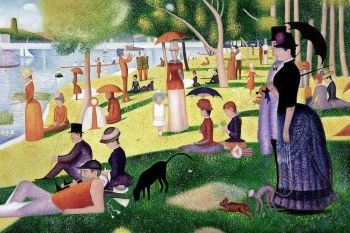
Georges Seurat, A Sunday Afternoon on the Island of La Grande Jatte
Tracking the avant-garde Origins and attitudes
Origins and attitudes
When Emperor of France Napoleon III set up the ‘alternative’ Salon of rejected artworks, the ‘Salon des Refusés’, in Paris in 1863 he was, in effect, belatedly acknowledging a social and aesthetic development that was already underway: the accelerating increase in the number of artists wishing to make a career in his capital, and needing to exhibit in the annual Salons as a means to that end, and the proliferation of aesthetic interests that they were displaying in their works (the majority of which were failing, evidently, to impress the Salon jurors). This development was paralleled across Europe, as one feature of a widespread rise in the status and profile of the cultural professions, but it was in Paris, with its unrivalled artistic reputation and prestigious cultural institutions, that it was most acute. Aspirant artists flocked to the city from all over the world, especially after the collapse of Napoleon’s empire in 1870, the establishment of the Third Republic that followed, and the reforms of the state’s apparatus of cultural regulation and control that it introduced – as a part of which, artistic education was overhauled, and censorship and licensing of the press and the entertainment industries were loosened. By the turn of the 20th century, it has been estimated, the number of artists in France (most of whom were in Paris) had nearly doubled, and that of journalists and ‘men of letters’ had trebled.
But many of the newcomers found themselves deceived by the new Republic’s promises of equality of access to fame and fortune, and their paths to career advancement obstructed by the realities of class hierarchies and professional protocols. It took more than a few new pieces of legislation, they discovered, to change the settled customs, privileges, and prejudices of generations. Thrown back on their own devices, they instead created new means of support for themselves and outlets for their work outside the mainstream of academically sanctioned art, in and around the newly liberated sectors of journalism and entertainment. Private art academies mushroomed, initially complementing (and preparing their clients for) the state art schools, but eventually taking their place; artists’ groups used cafés and cabarets as their bases, exhibiting their work in them, as well as in the offices of the proliferating ‘little magazines’. There were nearly 200 such magazines circulating in Paris on the eve of the First World War – publications whose writers made their names in these seething milieux by reviewing the new art that they incubated. Within a generation – by the time of the First World War – Paris had spawned a counter-culture whose vitality and hectic networking was registered in the scores of artistic and literary ‘isms’ that it generated. These ‘isms’ functioned as aesthetic trademarks, unrecognised (indeed ridiculed) in the mainstream, but sanctioned by this emergent ‘avant-garde’. The term was claimed by its members at that time – who borrowed its implications of advanced status, of being ‘ahead of the game’, from an original military usage that had already been broadened into political discourse – as a means of compensating themselves for the social and cultural marginalisation that they were experiencing.
Shut out of the mainstream and its material rewards, many self-styled avant-garde artists also channeled their idealism not only into experimentation with their chosen medium and its possible new modes and meanings – a matter to which I shall return – but into a belief that art had a public role to play, that it could be lifted from the status of trivial and anecdotal entertainment to which it had sunk in the Salons. Indeed, this commitment to a public art was integral to the founding gesture of avant-gardism: the launch of ‘neo-impressionism’ in 1886. Its members had been among those who had in 1884 created the Society of Independent Artists, the main purpose of which was to hold an annual exhibition in Paris each spring that would be unjuried, and open to all. The ‘Indépendants’ was, as a result, quickly to become the showcase for the most adventurous art of the next quarter-century. Two years later the leading painter in the group, Georges Seurat, exhibited his huge picture A Sunday at La Grande Jatte (Plate II), alongside smaller works painted in the same ‘pointilliste’ style by half a dozen other artists, in what was to be the last impressionist group exhibition. Inescapably public both in scale (no drawing-room could hold it) and in subject matter (a cross-section of Paris’s contemporary inhabitants at leisure on one of the city’s favorite river islands), its stiff formality, considered compositional geometries, painstakingly systematic brushwork – and it’s more than a hint of caricature – marked it off from the work of the older impressionists. The painting thus declared itself and was taken as, the ‘manifesto’ of a new approach to art, one that sat astride two of the paradoxes I outlined earlier. For it was both a clear return to traditional values in painting that both Salon artists’ anecdotalism and the informalities of the impressionists’ pictures had discarded, and a new departure in painting technique whose machine-like regularity of brushwork and pedantic separation of colours seemed to ape, absurdly, modern mass production and scientific knowledge – thus, a picture whose supposedly public, even populist, mode of address seemed, to a contemporary audience, fatally undercut by its specialist and perhaps mocking novelties of style. Like Manet’s Picnic Luncheon of 20 years earlier, but now from a declared ‘neo’ position, it managed to alienate and to register alienation, at the same time.
The early years of the avant-garde established the key features of modern art and its relation to the public. But the emergence of that avant-garde was not confined to Paris. In every major city across Europe, and to an extent in the USA as well, similar communities of anti-academic artists sprang up in the years before 1914, like mushrooms overnight – the by-product, as it were, of the process of social and cultural ‘modernization’ in the advanced capitalist countries of the Western world. By 1914 there were such communities in every major city from New York to Moscow, from Rome to Stockholm; a book published in 1974 simply listing the modern art exhibitions held in these cities between 1900 and 1916 filled two volumes. Artists and artworks, and their associated art critics and collectors, crisscrossed the continent, and increasingly the Atlantic, comparing and disseminating their ideas, producing not only an alternative ‘art world’, but one that came steadily to dislodge from its position of pre-eminence an art world centered on Salons and other official art institutions. And at its centre, generated by and generating it, were two driving forces. The first of these was a spirit of competitive innovation – a rage for the new, even – that was expressed not only in art practices and experimentation with expressive means, but also in strategies of organization and promotion: the ‘isms’ that proliferated so bewilderingly; the manifestos, events, and provocations that have come to be synonymous with ‘avant-garde’ behaviour. The second was a spirit of internationalism that sat uneasily with (and sometimes acted to mitigate) the rampant nationalism of the time – for the members of this community, their sense of national identity was qualified in complex and often contradictory ways by their avant-gardist affiliations. Between 1912 and 1914 the avant-gardism of the Italian futurists led by Marinetti, and in England the vorticists led by Wyndham Lewis, exemplified this contradiction: each group outdid the other, not only in its aggressive self-promotion and declaration of commitment to the modern world of steel machines but also in its patriotic attachment to traditional national values.
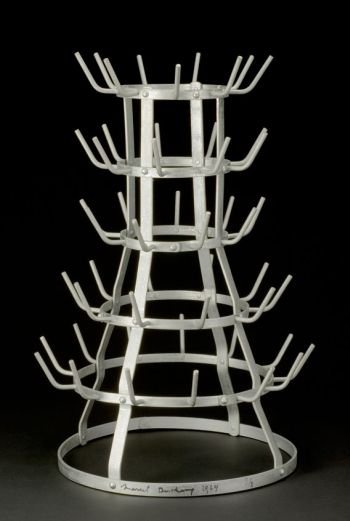
For many artists, these affiliations and their implications so outweighed the appeal of nationalism, in those years of catastrophic conflict between nation-states, that they found expression in outright opposition to the social order that had brought the world to war. Thus artists of the international ‘Dada’ movement (the meaning of the name is uncertain, and may be an imitation of a baby’s babble) sought in different ways to mock, outrage, or vilify bourgeois society into its grave. In Zurich and Paris, Hugo Ball, Emmy Hemmings, Tristan Tzara, and others attempted this with cabaret performances and art exhibitions in which chance, absurdity, profanity, insulting and even assaulting the audience were key devices. In Berlin, George Grosz, John Heartfield, and others worked with the political Left, producing artworks, cartoons, and propaganda material that sharply satirised post-1918 German society. Less overtly political but also subversive, Marcel Duchamp in New York conducted a virtually solo campaign of calling into question the status of art and its relation to language, and the role of the artist, nominating a series of ‘ready-mades’ as art. The first of these, the Bottlerack ‘made’ in Paris in 1914, was followed by, among others, a coat-rack nailed to the floor entitled Trap, and a urinal entitled Fountain (this last was entered – and refused by the jury – for a New York avant-garde art exhibition).
Artists in other ‘isms’ were equally subversive. In Paris from the mid-1920s, artists of the surrealist movement, founded by poet and essayist André Breton, took the antisocial gestures of the Dadaists and built on them a set of principles that directly challenged the suffocating ‘rationality’ of bourgeois society. Their art would be the means to break open its grip on the human imagination, liberate desire, and make us whole again; any object, text, or image that – wittingly or unwittingly – served to assist in this was celebrated for its ‘convulsive beauty’ (Figure 2). In Mexico, former adepts of advanced Parisian picture-making such as Diego Rivera, returning from Europe to find a revolution had occurred while he was away, abandoned the complexity and sophistication of cubism in favour of a revival of narrative fresco painting, putting modernism to the work of marshalling uplifting images for an illiterate peasantry. And in Moscow and St Petersburg the constructivists, fired by the aesthetic revolution of cubism and the iconoclasm of futurism, and driven by hatred of the conservative Tsarist regime, readily identified with the political revolution of the Bolsheviks and sought both to express its Utopian ambitions in their art and to adapt their artistic practices to the task of building the new society. Art, even avant-garde art, was bourgeois and redundant in their new Soviet Republic, and so, led by the example of Vladimir Tatlin, ‘constructivism’ became ‘productivism’: instead of making paintings and sculptures, its adherents made prototypes for useful clothing, furniture, ceramics, and textiles. Most ambitious of all their efforts was Tatlin’s Monument to the Third International of 1920.
Intended as colossal steel and glass building, spiralling higher than the Eiffel Tower, that would have contained the legislature, executive, and commissariat of the new government all in one and would have projected the news on the night sky with its searchlights, the project never made it past the model stage. Nor, in the desperate circumstances of post-revolutionary, civil-war-riven, half-starving Soviet Russia, did it ever have a chance of doing so. But even as a model, Tatlin’s Monument was such a potent symbol of avant-gardist Utopianism that it became instantly notorious, and has remained so into the present.
The accumulation of such initiatives, and the dissemination of their example around the increasingly self-supporting circuits of the avant-garde network through the middle years of the 20th century, helped shape an identity for the avant-garde artist as culturally independent, politically as well as aesthetically radical, and socially rebellious. And they shaped his or her art into a weapon for critiquing the dominant visual codes of modern capitalist society. So that by the mid-1980s, critic and art historian Benjamin Buchloh could define, and celebrate, avant-garde art-making as:
a continually renewed struggle over the definition of cultural meaning, the discovery and representation of new audiences, and the development of new strategies to counteract and develop resistance against the tendency of the ideological apparatuses of the culture industry to occupy and to control all practices and all spaces of representation.
This definition raises some important questions. To what degree are that identity and this role mythic in nature – to what extent, that is, (and in what ways) have the many and varied lived experiences, and aesthetic positions, of anti- or un-academic artists been simplified, for society’s own purposes, into a history of heroic cultural struggle? To what extent do the spaces still exist from which the practices that Buchloh celebrated can mount the resistance he describes? These are questions too complex for this book fully to resolve – but we need to explore their ramifications if we are to understand how (and why) modern art and its meanings are produced. On the one hand, many artists within the avant-garde community (or rather communities, in their different cities) in the middle years of the last century did pick up the mantle of resistance to capitalist culture and its ‘apparatuses’ from the productivists, Dadaists, surrealists, and their generation. Following such examples, they devised strategies to contest the turning of art into a gallery-based commodity, its institutionalisation by increasingly powerful museums such as New York’s Museum of Modern Art (MoMA); its exclusion, as ‘high’ culture, from the vitality of a burgeoning popular and commercial ‘low’ culture. In the mid-1950s USA, for example, Robert Rauschenberg and others mocked both rampant consumerism and ‘high’ art by making use of unusual materials, including a stuffed goat and rubber tyres in ‘assemblages’ that not only picked up where Picasso’s little constructions made of junk materials had left off, but also anticipated Damien Hirst’s most notorious ensembles. Claes Oldenburg rented a shop in 1960 in the down-at heel lower East Side in Manhattan, where he offered for sale little paster-and-chicken-wire mock-ups of sandwiches, shoes, and other goods (nobody bought a thing), and staged performances or ‘happenings’ that were equally unsaleable. Late in the decade Robert Smithson, Richard Long, Michael Heizer, and others on both sides of the Atlantic expanded the field of art quite literally (and some of them sought to escape the constraints of the gallery) by making huge earthwork sculptures, or sculptures from natural materials that came to hand in hard-to-reach places. Through the 1970s such departures from, and challenges to, the institutional and market norms of art became, in the work of some artists, explicitly political. In Britain, Stuart Brisley and, in Germany, Joseph Beuys performed actions or staged events that sometimes mocked social and aesthetic conventions, and sometimes bitterly lampooned them. Beuys once gave an art history lecture to a dead hare cradled in his lap, and on another occasion lived for days in a bare room with a coyote, while Brisley’s performances included sitting on a theatre stage swallowing litres of water while a throne was built around him, and then spewing the water out to the strains of the National Anthem, as a symbolic attack on class structure and the monarchy. As the women’s movement gained momentum in the same decade, increasing numbers of women artists, as well as art historians and critics, challenged the masculinism of avant-garde culture, and beyond it the injustices of patriarchy. In a series of wall-length, frieze-like paintings on paper made through the 1970s, New York artist Nancy Spero recovered and celebrated an almost-lost genealogy of female goddesses, alternating texts connotative of ‘female’ and ‘male’ speech with repeated images of goddess figures, suggesting an equivalence between embodied female identity and female writing. In the same decade another New Yorker, Carolee Schneemann, developed a style of performance art that celebrated the active female body, in a challenge to the conventional representation of this in art as passive. In her 1975 piece Interior Scroll she stood naked before her audience, gradually unravelling a scroll from her vagina, and reading from this a critique of her work by a ‘structuralist filmmaker’ as too personal and cluttered with emotion.
Alongside the feminists, other politically radical artists made work that openly criticised the policies of art museums. None did so more directly and confrontationally than German artist Hans Haacke, in a series of documentary ‘installations’ in which he laid out the results of research he had conducted into aspects of the museums who had invited him to exhibit – material that tended to look embarrassingly like those museums’ ‘dirty linen’. In the case of the Guggenheim Museum in New York in 1970, the dirty linen that Haacke uncovered concerned the slum tenements owned by one of the museum’s trustees; in response the Guggenheim cancelled the show, a move that backfired badly, as it led to charges of censorship, which generated much publicity of the wrong kind (as well as further spotlighting the behaviour of its slum-landlord trustee). On the other hand, such oppositional gestures, however varied and inventive they were, could not halt the steady process of the cooption of the avant-garde, and of the art it produced, by those same mainstream forces that it opposed. Ironically, the Guggenheim cancellation did Haacke no harm at all: he found himself invited to conduct similar research by other museums, who presumably calculated that the possibility of him discovering shady dealings in their pasts was outweighed by the publicity surrounding the subsequent controversy – there being in the end, it is widely asserted, no such thing as bad publicity. So Haacke built a career on what might be called ‘muck-raking’ exhibitions – which did shed light on the dubious past practices and politics of specific museums, but whose political message was blunted, if not completely obscured, by the ways in which his work was ‘framed’ by those museums, and by the reputation for even-handedness that they gained in commissioning him in the first place. Such co-option, as this must surely be called, was by no means unique to Haacke. For, despite the avant-garde’s cultural and social marginalisation, those very motors that were driving its activities – the rage for the new and internationalism – were also driving modern, consumerist capitalism. As this consumerism was progressively extended through the mid-20th century, so the avant-garde became what one art historian has called the ‘research and development arm’ of the culture industry at consumerism’s centre. The massive expansion of the Museum of Modern Art in New York over the half-century from its beginnings as the showcase of a couple of private art collections, into the most important collection of modern art in the world and the unrivalled arbiter of cultural taste, is indicative of this co-option.