For Chanel’s spring 2008 couture catwalk show, a huge replica of the label’s signature cardigan jacket was placed on a revolving platform at the centre of the stage. Made from wood, but painted concrete grey, this monumental ‘jacket’ towered over the models, who emerged from its front opening, paraded past the audience of fashion press, buyers, and celebrities, pausing in front of its interlocked double ‘C’ logo, and then disappeared inside this iconic emblem of Coco Chanel’s legacy.
The models wore a simple palette, again reflecting the label’s heritage: graphic black and white was tempered with dove greys and palest pinks. Outfits were developed from the tweed cardigan jacket that literally and metaphorically dominates Chanel, but this classic garment was made contemporary, light and feminine, shredded into wispy fronds at its hem, or fitted and sequined, worn with tiny curving skirts that drew on the organic forms of seashells for their delicate silhouettes.
Both the show’s staging and the clothes shown epitomized the house’s origins, in their combination of Coco Chanel’s love of chic skirt suits, glittering costume jewellery, and tiered evening dresses, merged with current designer Karl Lagerfeld’s sharp eye for the contemporary.
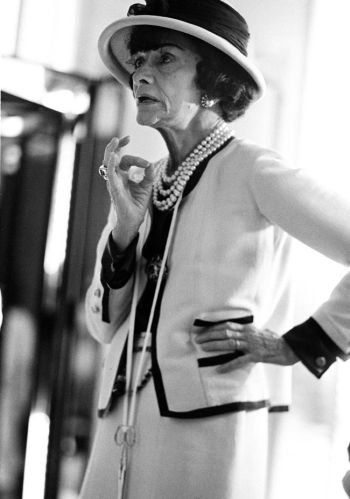
Chanel’s evolution as one of the most famous and influential couture houses of the 20th century highlights many of the key elements to successful fashion design, and exposes the relationships between design, culture, commerce, and, crucially, personality. Coco Chanel’s emergence in the 1910s and 1920s as a prominent figure on society and fashion pages, her mythologized rise from nightclub singer to couturier, and gossip surrounding her lovers, gave her simple, modern styles an air of excitement and intrigue. Her designs were significant in their own right, and epitomized contemporary fashions for sleek, pared-down daywear, and more feminine, dramatic evening wear. She asserted that women should dress plainly, like their maids in little black dresses, although Claude Baille´n quotes Chanel as reminding women that ‘simplicity doesn’t mean poverty’. Her love of mixing real and costume jewellery and her borrowings from the male wardrobe became internationally famous. Coco Chanel’s biography provided the publicity and interest necessary to distinguish her house, and dramatize her as a designer and personality. Importantly, her diversification into accessories, jewellery, and perfumes, and the sale of her designs to American buyers, brought the essence of her fashions to a far wider market than could afford haute couture, and secured her financial success.
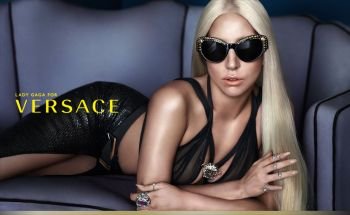
In the 1980s, fashion commentator Ernestine Carter characterized Chanel’s success as founded upon ‘the magic of the self’. As important as Coco Chanel’s undoubted design and styling skills were, it was her ability to market an idealized vision of herself, and to embody her own perfect customer, that made the label so appealing. Chanel designed herself, and then sold this image to the world. Many others have followed her example: since the 1980s, American designer Donna Karan has successfully projected an image of herself as a busy mother and businesswoman who has designed clothes for women like herself. In contrast, Donatella Versace is always photographed in high heels and ultraglamorous, tight-fitting clothes, her jetset lifestyle mirrored in the jewel-coloured luxury of the Versace label’s designs.
Karl Lagerfeld, Chanel’s present designer, represents a variation on this theme; rather than embodying the lifestyle of his customers, his personal style denotes his status as a cultured aesthete. If Coco Chanel was a fashion icon to her followers, embodying a modernist ideal of chic, streamlined femininity in the early 20th century, then Lagerfeld is a Regency dandy remodelled for contemporary times. The key elements of his personal style have remained constant throughout his stewardship of Chanel: dark suits, long hair pulled back into a ponytail and at times powdered white. Combined with the constantly flicking black fan he used to carry, his image harks back to the ancien regime. This evokes the elite status of couture, and the consistency of Chanel style, while his involvement in various art and pop cultural projects maintains his profile at the forefront of fashion.
When Chanel died in 1971, the house lost its cachet and its sales and fashion credibility dwindled. In Lagerfeld’s hands it has been revitalized. Since his arrival in 1983, he has designed collections for couture, ready-to-wear, and accessories that have balanced the need for a coherent signature, and the equally important desire for fashions that reflect and anticipate what women want to wear.
Lagerfeld’s experience in freelancing for various ready-to-wear labels, including Chloe´ and Fendi, had proved his design skills and his crucial ability to create clothes that set fashions, and flatter women’s bodies. He merged high and popular culture references to maintain Chanel’s relevance, and to invigorate its fashion status. His spring 2008 Chanel couture collection demonstrated this and showed his business acumen. While he kept older, loyal customers in mind with his variations on the cardigan jacket, the collection’s tone was youthful, with girlish flounces and froths of light fabrics counterpoised with its more sombre tones. Lagerfeld therefore looked towards the future to ensure Chanel’s survival, encouraging new, younger clients to wear this iconic label.
Evolution of the couturier
Historically, most clothing was ma de at home, or fabrics and trimmings were bought from a range of shops and made up by local tailors and dressmakers. By the end of the 17th century, certain tailors, particularly in
Although fashion has remained an essentially collaborative process, in terms of the number of people involved in its production, it came to be associated with the idea of a single individual’s design skills and fashion vision. The most famous early example of this shift was Rose Bertin, who created outfits and accessories for Marie Antoinette and a host of European and Russian aristocrats in the late 18th century. She was a marchande des modes, which meant she added trimmings to gowns. However, the marchande des modes’ role began to change, in part as a response to Bertin’s skill at creating a fashionable look. She drew inspiration from contemporary events, crafting a headdress incorporating a hot air balloon in honour of the Montgolfier brothers’ balloon flights in the 1780s, for example. She generated publicity with such creations, and although other marchandes des modes, including Madames Eloffe and Mouillard, were also famous at this time, it was Bertin who best expressed the ebullience of contemporary Parisian fashion.
In 1776,
In this way, Bertin helped to disseminate Parisian fashion, and to assert its dominance of womenswear. Her development of a wide customer base and her close relationship with the French queen ensured her fashion status. Significantly, contemporary commentators noted with horror that Bertin behaved as though she was equal to her aristocratic clients. Her elevated status was another important shift that set the stage for the dictatorial ways of many designers. She was aware of her power and confident of the importance of her work, creating fashions, but also fashioning the image of her customers, who relied on her for their own status as fashion leaders. Indeed, her boutique, the Grand Mogul in
Her innovative styling and witty references to both historical and contemporary events showed her design skills, as well as her awareness of the importance of generating publicity. She therefore became a precursor to the couturiers, who were to evolve their own status as dictators of fashion in the 19th century.
The French Revolution effected a temporary halt in information about Parisian fashions reaching the rest of the world.However, once this was over, the luxury trades in
However, alongside leading dressmakers, there was another aspect of the fashion industry that was also involved in the evolution of the idea of the fashion designer. Art historian Françoise Tetart Vittu has shown that some artists worked in ways that mirror freelance designers today, with dressmakers buying highly detailed drawings of fashions from them. These would then be used as templates for garments, and would even be sent to customers as samples. Advertisements for the dressmakers would be attached to the back of the illustrations, along with prices for the outfit shown. By the middle of the 19th century, artists such as Charles Pilatte advertised themselves as ‘fashion and costume designers’ and appeared in Paris directories of the time under a list of ‘industrial designers’.
The idea of clothing needing to be designed by someone with fashion authority, and with particular skills in defining a silhouette, cut, and decoration, was evolving across the Western world. Each town would have its most fashionable dressmakers, and designs themselves were gaining commercial value as fashions began to change more rapidly along with the public’s desire for new styles. For the idea of the fashion designer to crystallize, there needed to be not only creative individuals ready to generate new fashions, but a growing demand for novelty and innovation. The 19th century saw the rise of the bourgeoisie and wealthy industrialists, whose newly found status was in part constructed through visual display, in their homes and, even more importantly, their clothes. Couture became a source of exclusivity and luxury for wider groups of women, with Americans amongst the most prolific customers in the second half of the century.
Added to this was the growth of fashion media, photography, and by the end of the century, film, which disseminated imagery of fashion more widely than ever before, and fuelled women’s desire for more variety and quicker turnover of styles. As the huge growth in cities led to greater anonymity, fashion became a major way to formulate identity and to make social, cultural, and financial status visible. It was also a source of pleasure and sensuality, with Parisian couture at the apex of this realm of fantasy and luxury.
While ‘industrial designers’ supplied fashion designs to the wider dressmaking trades, it was the evolution of the couturier that was to establish the role and image of the fashion designer. Although Charles Frederick Worth, the most famous couturier of the 1850s, succeeded in part because of sound business practices, this side of his work was masked by the drama of his creations, and his persona as a creative artist whose fashion pronouncements were to be followed without question. An Englishman who had honed his skills in the dressmaking section of department stores, he was able to distinguish himself early on in his career in part because he was a man in a profession dominated by women.
Indeed, in All Year Round in February 1863, Charles Dickens remarked with horror at the rise of the ‘bearded milliner’. As a man, Worth could promote himself in ways that would be seen as inappropriate for a woman, and he could treat his female clients differently, irrespective of their rank. His most famous designs comprised froths of ivory tulle, creating clouds around the wearer that would glimmer in candlelit ballrooms as the beading and sequins embroidered between the layers caught the light.
Other couturiers were also rising to prominence, often propelled to fame by their royal customers. In
In the first decades of the 20th century, designers such as Paul Poiret and Lucile became internationally famous. They dressed theatrical stars, aristocrats and the wealthy, and promoted their own identities as decadent socialites in their own right. Poiret was a fashion designer in the modern sense of the phrase. He was known for his signature luxurious style, and the radical, seasonally changing silhouettes he created. Georges Lepape’s fashion illustration shows Poiret’s famous Empire line silhouette of 1911, which broke away from the tightly corseted fashions of the Edwardian period. His lavishly embroidered gowns and opera coats were inspired by contemporary art and design, from modernism to the Ballets Russes, and the aura of his potent couture image was disseminated still further by sales of his own perfume line. Poiret’s contemporaries were equally adept at harnessing modern advertising and marketing methods to create the image of their fashion house. Most sold their designs to American wholesalers, for them to make up a strictly defined number of each model they had bought. This generated income for the couture houses, alongside money from the individually made garments that were the very definition of haute couture.
The interwar period was a
This is partly because design and innovation are the most valued aspects of fashion, since they are the basis for each collection and viewed as the most creative element of the process. Importantly, this focus on the individual is also a successful promotional tool, as it gives a focus for the identity of a fashion label, and quite literally, provides a ‘face’ for the design house.
Although not governed by the strict rules that apply to Parisian haute couture, other countries have developed their own couturiers and made-to-order industries. For example, in 1930s London, Norman Hartnell and Victor Stiebel asserted themselves as fashion designers rather than just court dressmakers, while in New York, Valentina evolved a dramatically simple style that drew on contemporary dance to create an American fashion identity, and in the 1960s in Rome, Valentino promoted a distinctively Italian form of couture that relied on overtly feminine luxury.
In the post-war period, fabric and labour costs increased, making couture even more expensive. Designers such as Christian Dior revelled in excess, after the hardships of the 1940s, with their focus on the traditions of couture craftsmanship, and led a decade in which couture continued to dominate international fashion trends.
Since the 1960s, despite the rise of throwaway youth fashions and the global fame of ready-to-wear designers, couture has maintained its visibility. Its significance has shifted, but certain couturiers, such as John Galliano at Dior, Alber Elbaz at Lanvin, and Lagerfeld at Chanel, are still able to set fashions that disseminate through all levels of the market. Despite a falling number of clients, ready-to-wear lines, accessories, perfumes, and a huge number of other licensed ranges place couture at the forefront of the huge global luxury market. Although there are fewer haute couture customers in