When I first laid eyes on A., I could tell she was in trouble. “Trouble” for me, a as doctor with oncology surgical practice bur not medical oncologist, means that a patient is sick from cancer and in urgent need of treatment. But like so many patients whom I meet for the first time, A. was not even sure she had cancer. So “trouble” also means that I faced a daunting task: I had to explain to A. (and her family) what cancer is, why it may have arisen, what it was doing to her body, which treatments were recommended, how those treatments worked, and how she could cope when her world was crashing in on her-all this in about an hour.
Furthermore, I needed to convey this information with great empathy and sensitivity, never forgetting that although my brain may sleep, eat, and breathe cancer, the cancer “lingo” is completely foreign to a person newly diagnosed with the disease.
As I present my assessment of a cancer situation to a new patient and family, my senses enter a state of heightened awareness: I continually monitor the body language of my listeners to discern if I am making myself understood, if my words are too strong or not strong enough, or if I should stop the flow of words to allow the necessary flow of emotions. I have taken to using a marker board, like a mini-lecture, to write out the technical words and details. As with so many other doctor is particularly oncologists, there is no need to ask me, “What would you do if I were your brother, wife, or mother?” Please understand that this is always a given. As A. walked into my office for a consultation, her husband and daughter were close behind. She was clearly exhausted, gasped slightly with each breath, and, after spotting the chair nearest to me, slumped into it. She exuded a soft, sincere demeanor, though she was obviously weighed down by worry.
A. gathered herself as I introduced myself, and then she asked me in a sweet, perplexed voice, “Doctor, what’s wrong with me? I am so tired I can’t even climb a flight of stairs. My stomach is bloated and I hardly eat anymore. Am I dying?” Before I met with A., I had reviewed her medical records. She had recently seen her internist, complaining of several months of unremitting fatigue, loss of appetite, and shortness of breath with exertion.
Her doctor had ordered CT scans of her chest, abdomen, and pelvis. These showed a large tumor on one of her ovaries, many other tumors throughout her abdomen, and smaller tumors throughout her lungs. He ordered a biopsy of one of the abdominal tumors, and it revealed a diagnosis of ovarian cancer. The tumors throughout A. abdomen and chest indicated that she had the most advanced stage of that cancer. A blood marker of ovarian cancer, named CA-125, was many times above the normal range, consistent with this diagnosis. When A. walked through the office doorway, I knew immediately that all her symptoms were caused by cancer. The sheer burden of having tumors involving so much of her body was exhausting her. The disease was competing with the rest of her body for vital nutrients, and the cancer was siphoning most of these away. The tumors in her lungs were interfering with the ability of her lungs to transfer oxygen to her bloodstream for delivery throughout her body; this accounted for her shortness of breath. The many tumors in her abdomen were causing her belly to swell and taking away her appetite. I began to talk to her. “I can see that you are suffering. Your breathing appears labored to me, and I can tell that you must be struggling just to get through the day.” With this, she nodded and began to weep. But this was a cry of relief; someone had finally explained why her condition was deteriorating so fast. “I will explain exactly what is wrong with you and tell you what we need to do to get you feeling better,” I said. “But I want to start off by saying that you will very likely be feeling better soon.” With that, she relaxed and started to breathe more easily. I explained what her CT scans showed and what the pathology report indicated. I told her she had ovarian cancer and that it had spread from her ovary to her abdomen and into her lungs, which classified it as stage IV. I explained how the extent of the cancer was causing all her symptoms and that if we could shrink it, she would begin to feel better. “Do I need chemo?” she asked. “I’m afraid of that, I don’t know if my body can stand it.” “Yes,” I replied, “we do need to use chemotherapy. But since most of your symptoms are due to the growth of the cancer, once we stop that growth with chemotherapy, you will actually feel better. There certainly will be see de effects from treatment, but we will monitor you closely for them and try to prevent as many as possible.” A. did not voice further opposition to the chemotherapy. She understood that she would be fighting for her life. “The standard recommended treatment,” I continued, “is two chemotherapy drugs, called Taxol and carboplatin, which are administered intravenously every three weeks. We are also participating in a study to determine whether adding a new medication to this standard treatment improves the outcome.” We discussed the short-term and long-term side effects of chemotherapy and went over the pros and cons of participating in the clinical trial. I told her that after our meeting, she would visit one of our oncology nurses, who would further explain what to expect and how to prepare for treatment. “Why can’t it just all be cut out?” A. asked. “For most cases of
ovarian cancer,” I replied, “surgery actually is the first step of treatment. But in your situation, because the cancer has spread outside of the abdomen and is causing so many symptoms, we need to attack it with a treatment that will shrink the cancer wherever it is growing in your body; the disease is too extensive at this point for surgery to be effective. So we need to start with chemotherapy and reserve surgery for a later date.” I inquired about her family history and whether other family members had been affected by cancer, in particular breast and ovarian cancer. When she answered yes, we discussed the need for genetic testing, which she wanted to do at another time. We talked briefly about her family life, habits, and spirituality as I tried to get a sense of the person. After I answered the questions A. and her family had, I told them about the counseling services for patients and families at our center: group counseling, in which those who have traveled or are traveling a similar road can share experiences; and individual counseling, in which patients can privately express to an experienced therapist their feelings,fears, and needs as a cancer patient and survivor.
We ended our first meeting exhausted. But we also ended it as partners, hopeful that A. condition would improve. I knew that we had covered a tremendous amount of new and complicated information and that A. would probably remember only a part of it. I reassured her that we would have ample time, in future meetings together, to go over what we had discussed.
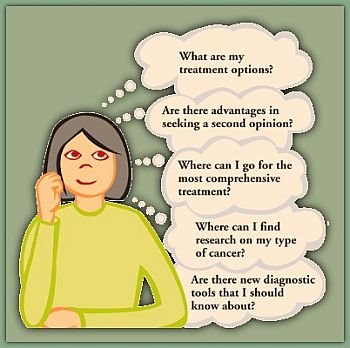
My meeting with A. and her family highlights the essential information that any patient must find out when he or she is diagnosed with cancer. The following list summarizes this information.