VIDEO
THE BAREFOOT DOCTORS OF RURAL CHINA
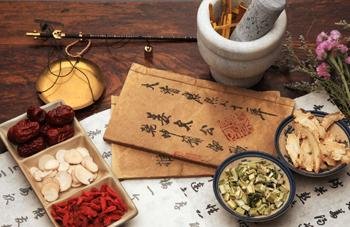
Jing Jie (Schizonepetae herba) and Fang Feng (Saposhnikoviae radix) are often used for Exterior Wind-Cold syndrome. What are the differences between using Ma Huang (Ephedrae herba) and Gui Zhi (Cinnamomi cassiae ramulus)?
Jing Jie and Fang Feng are both pungent and warm. However, they are far gentler than Ma Huang and Gui Zhi. They can expel Wind and Cold and are commonly used for mild Exterior Wind-Cold syndrome.
In regions with temperate climates, where Wind and Cold do not close the pores tightly, they are more often applied than Ma Huang and Gui Zhi for cold infections, influenza, certain stages of infectious childhood diseases and some skin diseases in which Exterior syndromes are involved. Meanwhile, they are also often used with pungent-cold herbs in syndromes where Wind-Heat is mixed with Wind-Cold. The patient may have symptoms such as chills, fever, thirst, sore throat, and general pain.
These two herbs are more often used in combination with cold herbs than Ma Huang and Gui Zhi. Comparing Jing Jie with Fang Feng, Jing Jie is lighter and more dispersing. It is pungent but not strong, slightly warm but not dry. It is especially good at expelling Wind, no matter whether it is Wind-Cold or Wind-Heat. Moreover, it can expel Wind from the Blood so is often used in skin disorders when there is itching caused by Wind invasion, for instance in eczema, urticaria and food allergy.
It is also used for infectious childhood diseases with Exterior syndrome and skin eruptions, such as measles, rubella, scarlet fever, and chickenpox and so on. Fang Feng is sweet, pungent, and warm and enters the Bladder, Lung and Spleen meridians. As its sweet taste moderates the pungent taste, it is less strong in dispersing Wind on the surface of the body than Jing Jie. However, as it is warmer than Jing Jie and enters the Spleen meridian, it is especially good at expelling Dampness and Cold in the layers below the body surface, such as the subcutaneous region and muscles, which are controlled by the Spleen. When the patient feels pain and heaviness of the muscles, Fang Feng is more suitable than Jing Jie. This is also the reason that Fang Feng is more often used in Bi syndromes. Although both herbs are gentle, they do have a pungent and warm nature, so both should be used with caution in patients without Wind invasion or in Yin deficiency with Empty-Heat.
What are the differences between the actions of Jing Jie (Schizonepetae herba), Jing Jie Sui (Schizonepetae flos), Chao Jin Jie (dry-fried Schizonepetae herba) and Jing Jie Tan (the charcoal of Schizonepetae herba)?
Generally speaking, Jing Jie Sui is more thin pungent than Jing Jie as it is the bud, which is believed to be lighter in nature. It has a quicker and lighter action in expelling Wind. It is used at the very beginning of Wind-Cold syndrome or Wind-Heat syndrome.
Comparing raw with roasted Jing Jie, raw Jing Jie is more pungent. It is used for Exterior Wind-Cold syndrome when sweating is not present, which means that the pores are closed. It can open the pores, cause mild sweating, and expel Wind and Cold. Roasted Jing Jie is less pungent because processing has reduced the taste. If the pores are open, sweating is present, or the patient has an aversion to wind instead of cold; this indicates that it is not necessary to open the pores, so roasted Jing Jie is then more suitable.
Jing Jie Tan is able to stop bleeding and it is used in bleeding conditions. When Jing Jie is roasted to charcoal, its pungent property is reduced, but an astringent property emerges. It can stabilize theBlood and stop bleeding. Meanwhile, it can also expel Wind and calm the Blood, therefore stopping bleeding.