VIDEO
Urine
I do not understand why it is that the glucose from the blood only spills into the urine above a certain level. I gather this level is known as the renal threshold – could you explain it for me in a little more detail?
Urine is formed by filtration of blood in the kidneys. When the glucose concentration in the blood is below about 10 mmol/litre, any glucose filtered into the urine is subsequently reabsorbed back into the bloodstream. When the level of glucose exceeds about 10 mmol/litre (the renal threshold) more glucose is filtered than the body can reabsorb, and as a result it is passed in the urine. Once the level has exceeded 10 mmol/litre, the amount of glucose in the urine will be proportional to the level of glucose in the blood. Below 10 mmol/litre, however, there will be no glucose in the urine and, since the blood glucose level never exceeds 10 mmol/litre in people without diabetes, they will not find glucose in the urine, unless they have a particular inherited condition called renal glycosuria.
How do you know if you have ketones in your urine? What are they and are they dangerous?
Ketones are breakdown products of the fat stores in the body. They are present in small amounts even in people without diabetes, particularly when they are dieting or fasting and therefore relying on their body fat stores for energy. In people with diabetes small amounts of ketones in the urine are commonly found. They become dangerous only when they are present in large amounts.
This is usually accompanied by thirst, passing large amounts of urine, and nausea. If ketones are present in the urine together with continuous 2% glucose, or blood glucose levels higher than 13 mmol/litre, then they are dangerous as this is the condition that precedes the development of ketoacidosis. Under these circumstances you should seek urgent medical advice.
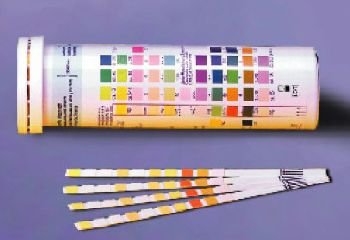
You can test your urine for ketones with strips such as Monitoring and control Ketur-Test or Keto Diabur; the latter tests for glucose as well and both are made by Roche; or Ketostix or KetoDiastix (made by Bayer Diagnostics) – they are all available on prescription from your doctor. MediSense produce an Optium meter that tests for blood glucose and blood ketones but, although the glucose testing strips are available on prescription, the blood ketone strips are not.
What does it mean if I have a lot of ketones but no glucose on urine testing?
Testing for ketones in the urine can be rather confusing and, unless there are special reasons for doing it, we do not recommend it for routine use. Some people seem to develop ketones in the urine very readily, especially children, pregnant women and people who are dieting strictly to lose weight.
Usually if glucose and ketones appear together it indicates poor diabetes control, although this may be transient, and glucose and ketones, present in the morning, may disappear by noon. If they persist all the time, then control almost certainly needs to be improved, probably by increasing the insulin dose.
Ketones do sometimes appear in the urine without glucose, although not very frequently. They are most commonly seen in the first morning specimen and probably occur as the insulin action from the night before is wearing off – in some people the ketone levels increase before the glucose levels. Under these circumstances it is not serious and no particular action is needed.
Finally, ketones without glucose in the urine are very common in people who are trying to lose weight through calorie restriction. Anyone who is on a strict diet and losing weight will burn up body fat and this causes ketones to appear in the urine. Provided that there is no excess glucose in your urine, these ketones do not mean that your diabetes is out of control.
Why do we not always get a true blood glucose reading through a urine test (as in my case)?
In most people urine contains glucose only when the glucose concentration in the blood is higher than a certain figure (usually 10 mmol/litre), so below this level urine tests give no indication at all of the concentration of glucose in the blood. The level at which glucose spills out into the urine (the renal threshold – discussed earlier in this section) varies from one person to another and you can assess it in yourself only by making many simultaneous blood and urine glucose measurements. If you undertake this exercise you will undoubtedly find, like most other people, that the relationship between the blood and urine concentrations is not very precise. For this reason most people nowadays prefer to do blood tests rather than urine tests, as they find that the increased precision of blood tests outweighs any disadvantage that may stem from having to prick your finger to get a drop of blood.
For some time now I have suffered from diabetes. I am always curious to know what type of tests is made on my urine specimens when they are taken off to the laboratory.
Urine specimens are tested for several things but the most common are glucose, ketones and albumin (protein). These tests serve only as a spot check and are meant to complement your own tests performed at home. Clinics like to know the percentage of glucose in samples taken at different times of day as giving some measure of control at home. The detection of ketones is of rather limited value since some people make ketones very easily and others almost not at all, but the presence of large amounts of ketones together with 2% glucose shows that the person is very badly out of control. The presence of protein in the urine can indicate either infection in the urine or the presence of some kidney disease, which in people with diabetes is likely to be diabetic nephropathy, one of the long-term complications for more information about this). A more recent test is for microalbuminuria – the test detects microscopic amounts of albumin in the urine and can show signs of very early kidney damage.
Monitoring and control
I have a strong family history of diabetes. My daughter recently tested her urine and found 2% glucose. However, her blood glucose was only 8 mmol/litre. She underwent a glucose tolerance test and this was normal. Could she have diabetes or could there be another reason why she is passing glucose in her water?
It is very unlikely that she has diabetes if a glucose tolerance test was normal. If she had glucose in her urine during the glucose tolerance test when all the blood glucose readings were strictly normal, then this would indicate that she has a low renal threshold for glucose (as discussed at the beginning of this section). If this is the correct diagnosis, then it is important to find out whether she passes glucose in her urine first thing in the morning while fasting or only after she has eaten. In people who pass glucose in their urine during the fasting state, there is not known to be any increased incidence of development of diabetes, and the condition (called renal glycosuria) is inherited. If, on the other hand, she passes glucose in the urine only after meals containing starch and sugar, this condition sometimes progresses to diabetes.