VIDEO
Traditional Chinese Medicine: Herbal Prescriptions
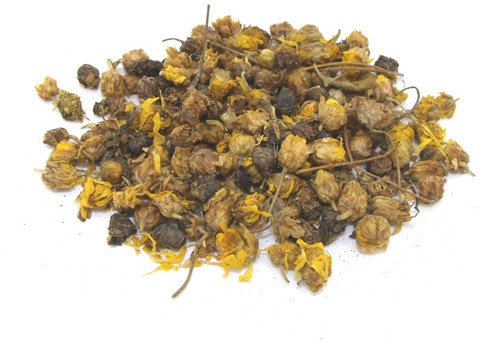
How many kinds of Ju Hua (Chrysanthemi indici flos) are used for medical purposes and how does one choose the correct one in practice?
There are several kinds of Ju Hua and Ju Hua products that have various properties according to the growing habitat, the color and the processing procedure. Huang Ju Hua, the yellow flower, is sometimes called Hang Ju Hua, as it comes from Hang Zhou. Bai Ju Hua, the white flower, is also called Gan Ju Hua, which means sweet Ju Hua. It is also sometimes called Chu Ju Hua because the white Ju Hua growing in
Huang Ju Hua especially enters the Lung meridian. It is more effective for expelling Wind-Heat in the Upper Jiao and is often used in cold infections, feverish sensations in the head and headache. It can also be used for acute infection of the eyes, such as acute conjunctivitis, which in TCM is considered to be Wind-Heat disturbing the Upper Jiao. In this condition, as well as oral use, the steam from Ju Hua decoction can be used for painful and itchy eyes.
The method is simple: pour the hot decoction into a glass, and bring the affected eye close to the glass for 2-3 minutes. Care should be taken not to burn the eye. Moreover, the cool decoction can be used externally to wash the affected eye. Bai Ju Hua is sweeter and cooler, and can slightly generate Yin and clear Heat. Because it enters the Liver meridian, it is more effective in cooling and pacifying the Liver and benefiting the eyes. It is used for dizziness, blurred vision, dry eyes and a tired feeling in the eyes, which are caused by Yin deficiency or Yin deficiency with uprising of the Liver-Yang. For patients with a Yin-deficient condition as well as eye problems as mentioned above, Bai Ju Hua is a good choice. Ju Hua tea is also recommended for daily use in this condition.
Ye Ju Hua are bitter and neutral. It can reduce Heat and remove Heat-toxin. It is used for all types of boils, furuncles, and carbuncles with localized erythema, swelling, heat, and pain. This herb can also be used topically: the smashed fresh Ju Hua can be applied to the affected region as a compress to reduce swelling and pain-for instance in mumps.
Besides treating cold infections or influenza, are there other uses for the herbs in the category of releasing the Exterior?
Cold infections are often not treated and most people recover in 1 or 2 weeks without medical intervention. It may take longer to recover from influenza. Herbs that release the Exterior are often used in cold or influenza infections as they can alleviate the symptoms and shorten the duration of morbidity.
This is especially useful and important for elderly people, children, and patients with chronic diseases and people with a weak constitution. Herbs in the category of releasing the Exterior can be used, in clinical practice, in many other conditions if the disorders link with the superficial layer of the body, or if the disorders have the same pathological changes in the body as those of the Exterior syndromes. Examples include the following.
Alleviation of pain
As pungency and warmth have dispersing and moving properties, most of these herbs that are warm and pungent can disperse Wind, Cold and Dampness. They are often used for Bi syndrome due to invasion of exogenous pathogenic Wind, Dampness, and Cold. The commonly used herbs are GUI Zhi (Cinnamomi cassiae ramulus), Qiang Huo (NotopterygiiNotopterygii rhizoma), Qin Jiao (Gentianae macrophyllae radix), Xi Xin (Asari herba) and Fang Feng (Saposhnikoviae radix). Some herbs are very effective for treating certain kinds of pain. For example, Xi Xin is very good for treating toothache; Bai Zhi (Angelicae dahuricae radix) is effective for treating headache due to sinusitis; Qiang Huo can relax the muscles in the neck and treat pain in the occiput, neck and upper back; Zi Su Ye (Perillae folium) can alleviate abdominal pain in abdominal influenza; Gui Zhi can warm the Blood, promote Blood circulation and relieve general pain.
Dispersal of the Lung-Qi and treatment of asthma
Most of the herbs that release the Exterior enter the Lung meridian. Because the Lung governs the superficial level of the body, dispersal of the Lung-Qi may assist in expelling Exterior pathogenic factors. In addition, these herbs are also often used to treat asthma, which is caused by dysfunction of dispersing and descending of the Lung-Qi. The commonly used herbs are Ma Huang (Ephedrae herba), Xi Xin (Asari herba), and Sheng Jiang (Zingiberis rhizome recens).
Regulation of water metabolism and treatment of edema
As most of the herbs that release the Exterior enter the Lung and Bladder meridians, which are important in water metabolism, they can also disperse the Lung-Qi, regulate the water passages, and treat edema due to dysfunction of the Lung. For instance, Ma Huang (Ephedrae herba) and Fang Feng (Saposhnikoviae radix) can be used in Wind-Water syndrome. In this syndrome, the patient suddenly has edema on the face as a result of Wind disturbing the Lung and blocking the upper part of the water passage. This can be seen in acute nephritis, premenstrual syndrome, and menopausal syndrome.
Expelling of Wind, clearing of Heat and treatment of skin diseases Exterior syndromes are located on the surface of the body, where skin diseases are also located. The pungent and cold herbs can disperse Wind to relieve itching; these include Chan Tui (Cicadae periostracum), Jing Jie (Schizonepetae herba), Bo He (Menthae herba), Niu Bang Zi (Arctii fructus), and Fang Feng (Saposhnikoviae radix). Some cold herbs such as Ju Hua (Chrysanthemi indici flos), Niu Bang Zi (Arctii fructus) and Bo He (Menthae herba) may reduce Heat and calm reddish skin lesions. Herbs entering the Lung meridian may regulate the function of the Lung to regulate the condition of the skin.
Treatment of infection or allergic reactions of the ears, nose, throat, and eyes
The pungent and cold herbs that expel Wind-Heat are light in weight and nature. They enter the Upper Jiao and can disperse Wind-Heat in the head, so can be used for acute or chronic infections and allergic rhinitis as well as some types of food allergies, which in TCM are considered to be Wind-Heat disturbance in the Upper Jiao. Herbs that can be used include Bo He, Ju Hua, Niu Bang Zi, Xin Yi (Magnoliae flos), Fang Feng, and Jing Jie.
Treatment of initial stages of infectious childhood diseases
Many infectious childhood diseases, especially those with skin rashes such as chickenpox, scarlet fever, and rubella, belong to the category of Wind-Heatattacking the Lung. The treatment in the initial stage is focused on expelling Wind, clearing Heat and regulating the Lung-Qi. Herbs such as Bo He, Ju Hua, Chan Tui and Niu Bang Zi are often used.
Treatment of acute infections, infectious diseases, or inflammation
For some acute infections, such as pneumonia or acute bronchitis, if caused by a virus then treatment with antibiotics is ineffective because the fever is still there and the infection continues. In such conditions, herbs that expel Wind-Heat combined with other herbs can bring a better result. In TCM there is a saying: no matter how high the fever is, if there is one percent chill, there is one percent Exterior syndrome. Antibiotics are considered in TCM to be bitter and cold substances; therefore their action tendency is downward and they can only clear the Heat. This action may bring about the side-effects of constrained Fire, so the result of treatment is not completely satisfactory. Herbs used in this condition not only clear Heat but also disperse it and at the same time expel other exogenous pathogenic factors. They match the pathogenic changes and the nature of Heat so are better in reducing fever and controlling the infections.