How to Recognize the Symptoms of Bipolar Disorder
I have recently been diagnosed with depression, but I have a family history of bipolar disorder. What is my risk of becoming manic if I take antidepressant medication?
Part of a comprehensive mental health evaluation involves a detailed past personal psychiatric history as well as a family psychiatric history. The family psychiatric history is important because many psychiatric conditions have a heritable component and can inform the clinician as to risks for certain conditions.
Although bipolar disorder is known to have genetic links, a family history of bipolar disorder does not automatically rule in bipolar disorder in a person presenting with a major depressive episode. In the absence of a personal past psychiatric history of mania or hypomania, bipolar disorder is not diagnosed.
That said, bipolar disorder can present with depression first and must always be considered even in the absence of family history of bipolar disorder. The presence of bipolar disorder in the family history increases the risk for the condition in a given individual, and it also increases the risk for mood disorders in general-not only bipolar disorder. In addition, the risk level needs to be kept in perspective.
Although there are known heritable conditions that are either dominant or recessive, and present with a very specific risk (e.g., 50% chance of Huntington’s chorea being acquired if one parent is afflicted), the risk for developing bipolar disorder, let alone any mood disorder, cannot be so precisely defined.
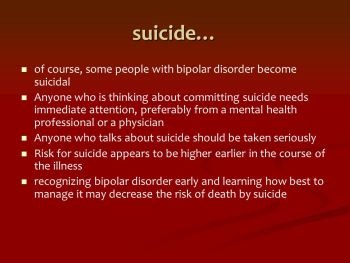
In such a situation, the risk of taking antidepressant medication has to be balanced against the risk of not taking it. In the case of moderate to severe depression, the risk of not taking the medication can include suicide, in addition to the consequences of significant functional impairment at work, home, and so forth.
Such a risk would likely outweigh the risk for becoming manic and thus would warrant an antidepressant trial. This situation would, of course, especially require very close follow-up with a psychiatrist and may warrant that certain safeguards are put in place (e.g., a family member could monitor for signs of mania, with a specific plan for such an occurrence).
As with a documented history of mania or hypomania, the psychiatrist may consider use of a mood stabilizer in conjunction with an antidepressant; however, the side effects and risks of taking a mood stabilizer, when in fact it may not be necessary, likely do not outweigh the risk for becoming manic on an antidepressant. Discuss the variables involved with your psychiatrist.