VIDEO
Living With Nicotine Addiction
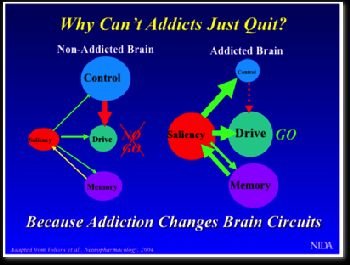
How can smoking be an addiction but at the same time be different from drugs we normally associate with addiction?
The answer lies in the definition of drug dependency and the confusion between this term and the terms bad habit and physiologic dependency.
This subtle distinction has lead to no end of confusion regarding all forms of addiction and dependence. Some contains the DSM-IV-TR Criteria for Substance Dependence. The DSM-IV-TR (Diagnostic and Statistical Manual of Psychiatric Disorders, 4th edition, Text Revised) is the diagnostic “gold standard” of psychiatric disorders.
The writers chose to replace the term addiction with the term substance dependence in an attempt to remove the negative connotation associated with addiction. Before the substitution of the terms, dependence traditionally only referred to physiological dependency.
Physiological dependency, as opposed to addiction or substance dependence, occurs with many drugs, including those not regarded as addictive, such as antihypertensive medications, anti-asthmatic medications, anticonvulsant medications, and even many over-the-counter (OTC) medications, such as aspirin. Alternatively, other drugs considered to be highly addictive are not associated with any typical physiological dependency, such as cocaine and amphetamines. Notice, after reviewing the criteria, that only three of seven of the criteria are required to make the diagnosis of substance dependence, while only two of the seven criteria refer to symptoms typically regarded as evidence of physiological dependency. Most notable are the first two criteria, which are referred to as “tolerance and withdrawal.
The criteria for substance dependence according to the Diagnostic and Statistical Manual of Psychiatric Disorders (DSM-IV-TR, 4th edition, text revised) dsm-iV-tr criteria for substance dependence A maladaptive pattern of substance use, leading to clinically significant impairment or distress, as manifested by three (or more) of the following, occurring at any time in the same 12-month period:
1. Tolerance, as defined by either of the following:
a) A need for markedly increased amounts of the substance to achieve intoxication or desired effect
b) Markedly diminished effect with continued use of the same amount of the substance
2. Withdrawal, as manifested by either of the following:
a) The characteristic withdrawal syndrome for the substance
b) The same (or a closely related) substance is taken to relieve or avoid withdrawal symptoms.
3. The substance is often taken in larger amounts or over a longer period than was intended
4. There is a persistent desire or unsuccessful efforts to cut down or control substance use
5. A great deal of time is spent in activities necessary to obtain the substance (e.g., visiting multiple doctors or driving long distances), use the substance (e.g., chain-smoking), or recover from its effects
6. Important social, occupational, or recreational activities are given up or reduced because of substance use
7. The substance use is continued despite knowledge of having a persistent or recurrent physical or psychological problem that is likely to have been caused or exacerbated by the substance (e.g., current cocaine use despite recognition of cocaine-induced depression, or continued drinking despite recognition that an ulcer was made worse by alcohol consumption).
The diagnosis should specify “With Physiological Dependence” Source: American Psychiatric Publishing, Inc. To reiterate, if you meet only two of any of the seven criteria, then you do not have the diagnosis. This now allows you to disconnect physiological dependency from drug dependence, reinforcing the fact that there are drugs that can cause only physiological dependency but are not addictive, and drugs that cause addiction but do not cause physiological dependency.
However, is it possible to take a drug daily that is known to cause physiological dependency and addiction and yet still not become addicted?
The answer is “yes,” as long as only the first two criteria are met. A chronic pain patient, for example, who requires daily opiate medications to manage his or her pain will develop physiological dependency, but is not drug dependent or addicted if he or she meets only the first two criteria. Nor, for that matter, is a depressed patient who requires daily medication to function, even though antidepressant medications can cause significant withdrawal effects if stopped abruptly. Alternatively, one need not meet either of the first two criteria, but meet three of the other criteria, to be diagnosed as drug dependent, or addicted.
This would include people who use drugs we normally associate with addiction, such as cocaine, but also drugs commonly argued as being non-addictive, such as marijuana and previously, tobacco. This also allows for the inclusion of behaviors such as gambling and sex, neither of which chemically alters the body. And this only compounds the confusion. Most smokers clearly report symptoms that meet the first two criteria. They report both tolerance and withdrawal symptoms.
However, scientists historically defined withdrawal not by subjective reports (or symptoms) but by objective measures (or signs) such as changes in blood pressure or pulse, tremors, sweating, diarrhea, hallucinations, or other forms of grossly aberrant behavior.
Smokers demonstrated none of these signs after abrupt cessation. Thus, the tobacco companies were able to successfully argue that withdrawal did not occur because there were no objective measures to demonstrate it. These issues about the meaning of addiction remain confusing even to this day.
Physicians and medical students often believe that any patient taking an opioid or benzodiazepine medication, who suffers from withdrawal symptoms after abrupt discontinuation, by definition, is addicted to that medication. They also believe that the mere fact that discontinuation of antidepressant medication leads to acute withdrawal proves these medications are addictive. And yet, at the same time, those very same physicians and students would not associate all the other medications that cause physiological withdrawal as evidence of an addictive potential.
The reason for this has to do with the fact that any medication having psychotropic or psychoactive effects (that is, affecting mind, emotions, or behavior) is automatically held to be morally suspect. All other medications, regardless of their risks and withdrawal effects, are alternatively perceived as morally neutral. Thus, antidepressants are thought to be addictive by some individuals while asthma medications are not. This is an example of how culture-and not scientific evidence-continues to play a large role in many physicians’ and lay persons’ perceptions of medicine.
Similarities and differences between tobacco addiction and other drug addictions similarities
Similarities -Differences
Compulsive use – No behavioral intoxication or adverse behavioral outcomes
Continued use despite harm – Does not cause other mental disorders
Impaired control over drug use – Giving up or reducing activities to use is rare
Tolerance – High intensity of use
Withdrawal – Little euphoria
Mediated via dopamine release – Spending lots of time in obtaining/using/recovering from effects is rare
Rapid relapse – Dependence is rare in adult nondaily users
Rapid reinstatement of dependence – Prosocial beneficial effects