Selling art: 17 top tips from the experts
How to Buy and Sell Modern Art
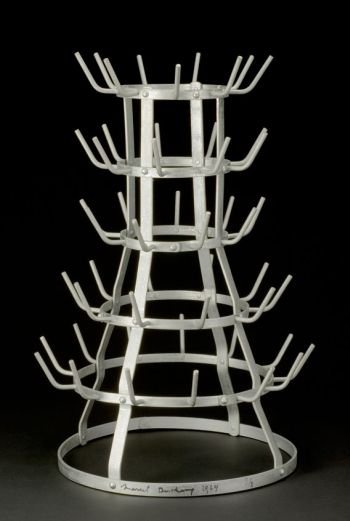
Marcel Duchamp, Bottlerack (1914)
Selling modern art
When Napoleon III set up that ‘Salon des Refusés’ in 1863, perhaps he did wish to reinforce the standards of the Salon jury, and thus of the academic system that regulated such careers, by holding up its rejects to public ridicule. This, at least, is how his gesture was interpreted for many years, by art historians for whom the opposition between ‘good’ avant-garde art and ‘bad’ academic art has been a cornerstone of that narrative of modernism’s heroic independence which still dominates popular understanding of modern art’s history. But recent research has shown it to be more likely that the Emperor wanted to shake the Académie out of its complacency, and to give some encouragement to a broad spectrum of artists, by putting on such a rival display, a gesture in keeping with his general aim of encouraging entrepreneurship in all sectors of the economy, not least the cultural. Alongside his decision to set up the alternative Salon, Napoleon took measures to weaken the Académie’s hold over art education, and to boost the status of design and the decorative arts. As Nick Green and other art historians have shown, his reasoning seems to have been that if a greater variety of artistic practices could be allowed to flourish, they would be able to meet the demands of an increasingly varied and expanding middle-class clientele with a multiplicity of pictorial and sculptural styles and products.
If this was Napoleon’s aim, it didn’t work out as he might have hoped – at least not immediately, since the combined resistance of the art hierarchy and the conservative tastes of that clientele put a banana-skin under the rival Salon. But that very conservatism, in the context of an expanding middle class, also left spaces, and provided opportunities, for art dealers with both flair and means to take risks on new artists. Paul Durand-Ruel was the most famous of the first of these, buying and supporting the impressionists through good times and bad from the 1870s, until the arrival of wealthy nouveau-riche patrons from the United States 20 years later secured his investment. His example was followed by a thin but widening stream of younger men, among whom were Ambroise Vollard and Daniel-Henry Kahnweiler – and one woman, Berthe Weill. Weill’s feisty support of the new young artists she showed in her tiny Montmartre gallery in the early 1900s earned her the appreciative, punning nickname of ‘la petite merveille’ [the little marvel], but it was Kahnweiler above all who brought new ideas and strategies to the business of selling new art when he opened his gallery in 1907. Setting himself up ambitiously in the most expensive district of the Paris art world, Kahnweiler introduced contracts that tied ‘his’ artists exclusively to his gallery, and promoted them assiduously through that mushrooming Europe-wide avant-garde network I have outlined, cultivating a small but select group of discerning ‘advanced’ collectors.
The collectors, of course, were the key; without a willingness to speculate, on the part of enough people with sufficient money to do so, the new market would not have emerged. But the speculative opportunities grew more obvious with each decade. In 1904 a group of ten middle-class Parisian men formed a society to invest a small sum (3,000 francs) each year for ten years in the art of young unknowns, agreeing to sell their collection in 1914. They called themselves the Société de la Peau de l’Ours [Skin of the Bear Society], after a fable by La Fontaine in which two hunters sell the skin of a bear before trying – and failing – to capture the animal; thereby acknowledging their own speculative motives, and even enjoying the risk they were taking with their money. The sale in 1914 realized well over 100,000 francs; and it demonstrated that contemporary art could make its collectors money. But money was not the only motive. As I have suggested, the discernment that collecting cutting-edge art required (or appeared to, as its dealers were quick to underline) reflected flatteringly on the collector and, costing less than the work of established artists, indicated his or her possession of as much independence of taste as disposable income. Even during the years of the First World War, there were enough (mostly US) would-be patrons of new art keen to acquire the reflected aura of individualism to sustain the art activities of non-combatant avant-gardes. After the War, the release onto the market of the huge cubist collections of Kahnweiler and Wilhelm Uhde that had been sequestered as enemy property (both were German) depressed the prices of these pictures drastically, to the despair of the artists who had created them. But
it’s an ill wind that blows nobody any good, for they were snapped up for a song by a rising new generation of collectors, who thus found themselves owners of scores of works by Picasso, Braque, Gris, and Léger. In the meantime, certain collectors were deciding to take what seems, in retrospect, to have been the inevitable next step, and to found a museum (as opposed to a gallery) that would display their art – and thus their taste – to the public. The Museum of Modern Art was established, in 1929 in a house in mid-town Manhattan, for this purpose. It was the only public collection anywhere in the world devoted exclusively to modern art. Its trustees appointed as the Museum’s first curator a young art historian, Alfred H. Barr, Jr, who brought with him not only a scholarly education but also an eye trained to make clear distinctions of both form and value. The appointment was shrewd, for this combination of qualities enabled Barr to undertake, by means of a series of themed exhibitions, the ambitious project of laying down a historical narrative of modernism that placed the Museum’s collection at its centre. These both consecrated its artistic values and secured its position as arbiter of what was not just good or bad, but the most important art of the century. Some of Barr’s exhibitions were such landmarks that they set the terms by which modern art was understood, and reshaped its chaotic eventfulness as a linear ‘development’, for the next half-century. The exhibition Cubism and Abstract Art of 1936 had a catalogue which has hardly been out of print since, and whose frontispiece diagram mapping that narrative (Figure 6) has been as reproduced as most of its exhibits.
Barr’s appointment was also timely, for it came at the same time as the Wall Street Crash. Although art collectors seem not to have suffered greatly financially, the art market slumped until the mid-1930s. In this context the construction of a history for modern art, and of a canon (or roll-call) of the ‘great’ modern artists, was an invaluable bulwark against the loss of speculative confidence. Coincident, too, with the early years of MoMA was the growing threat of war in Europe. The greater familiarity with contemporary European art that Barr’s exhibitions fostered was further enhanced up for a song by a rising new generation of collectors, who thus found themselves owners of scores of works by Picasso, Braque, Gris, and Léger. In the meantime, certain collectors were deciding to take what seems, in retrospect, to have been the inevitable next step, and to found a museum (as opposed to a gallery) that would display their art – and thus their taste – to the public. The Museum of Modern Art was established, in 1929 in a house in mid-town Manhattan, for this purpose. It was the only public collection anywhere in the world devoted exclusively to modern art. Its trustees appointed as the Museum’s first curator a young art historian, Alfred H. Barr, Jr, who brought with him not only a scholarly education but also an eye trained to make clear distinctions of both form and value. The appointment was shrewd, for this combination of qualities enabled Barr to undertake, by means of a series of themed exhibitions, the ambitious project of laying down a historical narrative of modernism that placed the Museum’s collection at its centre. These both consecrated its artistic values and secured its position as arbiter of what was not just good or bad, but the most important art of the century. Some of Barr’s exhibitions were such landmarks that they set the terms by which modern art was understood, and reshaped its chaotic eventfulness as a linear ‘development’, for the next half-century. The exhibition Cubism and Abstract Art of 1936 had a catalogue which has hardly been out of print since, and whose frontispiece diagram mapping that narrative has been as reproduced as most of its exhibits.
Barr’s appointment was also timely, for it came at the same time as the Wall Street Crash. Although art collectors seem not to have suffered greatly financially, the art market slumped until the mid-1930s. In this context the construction of a history for modern art, and of a canon (or roll-call) of the ‘great’ modern artists, was an invaluable bulwark against the loss of speculative confidence. Coincident, too, with the early years of MoMA was the growing threat of war in Europe. The greater familiarity with contemporary European art that Barr’s exhibitions fostered was further enhanced contemporary art galleries – as long as they were underwritten by patrons rich enough to absorb some early losses. The Guggenheim family, stupendously wealthy thanks to mining interests, held some of these: Solomon Guggenheim established in 1937 the Museum of Non-Objective Art that still bears his name (and whose recent challenge to MoMA’s hegemony we shall explore later). In 1942 Peggy Guggenheim opened her Art of This Century gallery on 57th Street, showcasing work not only by the European émigrés but, alongside it, that by young New York artists too. By the time it closed in 1947 (and Peggy had moved to Venice, to start afresh there), Art of This Century had launched the careers of most of the pioneers of Abstract
Expressionism, and had been followed by other contemporary galleries, whose dealers – Sam Kootz from 1945, Betty Parsons from 1946 – supported (and often subsidized) the work of the rising young generation of New York’s newly international avant-garde.
The Abstract Expressionist movement was the first fully fledged artistic product of this avant-garde, and the process of its emergence and consolidation established, at the same time, New York’s leadership of the international modern art world with MoMA as its headquarters. The city’s art market by then had sufficient critical mass, in terms of the number of its dealers and its seriously wealthy collectors, and an associated corps of art critics – informed, ambitious writers (and sometimes artists) reviewing exhibitions, staking out positions, shaping the tastes of their assorted publics. The movement they fostered became known as the New York School. Some of these critics, above all Clement Greenberg and Harold Rosenberg, became as celebrated as the artists they wrote about, and (in ways we shall explore) perhaps even more influential. Underwriting their growing confidence and combativeness was a strengthening alignment between their cultural values and those represented as characteristically American in the postwar, Cold War world. No longer – it appeared – the standard-bearers of an oppositional aesthetics or politics, the paintings of the Abstract Expressionists were paraded around the world as exemplars of the creative freedoms that were denied to artists in the Communist countries under Soviet rule. MoMA set up an International Program of Circulating Exhibitions in 1952, working, often with government agencies, to disseminate the work of the New York avant-garde, in shows such as The New American Painting, which toured Europe (and came to the Tate Gallery) in 1959. A far cry, this, from 1863 and the Salon des Refusés. Perhaps the apotheosis of the New York avant-garde formation and market came, though, in the next decade, as a succeeding generation of artists, dealers, critics, and collectors acknowledged the cultural authority of Abstract Expressionism in the time-honored way, by overturning its precepts and abandoning its altars in favor of other religions. Pop art’s (often ironic) celebration of the vitality of consumerist culture attracted new dealers like Leo Castelli and Ivan Karp, and new collectors such as Robert and Ethel Scull, and Emily and Burton Tremaine, whose voracious and well-publicized collecting activities – and, perhaps as significantly, their ostentatious unloading of their collections in the salerooms a decade later – enhanced the reputation of the New York market as much as they enriched its leading providers. When minimalist and conceptual artists made work, and followed strategies, in the late 1960s and through the 1970s that implicitly or explicitly critiqued the co modification of contemporary art that Pop and its handlers seemed to relish, these same dealers and collectors were happy to fund them – Scull backing the Green Gallery, showcase of minimalism, and Castelli adding Morris and Judd, its leading lights, to his stable, even though the anonymous, boxy, untitled objects that these artists made seemed light years away from the Pop exuberance that both the dealer and the collector had previously favored.
Nevertheless, minimalist and conceptualist art proved harder to sell. Both ‘isms’ burst onto the art scene in the mid-1960s to critical acclaim, and the artists involved carried avant-garde authority – they were among the first whose art education was university- based, and they wrote a lot about their own work. But it was, when all was said and done, not so much fun as painting and pop, and quite a number of major collectors gave up buying in the 1970s, causing the collapse of some galleries (such as Bykert in New York, which had focused on minimalism). Not surprisingly, therefore, leading players in the market sought to turn the tide, and within a few years they had done so: the early 1980s saw a return not only to conventional fine art media but to figuration too. ‘Neo-Expressionism’ was a loose and journalistic label for a group of painters working in a diverse range of figurative styles, whose rapid and simultaneous rise to prominence on both sides of the Atlantic – in Italy, Germany, and the USA – pointed more directly to the power of dealer cartels to control the contemporary art market than to any profound or widespread change in avant-gardism thinking (although the ‘retro’ preoccupations and pastiche manner that several of them shared had all the hallmarks of the postmodernism then becoming a buzzword). New names became familiar almost overnight – such as those of Sandro Chia and Francesco Clemente from Italy; Georg Baselitz, Rainer Fetting, and Anselm Kiefer from Germany; David Salle and, above all, Julian Schnabel from the United States. Alongside them, new dealers gained rapid prominence: among them Sperone West water Fischer, launched in Manhattan’s SoHo by associates of Castelli from Frankfurt and Milan, and whose trilingual masthead epitomized the internationalism of this market-created art; and Mary Boone, who had worked for Bykert before setting up on her own, promoting Salle and Schnabel with such success that by 1982 she was being proclaimed (ahead – naturally – of her artists) as ‘the new queen of the art scene’ by New York Magazine. The work of these artists, and equally of these dealers, was consecrated, after a fashion, by a major show at the Royal Academy in London in 1981. A New Spirit in Painting, cleverly titled to disguise its eclectic mix of blue-chip, early-century moderns, elderly make-weights, and the Neo-Expressionist ‘transavantgarde’ (as they were now termed), at once confirmed the ascendancy of neo- conservative attitudes in the art world in the wake of the political victories of Margaret Thatcher and Ronald Reagan, and turned around the genteelly declining fortunes of its host institution.
Perhaps equally important for the future of the art market, however, was its ‘making’ of the collection of Charles Saatchi, who had been investing in many of the artists represented in the exhibition, and who obtained a strategic position in that market over the next few years, publishing a glossy four-volume catalogue of his collection, The Art of Our Time, in 1984, and a year later opening his own huge exhibition gallery to show it, in Boundary Road, London. Although ostensibly a collector rather than a dealer, Saatchi had mixed business with pleasure ever since starting both his advertising agency (with his brother Maurice) and his art buying in the early 1970s, and by 1978 Saatchi & Saatchi the agency was reporting art sales of £380,000 for the year. At the start of the 1990s the precipitate expansion of the agency plunged it into debt, compelling Charles to sell art in large quantities – which he did just before the art market crashed: the sale of 200 works brought £23 million against an outlay of £8 million. Ironically, it was this sharp fall in art prices, coincident with the recession of the early 1990s that further (if indirectly) strengthened Saatchi’s strategic position in the market. He had exercised considerable ‘leverage’ on this market twice in the previous decade, in 1982 notoriously lending the Tate Gallery almost all of the exhibits in a show that it mounted of Julian Schnabel’s painting – a gesture of acclaim by a major international public gallery that substantially enhanced the market value of these works – and a few years later unloading all of his many Sandro Chia paintings in a single sale that had a disastrous effect on Chia’s prices. The immediate effect of the early 1990s recession was to unravel, to some degree, the international contemporary art network – in Britain, at least, where Saatchi is based, it was to ‘reconfigure’ British art to domestic concerns, and to foster the emergence of a more localized network of smaller galleries and warehouses, in London and other cities, where ‘cutting-edge’ art was shown. Saatchi’s response was, uniquely for a collector on his scale, to acquaint himself with this emergent network, and, perhaps with an advertising professional’s ‘nose’ for a fresh scent, to pursue and purchase the edgy new art that was appearing across it: the work of young unknowns such as Damien Hirst, Tracey Emin, and Gavin Turk. The rest, of course, is history of sorts: the Royal Academy’s Sensation exhibition in 1997 of this collection, and its establishment of the ‘young British artists’, or ‘yBas’, as a media phenomenon, and in some cases as art celebrities; the opening in April 2003 of the Saatchi Gallery, showcasing this work, in the prime tourist location (if awkward exhibition spaces) of the former Greater London Council building on the South Bank opposite the Houses of Parliament.
Indeed the location of the Saatchi Gallery was also a tacit acknowledgement of (and perhaps challenge to) the resurgence of the public art museum, epitomized by the colossal Tate Modern in the former Bank side power station just downriver from it. Although not too much distinction should be made between the public and private sectors of the art world – as art historian Chin-Tao Wu has shown, the two commingle closely, and the boards of trustees of the former are packed with the leading players in the latter (or their relatives) – it is the extraordinary flourishing of modern art museums across the globe in the last decade that has been the most spectacular feature of this art scene, eclipsing even the activities of collectors like Saatchi in its impact both on art’s audiences and on its economics. To name but a few examples: the Guggenheim at Bilbao, designed by Canadian architect Frank Gehry and opened in 1997, is perhaps the most renowned, but it was preceded in 1996 by Brazilian Oscar Niemeyer’s equally stunning art museum for Rio de Janeiro. Tate Modern, refurbished by the Swiss partnership of Herzog and de Meuron, opened in 2000, and was matched in 2004 by a much-expanded MoMA New York, the work of the Japanese architect Yoshio Taniguchi. The global character of this development is striking, but equally significant are two other features. In every case – as with the first of these ‘postmodern’ museums, the Centre Pompidou in Paris, designed by Renzo Piano and Richard Rogers, and opened in 1977 – the museum itself is its own primary exhibit, not only supplanting the art in its collection as the main reason for visiting it, but upstaging that art with its scale and/or visual exuberance. Moreover, viewing the collection is understood, by these museums, as only one among several experiences they are now expected to offer. Others include those of shopping for books on, reproductions of, or merchandise decorated with the art in their galleries, and enjoying up market food in their cafés and restaurants. More and more, public modern art museums are thus being reconfigured as sites for consumption. (And with good reason: the MoMA’s store, across from the museum, now makes seven times the sales per square foot of the average US shopping mall.)