A family member has bipolar disorder. Is there anything I can do to help?
Helping your family member seek treatment is one of the more important ways to assist, particularly when a patient is manic. Because mania is so often perceived by the affected individual as a positive experience, the likelihood of him or her pursuing treatment for it is close to zero. Even when depressed, many individuals have difficulty taking the first step of making an appointment with a mental health practitioner.
Family support is critical to treatment success for these and other reasons. If the person is already in treatment, helping him or her remember the appointments and providing encouragement to stay in the treatment will be of tremendous help. Accompanying your family member to any appointments to provide feedback to the clinician can be of help, as some persons have difficulty identifying either symptoms of mania or depression in their condition.
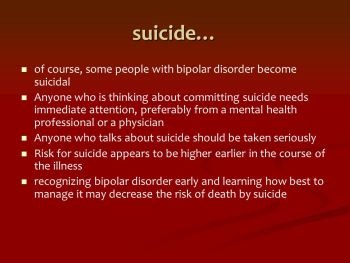
If the patient is on medication, assistance and reminders to take medication are useful, as a lack in compliance with medication is a common reason for relapse. If you believe that someone is suicidal, seek assistance as soon as possible. If a family member is manic, out of control, and in immediate danger to themselves or others and refuses to get assistance, call the local authorities, such as emergency medical services. EMS will generally bring your family member to be evaluated in the emergency room setting.
Although this option is not always well received by the person involved, it is the best and may be the only choice if someone is at risk for hurting others or, even more worrisome, killing himself or herself.
Leslie’s comments:
I’d like to speak to this question from the perspective of what would be (and is) helpful to me. The key is understanding. However, understanding is not the same as being willing to go along for “the ride” as I move through my mood swings. Understanding means being able to identify behaviors in me that fall outside of my norm and making me aware of them so that I can evaluate my mood and decide if what I am feeling comes from “normal” life stressors or if I am having mood fluctuations that are induced by my brain chemistry.
Being kind and understanding about the reality of bipolar disorder without letting it be used as an excuse is the most helpful to me.
Term:
Compliance – extent that behavior follows medical advice, such as by taking prescribed treatments. Compliance can refer to medications as well as to appointments and psychotherapy sessions.
My mother appears to be hippomanic, but she refuses to see anyone. What can I do?
This situation can be very complicated for the family members of a person who appears to be suffering from hypomania. Hypomania can be difficult to recognize because although it is characterized by a change in functioning, by definition it does not cause marked distress or disability. It can make the person more difficult to work with because he or she is often less willing to listen to and follow directions from others as a result of inflated self-esteem, a situation that often leads to frequent arguments and irritability in the affected individual.
But such symptoms can also be character traits that are always present, though perhaps to varying degrees rather than any dramatic change in personality. Also, because of the stigma of mental illness, many persons with mood disorders never seek treatment. Treatment avoidance may be more likely based on age (older), gender (male), or ethnic and cultural identity (mental illness has a greater stigma in many cultures). Perhaps your mother will not see a psychiatrist but will agree to meet with her primary care physician.
You could accompany her to her appointment, where she might be willing to have you communicate concerns to the doctor. Making an initial appointment with a mental health practitioner on her behalf may be enough to motivate her to seek help, especially if you agree to attend the appointment as well. If, however, your mother absolutely refuses to meet with anyone, a decision needs to be made as to potential for dangerousness to self or others.
For example, if suicidal ideation is suspected, local emergency personnel can be called to take the person to the emergency room. She may be angry about this, but if suicide is a possibility, the risk is worth taking. Some communities have mobile crisis units available in which a team of mental health practitioners can come to the home to evaluate your mother if you feel she is in crisis and agrees to the meeting. You can usually obtain information about home-based mental health services for persons in crisis from the community or city hospitals that sponsor such programs.
Leslie’s comments:
It must be difficult when you see your loved one escalate to a hippomanic state. In my case, the only thing that gets through to me is being told (constantly) that my behavior isn’t normal; that perhaps I should call my clinical nurse specialist to discuss my medication; that maybe I should see my psychotherapist for another opinion.Anyway, it’s hard to hear this especially when I have spent so much time in a depression. It feels great to be completely energized; not needing much sleep, completely motivated to do anything and everything. It’s really hard to acknowledge that I am over the top and need some help getting back on an even keel.
What are the different types of treatment for bipolar disorder?
Types of treatment for bipolar disorder fall into two broad categories: psychosocial treatment and pharmacological treatment. Within each category are many choices. Psychosocial treatments include individual therapies, group therapies, vocational services, family/couples therapies, as well as others. Further, there are different types of individual therapies, such as supportive, insight-oriented, or cognitive-behavioral.
There are also various levels of treatment settings, ranging from private practice settings, outpatient clinic settings, day treatment or partial hospital programs, and inpatient treatment. Pharmacological treatment involves the use of medications from various groups, such as anticonvulsants, antipsychotics, antidepressants, mood stabilizers, or anxiolytics.
Psychotropic medicines are primarily used in psychiatric care for the treatment of mental disorders, including bipolar disorder. Many medications are utilized in other medical areas as well, such as the use by neurologists of antiseizure medications (anticonvulsants), which have been found to be efficacious in the treatment of bipolar disorder.
As part of an evaluation, your clinician will consider the most appropriate treatment plan for your bipolar illness. In part, the intervention will be based upon the phase of the illness, such as depressed, manic, or mixed. The first determination will be whether the illness can be managed acutely in the outpatient setting or best as an inpatient.
Manic phases often require hospitalization unless caught relatively early. For severe bipolar depression, hospitalization may also be required if there is risk for suicide. Patients in an acute mixed state are at particular risk for suicide due to the depression along with the impulsivity of mania. If deemed appropriate for outpatient stabilization, medication will likely be recommended along with psychotherapy.
If a clinician other than a psychiatrist makes your diagnosis, he or she will likely refer you to a psychiatrist for medication consultation. The type of therapy chosen for treatment can depend upon many factors such as cost, duration, or patient fit. Psychosocial interventions commonly used for bipolar disorder are cognitive behavioral therapy, psycho education, family therapy, interpersonal, and interpersonal social rhythm therapy.
Cognitive-behavioral therapy helps people with bipolar disorder learn to change inappropriate or negative thought patterns and behaviors associated with the illness. Psycho education serves to teach people with bipolar disorder about the illness and its treatment, and how to recognize signs of relapse so that early intervention can be sought before relapse occurs.
Family therapy uses strategies to reduce the level of distress within the family that may either contribute to or result from the ill person’s symptoms and can provide psycho education for the family members.
Interpersonal social rhythm therapy helps people with bipolar disorder both to improve interpersonal relationships and to regularize their daily routines. Frequency of psychotherapy typically starts at once per week but may be more or less often depending on your individual needs or therapy type. Frequency may be increased around acute episodes.
Family involvement is important as part of the therapy in bipolar disorder, as family members need to be aware of and able to inform the clinician of any signs of relapse.
Again, as part of the treatment plan, the treatment setting also needs to be determined. Most individuals can be treated in private office settings or outpatient clinic settings. Sometimes, a higher level of structure is needed in which more services can be provided, on a daily basis, such as in a day treatment program. If impairments are severe, or safety is in question, hospitalization may be warranted.
Term:
Insight-oriented also known as dynamic – A form of psychotherapy that focuses on one’s developmental history, interpersonal relationships with one’s family of origin, and current relationships with friends, spouses, and others.