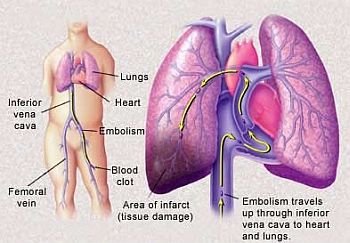
What is pulmonary embolism?
A blood clot in one or more of the arteries in the lungs causes pulmonary embolism. Its clinical picture closely resembles that of a heart attack. However, various diagnostic tests, particularly a lung scan (a special x-rayexamination) confirm the diagnosis. If you had this type of embolism, you might cough up blood.
On an ECG, the typical abnormalities brought about by pulmonary embolism (beyond the scope of this book) differ markedly from those of a heart attack. In most cases, the blood clots usually arise from your leg veins, and you would feel a very rapid heart rate. Of course, pulmonary embolism does not damage your heart muscle. This can be checked by blood enzyme tests and ECG analysis.
What is a pneumothorax?
Pneumothorax in nonmedical terms means collapse of the lungs. Pneumothorax produces a sudden and severe shortness of breath (dyspnea) that comes with significant chest pain and profuse sweating. At first glance, the clinical picture of pneumothorax mimics that of a heart attack, but x-ray pictures can point out the differences between the two disorders. Of course, no evidence can prove that pneumothorax would damage your heart muscle. Pneumothorax can occur spontaneously, for no obvious reason, but it may be caused by trauma or certain lung diseases as well.
What is dissection or rupture of the aorta?
Dissection of the aorta takes place in the main artery leading from the heart.When the inner layers of the aorta separate, thereby forcing blood flow between them, they do so suddenly, and you would feel tearing chest and back pain. Even a sharp blow to your chest could cause aortic dissection. It may happen as aserious complication of uncontrolled high BP. Clinically, aortic dissection effects closely resemble those of a heart attack, but various diagnostic tests can tell the difference. When aortic dissection is severe, the aorta will rupture. For many people, a dissected or ruptured aorta is fatal. However, this disorder doesn’t damage your heart muscle, so if caught quickly an aortic dissection can be repaired surgically.
What are myocarditis and pericarditis?
Myocarditis is the inflammation of the heart muscle itself, whereas pericarditis is the inflammation of the pericardium (the sac surrounding the heart). Very often, myocarditis can coexist with pericarditis. Either disorder may be caused by a variety of viruses and bacteria, but it may be idiopathic (arising from an unknown cause). Nevertheless, in the majority of cases a virus is responsible, particularly for pericarditis.
Often you can relieve chest pain from pericarditis by sitting up. At first glance, the symptoms mimic those of a heart attack, but physical findings along with various diagnostic tests can distinguish between the two. Affected patients often have a mild fever.
Term:
Idiopathic – arising from an unknown cause.