Weaning: When and how to stop breastfeeding
12-18 months
What you can expect
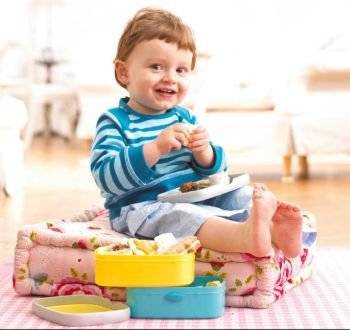
The transition from baby to toddler is an exciting one for both you and your little one, and you’ll find he is now capable of eating a wide variety of foods-some of them all on his own!
My toddler seems to be using mealtimes to exert her will; how can I prevent this from becoming a problem?
Early in life, most children catch on to the fact that their parents are concerned about what and how much they are eating. Making a fuss about food guarantees instant attention, and many children slide into the habit of using food to wield power over their parents. The best advice is to remove the pressure. If children fail to get a response, they get bored. When they realize that they won’t get attention for eating badly, they’ll stop using food as a tool to do so.
So, if your toddler won’t eat, remove full or half-empty plates without a murmur, after around 30 minutes. Don’t offer an alternative, and try not to panic too much that she hasn’t eaten enough of the right foods. No child, whatever her age, will willingly starve herself, and if you continue to offer healthy food, with no pressure attached, she will eventually eat it.
Should my toddler be feeding himself by now?
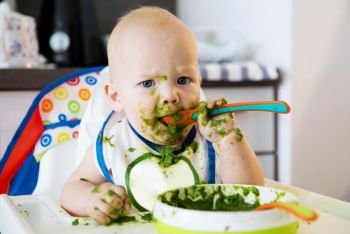
Most toddlers will be able to finger feed themselves successfully at 12–18 months. They are very unlikely to manage to eat with cutlery, but they can try! Provide your toddler with his own cutlery, and encourage him to get his fingers messy, and he’ll soon learn the necessary skills. The best way to approach this is to encourage him to eat with both his hands and cutlery, while you feed him at the same time. By watching you feed him, he learns the art of picking up a spoon, filling it with food, and placing it in his mouth-he’ll soon be doing this himself, once he knows how.
Is it OK for my toddler to eat little but often?
Some little ones can’t seem to manage much at mealtimes, either because they lack the concentration necessary to sit down and finish a bowl or a plate of food, or because their tummies are small, and it takes very little to fill them up. In this case, it’s fine to offer a few small meals, as long as they are all equally healthy, and not junky snacks that will fill them up with empty calories.
Is it necessary for my toddler to use cutlery?
Presenting a set of “safe” and child-friendly cutlery at a young age, even if your child doesn’t use it, instills the idea that cutlery accompanies mealtimes. Many little ones eat with their hands alone, which is certainly a necessary skill to develop, and perfectly acceptable in toddlerhood, but not something that should be encouraged into the preschool years.
- Temper tantrums
Tantrums may become increasingly evident at mealtimes. A good way to bypass these is to offer a few choices in advance, so your toddler feels she has a little control. Perhaps let her choose her bowl or which vegetable she might like.
12-18 months
Gentle weaning
Weaning is often a tricky and emotive period for toddlers and parents alike, because regular milk feeds are replaced with wholesome, nutritious meals. Don’t rush the process if you aren’t ready. As long as milk isn’t forming the main part of your toddler’s diet, you can continue to enjoy those comforting moments.
Is it OK to continue to breastfeed even when my toddler is eating a varied diet?
There is absolutely no reason why you can’t continue to breastfeed as long as both you and your toddler are enjoying it. There is plenty of research to suggest that breast milk continues to offer antibodies well into toddlerhood, which can help build up your little one’s resistance to infection. Breast milk also contains a whole host of vitamins and minerals. It is important, though, that your baby has a healthy balance between breastfeeding and solids. The majority of nutrients at this age should come from food, and not breast milk. Filling up on breast milk can lead to reduced food intake, which may lead to vitamin deficiencies.
Most importantly, perhaps, is that breastfeeding offers emotional nourishment and comfort to your child, and helps to build a healthy mother child relationship.
My toddler shows no desire to stop breastfeeding, but it’s starting to get embarrassing. What do you recommend?
If you are feeling pressured because you are breastfeeding past the point at which many moms give up, try limiting it to morning and evening feeds, when you can feed in private. If you are ready to give up altogether, take it slowly. Start by losing one feed at a time and offer a drink or snack in its place. It can take time, but weaning needs to happen sometime.
Should I stop the nighttime bottle?
It is easy to fall into the habit of offering a nighttime bottle because it’s comforting. The longer this goes on, the harder it is to stop, and drinking from a bottle at night can wreak havoc with children’s teeth. It’s a good idea to offer a cup instead. However, if you’re finding it hard to get your toddler away from his bottle, gradually water down his evening bottle over a few weeks, until it is virtually tasteless, and encourage other comfort items, such as a favorite toy. See box, right, to ensure he gets his calcium requirements though.
My child doesn’t seem to like water. How can I make it more appealing?
If your toddler is used to sweet drinks and milk, water probably does seem boring. Buy her a water bottle, perhaps with her favorite character on it, and keep it filled throughout the day, so she gets into the habit of drinking whenever she is thirsty. Sometimes offering water with some ice cubes and a straw can make it more fun, too. If this doesn’t work, try adding a tiny bit of juice and then reducing the flavoring little by little until she’s drinking water alone.
Does it matter if my child won’t drink any milk?
Lots of children can’t or won’t drink milk, and grow and develop perfectly well. The most important element of milk is calcium, which is required for healthy bones and teeth. Calcium is found in all dairy products, so if he’s eating yogurt, fromage frais, and cheese, he’s probably getting enough. Leafy-green vegetables are also a good source of calcium, and use milk when you can in cooking: in rice pudding, creamy or cheese sauces, or even mashed potatoes or other root vegetables.
Should my toddler be drinking her milk from a cup?
It’s a good idea to wean your baby on to a cup by the age of 6-12 months, when the sucking reflex is replaced by an ability to sip and swallow. A cup is less damaging to her teeth because the sucking action when drinking from a bottle causes milk to “swirl” around the mouth, bathing the teeth in the natural sugars that it contains. A cup will also limit her association of milk with comfort, which can sometimes lead to problems with comfort eating and weight problems later on-and also difficulties settling without a bottle. Start by switching the teat on her bottle to a “spout,” so that she becomes used to drinking rather than sucking. Then buy a few brightly colored cups with lids and ask her to choose the one she’d like to have her milk or water in. If she feels that she has some power to choose, the disappointment of not having a bottle will soon be forgotten.
- Did you know …
That children over the age of one should get about 20fl oz (570ml) of milk a day? Remember, though, that this is to provide the total amount of calcium required, so if your toddler has a yogurt or two, some cheese, and milk on her cereal, she’ll need correspondingly less. In fact, a glass of milk a day, plus a yogurt and a small piece of cheese is actually just about right for most toddlers, even though it’s tempting to offer more than this.