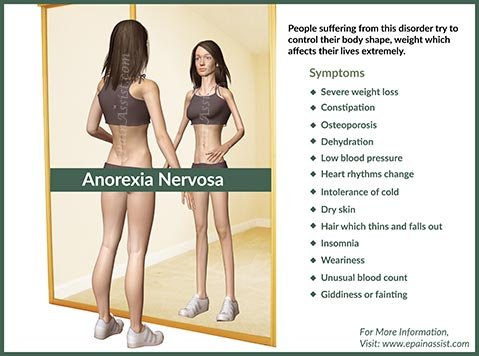
Anorexia Nervosa – Signs, Symptoms, Causes, and Treatment

What is nutrition counseling?
The purpose of nutrition counseling includes helping patients enhance their understanding of healthy eating, learn a balanced approach to food, make and maintain dietary changes, and increase motivation to acquire and maintain a healthy weight. Nutrition counseling can also help patients examine underlying beliefs about food, correct any misconceptions or “diet myths,” provide an understanding of necessary nutrients for healthy living, assess nutritional imbalances or deficits, and help reestablish a connection to physical hunger and satiety cues that may be significantly impaired by their eating disorder. Knowledgeable nutrition experts (registered dietitians, for example) are included in a patient’s treatment team to help facilitate these goals. While studies show that nutrition counseling in isolation is not an effective treatment for anorexia, and is therefore not recommended, it is highly recommended in conjunction with medical and psychological treatment, both for short-term weight recovery as well as to prevent long-term relapse.
It has been so long that I need to be reminded-what does “healthy eating” look like?
Healthy eating is flexible eating. Healthy eating allows for a wide variety of foods, both for nutritional value as well as for the emotional value of having a balanced, non-restrictive approach to eating. Healthy eating yields physical benefits (e.g., clear thinking, mood stability, physical strength, and endurance), and it also allows for the experience of pleasure when eating-something that is usually absent for a person with anorexia.
According to psychotherapist Karen Koenig, author of The Rules for Normal Eating, there is no one right way to be a “normal eater.” For example, healthy eating may consist of three large meals, or many small ones throughout the day. Koenig adds that “normal” eating means focusing on the food in front of you, rather than worrying about what you ate yesterday or planning what you will eat tomorrow. Healthy eating means not caring what people around you are eating or comparing your portion sizes to theirs. It excludes feelings of guilt, shame, or embarrassment, and it does not judge one’s deservingness when it comes to food and eating.
Registered dietitian Ellyn Satter, author of Secrets of Feeding a Healthy Family: Orchestrating and Enjoying the Family Meal, sees normal eating as comprised of the following:
• Being able to eat when you are hungry and continue until you are satisfied
• Being able to choose food you like, eat it, and truly get enough of it, not just stop eating because you think you should
• Being able to give some thought to your food selection so you get nutritious food, but not being so wary and restrictive that you miss out on enjoyable food
• Giving yourself permission to eat sometimes because you are happy, sad, or bored, or just because it feels good In short, healthy eating is not just about what kinds of food you may eat, how often you eat, or how much food you consume; it is also about a healthy attitude toward eating-being comfortable with food and being able to eat without fear, judgment, or shame.
Sarah shares:
A huge part of my treatment was learning to eat like a kindergartener-to eat what I wanted when I was hungry-and to stop when my stomach was full (not when my mind told me I should be). I needed a lot of help to relearn which foods I actually liked and which foods I had convinced myself I hated because of their undesirable nutrition facts. After a while, I learned what a healthy portion was and could leave food on my plate if I wanted or go back for seconds if I was still hungry.
What types of foods are included in a healthy, balanced approach to nutrition?
Nutrition experts advise including six basic types of nutrients as the building blocks of a healthy diet: carbohydrates, protein, fats, vitamins, minerals, and water. Each of these nutrients provides an important array of benefits to one’s health and well-being. Your dietitian can assist you in developing a plan that incorporates adequate amounts of key nutrients, energy (calories), and an appropriate proportion of foods for optimal health.
In addition, the U.S. Department of Agriculture (USDA) issued a new set of recommended dietary guidelines in 2005.
These guidelines describe a healthy diet as one that:
(1) Includes a variety of fruits, vegetables, whole grains, and low fat milk and milk products;
(2) Is low in saturated fats, trans fats, cholesterol, salt (sodium), and added sugars;
(3) Offers a regular intake of fluids; and
(4) Includes lean meats, poultry, fish, beans, eggs, and nuts.
The intent of the USDA guidelines is to provide science-based advice that promotes good health and to reduce risk for major chronic diseases through diet and physical activity.
Another helpful tool for good nutrition is the Food Pyramid. The USDA and the U.S. Department of Health and Human Services developed a new, interactive food pyramid that symbolizes a personalized approach to healthy eating and physical activity. The interactive Web site www.MyPyramid.gov allows you to personalize this food pyramid based on your age, gender, and amount of daily physical activity.
When my daughter was hospitalized with anorexia, her doctor cautioned us about “refeeding syndrome edema.” What is this condition?
Certain serious complications can occur in significantly underweight patients during the course of regaining weight (also called refeeding). These complications result from feeding a severely malnourished patient too much food, too soon. Thus, instead of rapid refeeding, a physician will start a recovering person on small amounts of food and progressively increase the amount of calories consumed. This is true for both oral and enteral refeeding. In refeeding syndrome edema, certain electrolyte disturbances can occur, causing a significant increase in fluid in the blood vessels. As a result, a patient’s hands, feet, and ankles may swell. If not properly managed, fluid can build up in the lungs. Abdominal pain, kidney and liver damage, heart failure, and even death can result from refeeding edema and other refeeding complications. The risk of these complications can be minimized or avoided with properly monitored refeeding.
Therefore, it is very important that a physician supervise weight restoration in a severely undernourished patient. A nutrition therapist or dietitian may also assist with refeeding that takes place in a medically supervised environment.
How weight restoration is achieved, and why is it important?
Remember that many of the medical, emotional, and social consequences of anorexia nervosa are a result of malnutrition. Proper physical and emotional health cannot be attained if a person remains undernourished. Additionally, maintaining a healthy weight is associated with a better treatment outcome and reduces the likelihood of returning to intensive treatment. For these reasons, returning to a healthy weight is an important aspect of recovery. The approach to weight restoration by a treatment team will depend in part on the severity of a person’s illness, medical history, eating disorder symptoms (frequency and severity of restricting food, binging/purging), and nutritional needs. Recommendations and goals regarding weight gain are determined in collaboration with the patient whenever possible. Both for medical reasons and to reduce any anxiety associated with weight gain, weight restoration proceeds incrementally and at a slow pace (generally within the range of 1-4 pounds per week, depending on medical need). Progress can be monitored by the patient, the patient’s family, and/or members of the treatment team. Once a healthy weight range is achieved, the focus then shifts to weight maintenance.
Nutritional counseling can help patients learn both what to eat as well as when to eat in the process of weight restoration. Many people with anorexia report eating at irregular intervals, thus refeeding plans often suggest eating at regularly scheduled times to correct unhealthy patterns. Other aspects of meal plans maximize nutrients and health benefits and provide structure and safety while attempting to take into account patient preferences. Depending on the level of care necessary, meal plans may be “structured” (stipulating what to eat, how much to eat, and when to eat), “semi-structured” (offering choices from a list of food groups or food options), or “unstructured” (providing a set caloric or weight-gain goal, but no designed food plan). Not every patient will need a refeeding plan. Some eating disorder patients begin eating normally again once they receive initial attention and care.
This decision is best made with the advice and input of a person’s treatment team. Refeeding may elicit intense anxiety and nervousness in some patients; however, one’s treatment team can assist in reducing concerns associated with weight gain. Relaxation exercises, psychotherapeutic techniques, and certain medications are just some of the tools that can help reduce any discomfort associated with refeeding.
Special Considerations
Severely malnourished patients will likely need a structured refeeding plan and generally call for a greater initial food intake than those who are better nourished. In order to maximize nourishment, nutritional supplements (such as Carnation Instant Breakfast, Ensure, or Ensure Plus) are often used as part of an initial food plan. Over time, supplements are reduced as nutritional balance is restored.
In severe cases, where marked dehydration, rapid weight loss, or significant electrolyte disturbance are manifest, emergency medical attention is given to refeeding. Universally, every attempt is made to elicit patient cooperation with refeeding; however, in rare cases, if food and nutrients are refused when a life-threatening risk is present, a medical team may implement compulsory refeeding. This can take place intravenously or with the use of a feeding tube, such as a naso-gastric tube. Artificial feeding is not preferred by doctors and is considered a last resort; thus, it is utilized only when medically necessary and is discontinued when it is no longer medically required. Additional medical circumstances (e.g., co-occurring diabetes mellitus) may be associated with a heightened risk of medical complications and may require hospitalization during the initial stages of weight restoration.
Terms:
Registered dietitian – A qualified, trained, and credentialed expert in food and nutrition.
Trans fats – Fats that have been treated with hydrogen. Used in many processed foods in order to increase shelf life and flavor stability.
Enteral – A method of substance delivery where nutrients are given directly into the gastrointestinal
Meal plan – A dietary guide that encourages adequate nutrition and caloric intake.
Intravenously – Injection of a substance or medication into a vein.
Naso-gastric – A tube that is inserted through the nose or mouth and into the stomach.
Healthy eating is flexible eating.