Who is the one? The difficulty in selection the partner
Partner selection and the arousal of love have interested poets, artists, and authors already for millenniums. The process of partner selection -“mate selection”, “mate seeking”, “spouse selection”, or “marital choice”-has proven quite an interesting research target especially in the United States.
Research has often been relatively narrow studies with small data but they have presented various theories to explain the start of a new relationship. This study forms a part of a research project in the field of love psychology. The name of the project is “Love-based leadership-An interdisciplinary approach” and it was launched at the university of Lapland in 2011 (http://www.ulapland.fi/lovebasedleadership). The organization of the article differs from a so-called traditional research article because here the theories, models, and previous studies of partner selection are connected with the results of the interviews. Therefore, the empirical study and the theory are in dialogue. Furthermore, the theoretical overview covers quite a long time span. It simultaneously shows how the criteria of partner selection have been at the center of research for decades. Many studies from the 1970s have similar results than studies from 2012. Certainly, there are some differences as well. The purpose of this article is to dissect Finnish people’s perceptions on where love begins, what makes one fall in love and what kinds of characteristics are the most appealing; in other words, what is the core criterion of partner selection. Two research questions are discussed: (1) How do the previous studies and criteria explain partner selection? (2) What kind of connection does the present study has with the previous ones?
Methods
The data in this research were collected through two methods and phases. The first set of data was collected among students at the University of Lapland. 35 students, aged between 20 and 45 years, were interviewed (22 women and 13 men). At the time of the study, 18 of them were either married or cohabited, 16 of them were singles, and one was divorced. Open interview was chosen as the interview method because it allowed the participants to freely describe what they think about love. The themes for interviews emerged from the participants’ views, thoughts, and experiences of love. What happens when one falls in love, what does love give and demand, how could love be strengthened, and what kinds of phases and contents does love involve or could involve? The interviews lasted between one to two hours and were recorded and transcribed word by word. In the next phase, the interview data was expanded by essays. Students of educational psychology (N=46) who studied at the University of Lapland wrote an essay about “What kind of person did you fall in love with? What did you find attractive in him/her? What was he/she like? Why did you fall in love with him/her?” The data were collected during the course of love psychology in 2012. The data comprised anonymously written essays that were between one to four sheets long. 36 of the respondents were women and 10 were men. 38 of them lived in cohabitation with their partners, two were married, and six were dating.
The reason for collecting two sets of informal data-essays and open interviews-was that people can reveal what they really think and feel and thus, the many forms and shades of love would be unveiled. Some of the participants described their experiences of falling in love, the process of finding a partner, in versatile ways. Some of them could have several experiences of falling in love while some of the participants did not have much personal experience: they had found their partner from college or their first love relationship had just begun. What is common to these two sets of data is the rich narration. The qualitative data analysis in this study followed three steps: data reduction, data display, and conclusion drawings. The aim was to create categories that describe the essence of partner selection. In order to be able to show their contents in practice, we have added plenty of quotations from the interviews and essays. In addition, the quotations function as the proofs for reliability. Naturally, the generalizability, validity, and reliability of the results can be criticized. The stories are summaries of the course of events and in that form the data describe every participant’s way of assessing their own life, the chains of events and emotions that mold it. Therefore, it is not salient whether the happenings are described comprehensively or truthfully but their interpretation of what happened is. Indeed, one of the interviewees told: It’s more essential to know why I love my spouse than why or what I fell in love with him in the first place. (Woman, married) Another found writing an essay as a good means of soul-searching: It really did good to contemplate these questions a bit. Now I remember better what a wonderful man is waiting for me at home. (Woman, cohabiting)
Results: Criteria of Partner Selection
Homogamy
Homogamy proved the most common description of the target of one’s love. Therefore, the most common criterion of partner selection seemed to be based on affinity. People tend to find their way to the company of their ilk and then personality traits, hobbies, values, and attitudes or religious and political views may be similar. He was the same kind of athlete as I was. Perhaps, that was the connective factor… He sort of understood that we have to get to bed early in the evening because we have to get early to exercise…so we had the same kind of rhythm of life. (Woman, 23, unmarried). In addition to being my husband, he is my best friend… We have so many common hobbies. (Woman, 21, married). He is a person in order of me because he has similar hopes and expectations. (Woman, 22, unmarried).
First, I fell in love with his looks, and after that I found out that we hit it off really well. (Woman, 21, cohabiting). Homogamy, selecting the partner based on his or her similar characteristics is a dominating criterion according to several previous studies as well.
According to studies, homogamy or similarity has been noticed important when it comes to for example:
– age
– race and ethnic background
– religion
– level of education
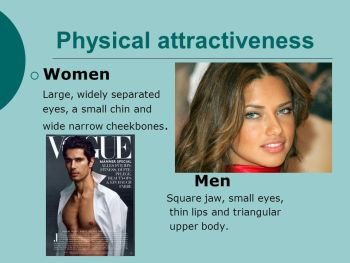
– beauty and physical attractiveness
– professional / societal position
– intelligence
– geographical proximity
– mental and physical health or disability
Partner selection that is based on homogamy is explained by for example psychoanalytical theory and the so-called filter theory. Freud’s psycho-analytical theory is considered from two perspectives: (1) studies that prove the connection between child-parent conflicts and the development of an intimate relationship, and (2) studies that show how the partner resembles the selector’s parents of his or her physical and mental features. The inconsistency of results and vagueness of concepts give reason to doubt the reliability and generalizability of the studies. Kerckhoff and Davis created the first filter theory. According to the theory, individuals get to know each other and start relationships first based on homogeneous cultural factors, then on the similarity of values, and-if the relationship still functions-on the fulfillment of the partners’ mutual needs. Despite the wide body of studies, they still have not provided much support to the theory.
Personality traits
When reviewing the research on partner selection based on similar personality traits, it can be noted that almost every possible characteristic has been studied in relation to partner selection, including “stubbornness”, “jealousy”, “openness to influence”, “sensitivity to criticism”, “talkativeness”, “sensational activity”, etc.
Hoyt and Hudson collected a ranking list of appreciated partner characteristics that appeared in studies in 1939-1977. According to the list, “reliability” and “emotional balance” had proven important since 1939. “Mutual attraction”, “social character, and “education-intelligence” were features that had become more and more appreciated. The same tendency occurred in men’s list for the partner’s “good looks.” Instead, “decency” had become less significant both in men’s and women’s lists as had “good cooking and housekeeping skills” in men’s appreciations.
The latest studies show that women consider important both men’s participation in household work and received support to their career development as women work outside home increasingly. In this research, the participants highlighted the importance of appearance but also “joyfulness”, “sensitivity”, “kindness”, “confidence”, “independency”, “activity”, “reliability”, and “emotional balance” were brought out. A similar political background which was introduced in previous studies seemed to be the least important.
As a summary of the research on personality traits, it can be stated that almost every characteristic correlates between the partners, at least to some extent. Buss noted that correlations varied from -.23 to +47, the mean being .None of the characteristics has constantly proven to be the factor that determines partner selection. Personality traits are not an easy research target whatever research method was selected.
Attitudes
It is easier to study attitudes than personality traits and therefore similarity between attitudes (value preferences and economic, aesthetic, social, political, and religious attitudes) have proven much more unambiguous factor combining partner than personality traits … the basic values of life must be similar, and the partners have to be able to take care of the everyday matters because it is not about that ecstasy all the time. (Woman, 21, unmarried) I had a great affinity with him in all big issues and questions of life. We have common thoughts for example about how we should eat or live a good life (Woman, 25, dating). The similarity at the level of attitudes and values has been found, for example, in the following fields: conservativeness, sexual interests, pessimism-optimism, and abstract versus concrete thinking. Caspi, Herbener, and Ozer noted that attitude correlations vary from 20 to 58. In addition, similar values seem to be the most important among couples who represent the highest social class.