VIDEO
The Obesity-Cancer Connection Panel
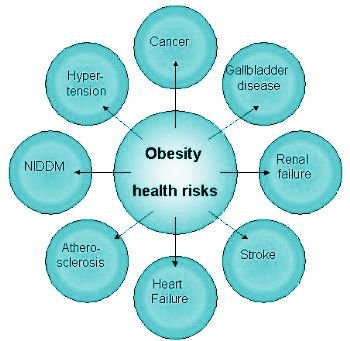
Overweight and Obesity Raises the Risk for Cancer
The Risks for Cancer
Excess body fat promotes the development of cancer because it leads to two important changes in the body’s chemistry:
(1) the development ofthe so-called insulin resistance syndrome or metabolic syndrome; and
(2) the increased production of estrogen.
Insulin resistance and cancer. Fat cells normally release fatty acids into the bloodstream. These molecules can be used for energy and actually compete with glucose as a source of energy by the body. In addition, fatty acids cause chemical changes inside our cells. One important change is making insulin work harder to do its job, that of having glucose transported from the outside to the inside of cells.
This situation is termed “insulin resistance,” and it often leads to adult-onset diabetes. Insulin resistance forces the body to pump out more insulin in order for cells to receive the glucose they need. As a result, higher levels of insulin are found in the bloodstream, and this in turn causes an increase in related chemicals called insulin-like growth factors (IGFs). High levels of insulin and IGFs create an unhealthy atmosphere for the cells they bathe, promoting heart disease, cancer, obesity, and a shortened life span.
Insulin-like growth factors promote cancer because they enhance the survival and growth of cells and prevent their death. This would be especially unwanted if a cell were to sustain a genetic mutation. Normally, such a cell would be sensed as damaged and targeted for elimination by the body. But in the presence of insulin resistance and high IGF levels, the cell may survive; the damaged cell can then go on to sustain additional DNA mutations that ultimately lead to cancer. In this way excess body weight, through the creation of insulin resistance, promotes the development of cancer.
More fat, more estrogen, more breast cancer. The ovaries are the main source of estrogen production in menstruating women. When ovarian function ceases upon menopause, estrogen is still produced in the female body, although in lesser amounts. In postmenopausal women, fat becomes the main estrogen factory, with higher body weights correlating with higher estrogen levels.
As every woman knows from the experience of menstruation, estrogen stimulates the growth of the breast and uterus. Just as the normal cells in these tissues multiply in response to estrogen, so do (most) cancers derived from them. Therefore, the higher the blood levels of estrogen and related sex hormones, the greater the risk of developing breast and uterine cancer.
Recent studies into how weight affects breast cancer control have shown that women who are overweight at the time of a breast cancer diagnosis and those who gain and retain extra weight after the diagnosis have an increased risk of breast cancer recurrence. The more weight gained, the greater the chances that the cancer may return. It is therefore recommended that women strive hard to maintain weight during breast cancer treatment or lose any weight gained after treatments end.
The connection between fat and breast cancer is in part caused by the fact that fat contains an enzyme called aromatase that increases estrogen production. So even after menopause, when the ovaries have ceased producing estrogen, the hormone still gets made in the body. A class of medicines called aromatase inhibitors (AIs) blocks aromatase from working and thereby drastically reduces the levels of estrogen in the bloodstream. AIs such as femara (Letrozole), anastrazole (Arimidex), and aromasin (Exemestane) are very effective in fighting breast cancer in postmenopausal women.