Dealing with Panic Attacks & Anxiety
What is the relationship between grief and anxiety?
Hurricanes hit; cancer strikes; drunk drivers run over loved ones. Real calamity characterizes life. These losses can devastate, leaving a lifelong impact. We might ask how we will be able to go on, or how to fill such a hole as has been left in the wake of a particular loss.
Anxiety is so appropriate because it reflects real, seemingly unspeakable loss. Only the grieving process allows us to slowly restabilize our shattered senses of self. The kind of loss always shapes the anxiety. Sibling loss can set in motion guilt for the surviving siblings. Not only does one lose a sibling, but one also has to struggle with the actualization of what had been a prior fantasy at times: the natural wish to murder the sibling. These feelings can leave one feeling deserving of punishment and lead to depression, a real punishment. Siblings may then attempt to compensate by becoming hyper responsible.
The death of a parent can also bring people to treatment because it leaves them feeling that they do not know how to go on. Despite their chronological age, they can psychologically return to feelings of childhood vulnerability and of needing a parent so deeply. As a function of grieving, a person can both let go of the lost parent or sibling as well as incorporate the most treasured aspects of that loved one into one’s own personality as a way to move on. The anxiety of death, loss, or separation can be devastating; it can also promote psychological growth in mysterious ways.
Term:
Grief – a process during which a person mourns the loss of something, whether that be a loved one, a home, or even something less tangible, like self-esteem.
NEWS:
Anxiety disorders are incredibly common and can be effectively treated.
In a given year, 13% of US adults – 1 in 8 – have an anxiety disorder. But despite the prevalence of anxiety disorders, far too many people – out of embarrassment or stigma – never seek treatment and suffer needlessly as a result. Anxiety can manifest itself in many ways. Emotionally, we have feelings of worry, nervousness, or even outright panic. But anxiety can commonly manifest as physical symptoms. Heartburn, chronic pain, and even sexual dysfunction are all examples how anxiety can be expressed physically.
Anxiety disorders are incredibly common and can be effectively treated.
In a given year, 13% of US adults – 1 in 8 – have an anxiety disorder. But despite the prevalence of anxiety disorders, far too many people – out of embarrassment or stigma – never seek treatment and suffer needlessly as a result.
Anxiety can manifest itself in many ways. Emotionally, we have feelings of worry, nervousness or even outright panic. But anxiety can commonly manifest as physical symptoms. Heartburn, chronic pain and even sexual dysfunction are all examples how anxiety can be expressed physically.
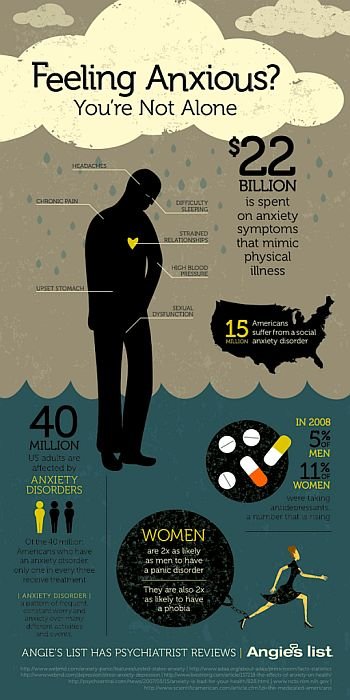
I thought the image below was a wonderful infographic on anxiety. It was created by Kris Davidson, a graphic artist located in Denver, Colorado. Kris graciously gave The Healthy Mind permission to use her beautiful image. Thank you Kris!
– See more at: http://www.thehealthymind.com/2012/09/08/feeling-anxious-why-youre-not-alone-infographic/#sthash.DRkdpeu7.dpuf
Anxiety disorders are incredibly common and can be effectively treated.
In a given year, 13% of US adults – 1 in 8 – have an anxiety disorder. But despite the prevalence of anxiety disorders, far too many people – out of embarrassment or stigma – never seek treatment and suffer needlessly as a result.
Anxiety can manifest itself in many ways. Emotionally, we have feelings of worry, nervousness or even outright panic. But anxiety can commonly manifest as physical symptoms. Heartburn, chronic pain and even sexual dysfunction are all examples how anxiety can be expressed physically.
I thought the image below was a wonderful infographic on anxiety. It was created by Kris Davidson, a graphic artist located in Denver, Colorado. Kris graciously gave The Healthy Mind permission to use her beautiful image. Thank you Kris!
– See more at: http://www.thehealthymind.com/2012/09/08/feeling-anxious-why-youre-not-alone-infographic/#sthash.DRkdpeu7.dpuf