VIDEO
The BEST EXERCISE for HEART DISEASE
Exercise
Why Bother?
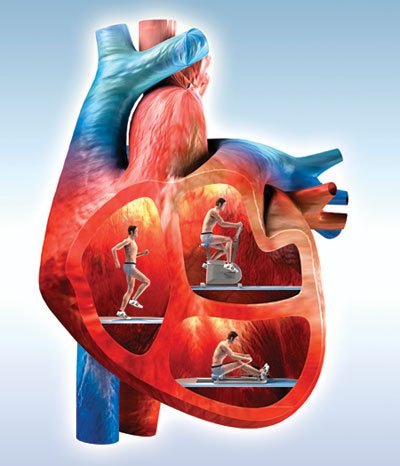
Most people get little vigorous exercise either at work or during their leisure time. We travel by car, bus, or train, and at the end of the day we flop down in front of the TV. There is now a lot of evidence that regular exercise of low or moderate intensity, done on a regular basis (daily if possible, four to five times a week otherwise), can reduce the risk of getting heart disease.
Activities that benefit the heart include walking, climbing stairs, gardening, housework such as making the beds or vacuuming the stairs (and not just wafting a feather duster), dancing or using home or gym exercise equipment. Increasing your exercise to be more vigorous helps further improve your heart and lungs – brisk walking, cycling, and swimming, skipping or running (jogging) are examples of easy exercise that can become part of your everyday lifestyle.
Throughout this book the importance of exercise for the heart has been stressed. It really does help to be fit. If you find it a struggle to exercise on your own, get the whole family to join in and be supportive.
Otherwise, try the following ideas.
• Join a sports or leisure club.
• Do any exercise that you enjoy.
• Try a new sport such as golf.
• Clean your car yourself, not in a car wash.
• Get working in the garden if you have one – 30 minutes in the fresh air digging or weeding is excellent exercise.
• Go swimming with a friend or relative.
• Get the bicycle out of storage; have it serviced if necessary, and buy the right safety kit; try it out on a quiet road at first if you don’t feel confident.
• If you have an exercise bicycle, stop hanging clothes on it and start using it.
• Don’t give up – every little helps.
• Keep working at it.
• Always be positive.
Remember that exercise should be enjoyed, not endured. You should be able to find some form of exercise that you really enjoy.
Why will exercise do me good?
There are many reasons why exercise is so good for everyone:
• It will help you lose and maintain your optimal weight.
• It increases your ‘good’ cholesterol (HDL).
• It helps smokers stop smoking.
• It lowers blood pressure and thus helps prevent heart disease.
Physically fit people are usually psychologically fit also. Fit people feel better, live longer, and have less heart disease and diabetes. They also sleep better and handle stress better.
What types of exercise are good for the heart? I have been doing weight lifting for years – is it of any help to my heart?
Activities that involve movement (walking, cycling, and swimming) are known as dynamic or aerobic exercise and these are the ones that benefit the heart. Aerobic means that the body uses oxygen to deliver the energy that you need for the activity that you are performing. Aerobic exercise for at least 30 minutes four or five times a week will strengthen your heart and help to reduce your chance of developing coronary artery disease.
Weight lifting is a form of static exercise, also known as isometric or akinetic exercise. This does not help the heart and can put on unnatural strain on it by raising your blood pressure. Other examples of static exercise are pushing a car that won’t start, lifting heavy bags without help, moving furniture on your own – you know that with a big effort you can do it, but if you wait for help there will less strain on your heart.
Building up your muscles without dynamic exercise may make the outside of your chest look good but it will not help the heart inside. Those ill-advised people who take steroids can actually damage their heart because steroids sometimes weaken the heart muscle so that it becomes flabby. Anabolic steroids can cause the blood to clot more easily and a heart attack becomes more likely.
I’ve read about exercise and there is often a mention of METs – what are they?
AMET is short for ‘metabolic equivalent’. This is a measure of the work the body does when exercising – the more you work at exercise, the more METs you use. Sitting watching the TV equals 1 MET, walking will use up to 5 METs depending on how brisk it is, and running will use even more. When we exercise we achieve our personal limit depending on how fit we are, and this is known as our ‘functional capacity’. As our fitness improves, so does our functional capacity.
If I’m fit why should I quit smoking as well?
No risk factor works on its own. Getting fit goes along with losing weight, not smoking, avoiding fatty foods and moderating alcohol. If you smoke you are three times more likely to get coronary artery disease. Smoking is a bigger cause of heart disease than lack of exercise. So if you are super fit but smoke 10–20 cigarettes a day, the smoking will win the argument and you will lose out – being fit does not allow you to smoke.
I am now 51 and made a resolution on my 50th birthday to take exercise regularly. I found that my good intentions fell away after 3 months when I was ill for a week with flu. What do you suggest might help now?
First of all it is important not to exercise when you are ill, so you did the right thing when you had flu. Start again with a practice walk for about a mile, going slowly, then try and reduce the time that this length takes. Keep a record. If you walk on a footpath by a roadway, you can measure the distance using a car; if you walk in the countryside, select a path where the distance is shown.
If you walk for 1 mile at 2 mph, you will take 30 minutes and use up 2.5 METs, which isn’t much effort but it is an important beginning. At 3 mph it will take you 20 minutes and use 3.5 METs; at 4 mph it will take 15 minutes and use 4.5 METs. When you are walking fast and just out of breath, fitness will be achieved for the over-40s at about 5 METs for men and women – this is equivalent to walking 2 miles in 30 minutes.
Activities and their metabolic equivalents
Activity – METs
Aerobics
Low impact – 5
High impact – 7
Badminton- 4.5
Bowling – 4
Cycling
< 10 mph – 4
10–12 mph – 6
> 12 mph – 10
DIY (e.g. wallpapering) – 4–5
Football – 8
Gardening (e.g. digging) – 3–5
Golf – 4–5
Horse riding (trotting) – 5–7
Housework (average) – 2.5
Scrubbing floors – 5.5
Playing the piano – 2.5
Office job – 1.5
Sex (‘normal’) – 2–3
Sex (‘vigorous’) – 3–6
Skiing
Downhill racing – 8
Leisure – 6
Squash – 12
Swimming
Fast – 10
Moderate – 8
Light – 6
Butterfly – 11
Table tennis – 4
Tennis – 8
Walking (1 mile in 20 min) – 3
I’m over 60 and have never really taken exercise properly, though I live an outdoor life. Am I too old to exercise now?
Age should not be a limitation to anybody starting to take exercise although it is better to have exercised throughout your life. Exercise will keep you feeling and looking younger longer. If you haven’t exercised before or are starting again after a long gap, just remember to build up gradually. Always check with your doctor first, if you are at all uncertain as to whether a particular form of exercise is suitable for you.
I am going to start an exercise routine. How will I be able to work out how many calories I use up?
This depends on the type of exercise you take and for how long.
• If you walk at 3 miles an hour (about normal walking speed), you will burn up 320 kcal per hour.
• If you walk at 4.5 mph (pretty fast, almost a jog), this goes up to 440 kcal per hour.
• If you cycle at 6 mph, you will burn 240 kcal per hour.
• If you swim 25 yards (a length of most swimming pools) in a minute, you will burn 275 kcal per hour.
The fatter you are, the more you burn, and you burn more if you exercise for longer rather than faster; for example cycling at 12 mph burns 410 kcal per hour not 480.