Requiem – A Short Film About Teen Suicide
Suicide
Suicide is a tragic event and leaves the family with lots of unanswered questions.
How often does depression lead to suicide?
Suicide is sadly sometimes the outcome of depressive illness. Some people can be terminally ill with their depression. No matter what the person tries to do, to overcome their illness, no matter what help and care relatives and friends give, and no matter how skilled the medical intervention, some people will killthemselves. Suicide is totally final. It is the one solution that offers no other options, no chance for change, no future. Those
left following the suicide of a loved one are left dealing with a huge range of feelings, many of which can never be fully resolved.
How to get help in an emergency
Call Emergency Hotline for general advice on how to get access to health services.
Make an appointment to see your doctor, for medical help, if you need to start talking to someone who may be known to you.
Ask to speak to your doctor urgently, that same day, if you feel like harming yourself.
Ask to see a psychiatrist. Your doctor will usually start the assessment and treatment process. He or she can contact psychiatric help in an emergency.
Ask to speak to a CPN (or other Mental Health Team member known to you). If you are in contact with an MHT, discuss what to do in the event of a crisis. There may be a crisis line number locally, or a Crisis Team. Some people will have a crisis plan.
Call the Samaritans, if you need to talk to someone now about how you feel. (Sometimes a stranger can be easier to talk to than someone you know.)
Call Emergency, if someone is about to, or has already attempted selfharm, or tried to harm another person.
Attend an Accident /Emergency Department, if injuries or an overdose have occurred, or if someone appears unsafe.
Call the police, if there seems to be any risk of violence or injury occurring.
Call the Social Services Emergency Team, if you are concerned about the care or well-being of children. Approved Social Workers will also help when an urgent Mental Health Assessment is needed.
About 5000 people die by suicide in the UK each year. Most will be linked with depressive illness. The suicide rate in the UK is one of the lowest in the world at approximately 11 male deaths per 100,000 and approximately 4 female deaths per 100,000. It ranks sixth as a cause of death. There are many more deaths from heart disease, cancer, chest disease, accidents and strokes. Suicide is most common in elderly, lonely men. The suicide rate in young men is, sadly, increasing rapidly.
What sort of people kill themselves? Is there a stereotype for suicide?
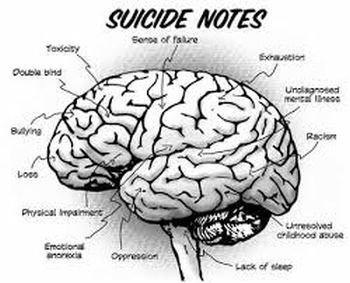
Not really. It is very dangerous to assume that just because someone does not fit stereotypes they are safe. It is estimated that approximately 95% of people who kill themselves are mentally ill, over two-thirds of them will be suffering from depression and about 15% will be suffering from alcohol dependence. Men are more likely to kill themselves than women and they are normally older men – nearly half of the male suicides occur in men over 50 years old. Rates of suicide are highest in the divorced and widowed – especially the recently bereaved. Married people have the lowest death rate. Suicide is more common in the spring. Nobody is really sure why this is. Perhaps the contrast of feeling so bad, when the rest of the world is changing and growing, is particularly painful. Being unemployed and living in the city rather than the country are also risk factors.
Social class has an effect – people in the highest and lowest social classes have increased rates of suicide. It is protective to be in the middle classes. Some professions are particularly at risk, for example doctors, dentists, vets and farmers, and people working in the hotel and bar trade. Strong religious convictions lessen the rate of suicide.
Will asking about suicidal thoughts make things worse for the depressed person?
No. Asking about it can be an enormous relief to someone struggling with suicidal thoughts. It will not encourage them to act on their thoughts. If you think somebody may be thinking about suicide, always ask and always encourage them to seek help urgently. Suicidal thoughts usually evolve fairly slowly. There can be a period of thinking in general terms about death, about how it may seem easier if, on sleeping, they never woke up. Accidents could seem to be ‘lucky accidents’ and a way out. These thoughts can then progress into more concrete plans. At no stage in the development of these thoughts is it too late to intervene and help. Always take statements about wanting to die by suicide seriously. Never assume that, because someone has talked about it, they will not do it.
People who talk about self-harm need to see a doctor; make sure that they do so. Talking to a friend or relative who feels like this is absolutely exhausting. Look after yourself very carefully too.
My daughter took an overdose. and was treated in Casualty. They had to wash her stomach out. It was a really horrible experience for all of us. Does such an awful experience make it less likely that she would do anything so silly again?
The psychiatrist saw her and said she was distressed rather than actually ill. Once people try to harm themselves, once they have gone that far and stepped over the limit that we all have built into ourselves, they are actually more likely to try to harm themselves again if their lives don’t change. The important thing for you to do is to see that your daughter knows she has other ways of letting out her bad feelings. Talking to family and friends can be just as important as seeing a counsellor. Experiences in the Casualty Department are unlikely to stop the behaviour. The underlying difficulties and problems need to be addressed.
How do psychiatrists decide who is really at risk of suicide? How do they tell when an overdose is serious?
We have to regard all overdoses as serious and everybody who takes an overdose, however small and apparently trivial, should be assessed in hospital.
People at risk include those who:
• have a diagnosable psychiatric illness, such as depression or psychosis;
• have had previous attempts at harming themselves;
• have actually caused them some harm;
• have other serious physical illnesses;
• misuse alcohol or drugs;
• have taken precautions against being found;
• have made preparations such as writing letters or notes;
• have made detailed plans;
• have given away possessions;
• have talked repeatedly about suicide;
• tend to be impulsive and aggressive, and
• are lonely and isolated without much social support.
The assessment after deliberate self-harm is an assessment of the balance of risk. All the above factors are examined and weighed up. This assessment is not, unfortunately, infallible.
We were terribly worried about my mother who was very depressed and tried to harm herself. She’s been in hospital for two weeks and already seems much brighter now that she’s started treatment. Does this mean that the risk of suicide has passed?
It is early days, and it’s too soon to be sure that the worst of the risk is over. If she had severe depression, she may improve quite noticeably in the first couple of weeks of treatment, but will not be safe yet. Sometimes getting more energy and drive can actually mean that she is actually at greater risk as she might get enough drive to carry out her wish to harm herself. Talk to the ward staff who are best placed to advise you how she isprogressing. It may be some time yet before they are happy to let her leave the ward, even briefly.
Will somebody who has taken an overdose go on to do it again?
Unfortunately some people will – about 15% will repeat it within the next year. There is more chance of repetition of deliberate self-harm if the episode was not obviously linked to a situational crisis or the use of alcohol or drugs. There is more chance of repetition if the person has few social supports, is in the lower social class and has been separated from a partner. There is an increased risk of repetition if there is a history of psychiatric treatment. It can be difficult sometimes to assess someone following deliberate self-harm. When people are referred to the casualty department, having taken an overdose, their medical state is dealt with and they are made physically safe. There then follows an assessment of their mental state. This is essentially weighing up the balance of risks. Another very important part of the assessment is deciding whether or not the person is currently mentally ill (rather than very distressed, without illness).
My mother had many spells of depression, and finally took a fatal overdose. What can we tell our children?
When somebody dies under tragic circumstances, such as a sudden illness, accident, or worst of all, by their own hand, then the loss is much tougher for everybody to deal with. Suicide is fortunately rare. We know that most people who do kill themselves are indeed suffering from depression (and in this book we repeatedly emphasise how important it is to have depression fully treated, because there is strong evidence that treatment can prevent self-harm and suicide). Sadly, in a small minority of cases, even when depression is treated, a depressed person will attempt self-harm, maybe fatally.
This is the sort of situation where there are no clear guidelines. You certainly won’t want to break this sort of bad news explicitly to a young person unless you are sure that they need to knowabout it – and are able to deal with it. Mature teenagers may want to find out for themselves what actually happened, and may well resent not being told the truth.
Family secrets are difficult things to keep. Very young children may have paid little attention to the loss of their grandmother. Older children and teenagers may have heard details of what happened at the time, or they may well pick up facts later. If you do need to explain to a young person what happened, remember that this will raise all sorts of painful feelings, not least of all anger.
Family may feel deserted or hurt by their dead relative, and may feel guilty or angry about what happened – angry with the deceased person, with other family members, or with themselves. Young people may show this in different ways, by changes in mood or by difficult behaviour. If the time does come when you have to discuss this with your family, emphasise that she had an illness, and that it was the illness that is to blame for taking her life. Remind your family to recall happy times they had together in the past, rather than today’s sadness, and make sure that you are around to give support to each other.
Grieving after bereavement is a natural process that takes time. If difficult feelings are not settling as the months go by, organizations such as Cruse can help the bereaved to resolve their loss.
My father died by suicide. I badly need to talk about it but my brothers won’t discuss it. What can I do?
We know that most people who die by suicide are definitely suffering depressive illness. Alcohol or drug misuse and other mental illness are also causes. Few people kill themselves without being seriously ill in one of these ways. Although your father’s death was caused by an illness, just as directly as heart disease or cancer causes people to die, he has left behind survivors – family and friends – who will carry the scars of what happened to him for the rest of their days. Depression leads people to live increasingly inward-looking lives, with less and less thought about other people. Sufferers may come to overlook the hurt that they will cause the family and act in a way that ignores other people’s feelings. Your brothers are, of course, going to be shocked and distressed by his death, but this sort of death is the most difficult to grieve over. His act of suicide may seem aggressive, a direct attack on the survivors. They may well be angry at what happened: angry at him for doing it, angry at his doctors for not somehow stopping him, and even angry – and guilty – at themselves for not realising how unwell he was.
Death is our last taboo, people will talk about anything else. There is much stigma attached to someone who has committed suicide, and so it won’t be easy to talk about his death outside your family. People grieve in different ways: some express themselves loudly and clearly, others deal with their grief in a quieter and more private way. Neither way is wrong. Perhaps you can make a start with them by saying that you feel angry too. If they are not ready to talk yet, do seek help for yourself from Cruse, the voluntary group skilled at helping the bereaved.
Every day I chose, sometimes gamely, sometimes against the moment’s reason, to be alive. Is that not a rare joy?