Spending Sprees in Bipolar Disorder
Mental Capacity and Mental Illness Factsheet

I have recently been diagnosed with bipolar disorder. What are the risks my children will inherit it?
The lifelong prevalence worldwide is anywhere from 0.3 to 1.6% for bipolar I disorder and larger for bipolar II disorder, with rates adding an additional 0.5 to 4% to the total number, depending on the epidemiological study. Thus, regardless of one’s background, this is the risk for the development of the disorder. Now, supposing you have the diagnosis of bipolar disorder, how much greater is the risk to your child? We know that bipolar disorder, especially bipolar I disorder, has a major genetic component, with evidence coming from several studies. First-degree relatives-that is, immediate family members who share 50% of your genes (siblings and children)-are around seven times more likely to develop bipolar I disorder than the general population. Additionally, the offspring of a parent suffering from bipolar disorder have a 50% chance of having another psychiatric disorder, independent of their chances of having bipolar disorder. Identical twin studies demonstrate a concordance rate of 33% to 90%, depending on the study. That is, if you have bipolar disorder, the likelihood of your identical twin having the disorder is between 33% and 90%. For nonidentical twins, the concordance rate is between 15% and 20%. For first-degree relatives-that is, brothers and sisters who are not twins or children of parents who suffer from the disorder-the concordance rate is between 5% and 10%. Adoption studies demonstrate that the risks of developing bipolar disorder follow those of the biological parent and not the adoptive parent.
Schizophrenic, schizoaffective, and manic syndromes appear to share genetic risk factors, suggesting that bipolar disorder is more akin to a psychotic disorder than a mood disorder.
The fact that there is not 100% concordance between identical twins demonstrates, however, that environmental influences still have a role in the development of the disorder. Environmental effects can mean anything non-genetic, from local chemical environmental effects on the gene, to more global biological effects like fetal exposure to some as yet unidentified substance, to what are more commonly thought of as environmental factors such as family and social circumstances. If a patient has negative family and social circumstances, environment is considered more of a trigger than an actual cause, and any genetic vulnerability may be either protected by a stable environment or, more typically, provoked or precipitated by an unstable environment. Putting together genetic and environmental factors as contributors to the onset of bipolar disorder means that with a family history, an individual has a higher relative risk than anyone in the general population for developing bipolar disorder.
Stressful life events, specific environmental circumstances, or certain psychological processes may serve as a trigger of a manic episode in someone with a genetic predisposition for the disorder.
Is there a link between epilepsy and bipolar disorder?
Questions about a possible link between epilepsy and bipolar disorder naturally arise due to the fact that anticonvulsants also treat bipolar disorder. From a historical standpoint epilepsy was first thought to be a purely mental or psychological disease, although at that time neurologists were the only specialists who treated both neurological as well as psychiatric conditions, and most medical people felt that psychiatric disorders were fundamentally neurological in origin.
Toward the end of the nineteenth century, epilepsy was beginning to be regarded as a distinct phenomenon, and controversy developed as to whether hysteria, a psychological condition, was actually due to epilepsy or to childhood trauma. Jean-Martin Charcot, a prominent neurologist in France, weighed in on the side of epilepsy, though he was most famous for his studies on hysteria utilizing hypnotism. His clinical picture of hypnotism was similar to the clinical picture he had previously developed for epilepsy. He believed that hypnotism demonstrated that hysteria was a form of epilepsy because it presented with the three clinical stages of catalepsy, lethargy, and somnambulism.
Catalepsy is a type of sudden paralysis, and somnambulism is sleepwalking. Another neurologist, Sigmund Freud, who first began developing his theory of hysteria as having roots in childhood, disagreed. Ultimately Freud’s arguments carried the day. Although Freud and Charcot both believed that all mental diseases were brain diseases, Freud’s writings ultimately led to the development of psychotherapy for all mental illnesses and the brief historical abandonment of biological causes of mental illness.
Research has increasingly demonstrated that the incidence of neurobehavioral disorders is higher in patients with epilepsy than in the general population. The link between neurobehavioral disorders and a particular type of epilepsy known as temporal lobe or complex partial seizures is particularly strong. The underlying mechanisms or causes of bipolar disorder share many similarities with epilepsy. As in epilepsy, the more episodes that occur in a bipolar disorder patient early in the course of the disease, the more frequent and severe later episodes will be. This is thought to be due to a well-known phenomenon called kindling. Kindling is defined as seizures provoked by repeated stimulation of the brain that require less and less intensity. In animal studies a particular stimulus that once required great intensity can thus be extremely faint after kindling to provoke the same level of seizure. The seizure threshold is then considerably reduced. Kindling may also explain why the levels of stress that can precipitate a manic episode in a particular individual often become reduced over time.
Additionally, anticonvulsant agents play an important role in the treatment of bipolar disorder. They affect the same neurotransmitter systems thought to play a role in both conditions-namely, the GABA/glutamate neurotransmitter systems. GABA is the brain’s major inhibitory neuron, suppressing or dampening brain activity through nerve cell membrane stabilization. Glutamate is the major excitatory neurotransmitter serving to activate brain activity. Seizures can then occur by relative decreases in GABA or increases in glutamate causing large segments of neurons to fire asynchronously or haphazardly. This leads to not only motor disturbances but sensory and mental disturbances as well.
I have recently been diagnosed with depression, but I have a family history of bipolar disorder. What is my risk of becoming manic if I take antidepressant medication?
Part of a comprehensive mental health evaluation involves a detailed past personal psychiatric history as well as a family psychiatric history. The family psychiatric history is important because many psychiatric conditions have a heritable component and can inform the clinician as to risks for certain conditions. Although bipolar disorder is known to have genetic links, a family history of bipolar disorder does not automatically rule in bipolar disorder in a person presenting with a major depressive episode. In the absence of a personal past psychiatric history of mania or hypomania, bipolar disorder is not diagnosed. That said, bipolar disorder can present with depression first and must always be considered even in the absence of family history of bipolar disorder. The presence of bipolar disorder in the family history increases the risk for the condition in a given individual, and it also increases the risk for mood disorders in general-not only bipolar disorder. In addition, the risk level needs to be kept in perspective. Although there are known heritable conditions that are either dominant or recessive, and present with a very specific risk (e.g., 50% chance of Huntington’s chorea being acquired if one parent is afflicted), the risk for developing bipolar disorder, let alone any mood disorder, cannot be so precisely defined.
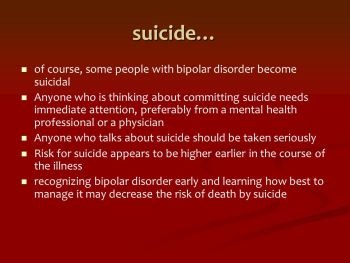
In such a situation, the risk of taking antidepressant medication has to be balanced against the risk of not taking it. In the case of moderate to severe depression, the risk of not taking the medication can include suicide, in addition to the consequences of significant functional impairment at work, home, and so forth.
Such a risk would likely outweigh the risk for becoming manic and thus would warrant an antidepressant trial. This situation would, of course, especially require very close follow-up with a psychiatrist and may warrant that certain safeguards are put in place (e.g., a family member could monitor for signs of mania, with a specific plan for such an occurrence). As with a documented history of mania or hypomania, the psychiatrist may consider use of a mood stabilizer in conjunction with an antidepressant; however, the side effects and risks of taking a mood stabilizer, when in fact it may not be necessary, likely do not outweigh the risk for becoming manic on an antidepressant. Discuss the variables involved with your psychiatrist.
Terms:
Relative risk – a ratio of incidence of a disorder in persons exposed to a risk factor to the incidence of a disorder in persons not exposed to the same risk factor.
Catalepsy – a condition that occurs in a variety of physical and psychological disorders and is characterized by lack of response to external stimuli and by muscular rigidity, so that the limbs remain in whatever position they are placed.
Somnambulism – sleepwalking.
Kindling – changes that occur in the brain as a result of repeated intermittent exposure to a sub threshold electrical or chemical stimulus (such as in seizures) so that there develops a permanent decrease in the threshold of excitability.