Angiogenesis: How Cancer Grows and Spreads
Cancer Can Grow Unpredictably
Although cancer appears to develop in an organized fashion when viewed from the outside, if we were to go inside a tumor with a little magnifying glass and monitor the movement of cells and the integrity of DNA, we would see a much more chaotic situation.
When the first cancer cell duplicates itself to make two cells, it also duplicates its DNA, which gets passed on to its offspring. As two cells become four and so on to generate the billionth cancer cell, the same DNA is duplicated over and over again (remember, a one-centimeter growth contains a billion cells). BUT (this is an important but!), DNA does not remain exactly the same over the lifetime of a cancer.
As a cancer develops and grows, the DNA that guides it along is prone to change. Although the billionth cell is quite similar to the first cell (and would look the same to the pathologist under the microscope), its DNA may have more mutations than the first cell; because DNA determines the functions of every cell, the billionth cell may have different physical properties than the first cell. Thus, as a cancer grows, its genetic makeup becomes diversified, which leads to a diversity of cell types within it. I imagine most readers will be surprised to learn that cancer is not a collection of identical cells.
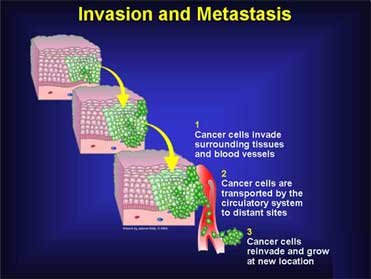
The tendency of a cancer to generate cells with different capabilities explains many of the dreadful aspects of cancer that patients find so hard to grapple with: why it can spread from one location to another, why it stops responding to a treatment that was working, and why it can return when it was in remission. The reason is that every cancer, whether it arises in the lung, breast, prostate, bone marrow, fat, or elsewhere, contains different populations of cells that have distinct properties.
Stated another way, the growth of a cancer from one mutant cell is not like putting the original cell on a photocopier, setting the copy number to one billion, and walking away. A cancerous tumor, in fact, does not contain billions of identical clones. Cancer could never develop in this way because it must avoid the immune system’s attack on it, live in areas of low oxygen tension, and compete with the rest of the body for vital nutrients. As these conditions change in the body, a cancer must adapt; if it fails to adapt, it is eliminated.
Inside any tumor are cells that are living and cells that have died. There are cancer cells capable of reproducing many others, called cancer stem cells, and cells completely devoid of this capacity. Cancer’s diversity is generated early. By the time it is diagnosed, some cells may already be capable of metastasizing and others may be able to withstand a particular cancer treatment. This is the basis of cancer’s resistance to treatment.
The most critical yet under-discussed property of cancer is its propensity to change and generate cells with different properties.