We have heard that if our daughter is as heavy as a baby, she will never escape being heavy. Is this true?
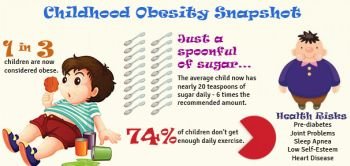
This is true in many children. Currently, a large ongoing study from the United Kingdom, called the Early Bird Study, has shown that between 75% and 90% of the excess weight in children is acquired before they start school that is, before age 5, or so. If they are heavy at this young age, the data show that they are likely to be heavy at age 9 and even later. This may be partly due to some earlier suggestions that babies born with low birth weights were at greater risk of becoming diabetic. Parents were thus encouraged to feed their babies with the aim of increasing the child’s weight to prevent diabetes. Work now suggests that this is not the case. More recent studies indicate that excess weight produces insulin resistance, which could be a cause or precursor of diabetes mellitus. This is called the “accelerator hypothesis.” Many researchers are now suggesting that a major effort be put into making sure that children are not heavy when they enter school.
Sandy’s mother:
Sandy is 4 years old and she’s adorable but a bit pudgy. She’s 3-feet 2-inches and weighs 55 pounds. The doctor said that she’s overweight but not obese but is afraid that she may become obese. He said she’s already over the 95th percentile. She’s adorable and is a wonderful kid, though she cries and can throw a tantrum if we don’t give her the food she wants. Her brother Tommy, who’s 7, is not overweight, and we never had eating issues with him. We’ve tried to do the same for Sandy as we did for Tommy, but she just won’t cooperate. So we’ve sort of given in and do let her eat candy and cookies more than we should. We do give her fruit and vegetables, but she won’t eat them unless we cut up the fruit and add sugar or syrup. The doctor wants us to be more careful about what we feed her, and I guess we’ll have to do that but the tantrums are a real problem.
But isn’t being obese normal? It seems almost everyone is heavy today.
Some data (published in the British Medical Journal) suggest that parents are less aware of obesity in both themselves and their children. That is, there is a perception now that being heavy is the norm in society and that there is nothing wrong with it. Why is this? There is no clear answer, but the speculation is that because so many people are overweight, we are seeing a combination of denial and desensitization to it.
Not surprisingly in America, there is now something of pushback to the views expressed by the medical establishment and health agencies against the “epidemic of obesity.” This is manifest as the “fat pride” or “fat acceptance” movement. Online blogs and websites are aimed at denying that obesity is as bad as conventional wisdom has it. Some claim that data show that it is better to be an active obese person (a “fit fatso”) than a nonactive normal-weight person (a “sedentary skinny”). Society, it is argued, is adjusting to this normalization with such things as shops aimed at “big” or “large” people as well as government policy now accepting obesity and, in some cases, declaring it to be a disability for which accommodations must be made. Although people should not be discriminated against, made fun of, avoided, or punished for being heavy, medical evidence overwhelmingly suggests that being too heavy is unhealthy, as noted throughout this text and elsewhere. Although some people may indeed be overweight and live to a ripe old age with few health problems-just as some three-pack-a-day smokers or heavy drinkers can also live to old age with few problems-this is not the usual case. One can never know in advance who the “lucky” ones will be. The wise course is to keep one’s weight down (and not smoke or drink too much).
Can any medical diseases cause obesity?
Yes, some diseases-primarily metabolic ones can cause a child to gain weight. Diseases such as hypothyroidism (low thyroid function) and growth hormone deficiency can cause excess weight. Certain drugs (such as certain psychiatric drugs or steroids, whether legal or street drugs) can also cause obesity, but these are unusual in children. Your child’s doctor will be able to test for these.
I have heard that viruses can cause obesity. Is that true?
There are data suggesting that adenovirus-36 may play a role in some cases of obesity. One study noted that approximately 30% of obese people had evidence of an adenovirus-36 infection at some point in their life compared with only about 10% of nonoverweight controls. When this virus is purposely given to monkeys, they gain weight. There is evidence suggesting that the virus can cause some stem cells to change into cells that hold much more fat than before. The researchers also found a gene in the virus E4 ORF-1 that may be responsible for the change. When this gene was blocked, the change did not occur. Adenoviruses are a class of viruses that produce various human diseases, including respiratory infections. Some researchers also speculate that a vaccine might be possible against one or more of the viruses to prevent their infections. Others, however, are sceptical of the possibility that obesity is an infectious disease. Research continues.
Terms:
Hypothyroidism – Decreased thyroid function. This can produce weight gain, low energy levels, anaemia, constipation, dizziness, hair loss, irregular menses, and other problems.
Stem cells – Cells in the body that are capable of transforming into different, specialized cells upon certain stimuli.
Adenoviruses – A group of viruses that affect mainly children. They can produce gastrointestinal and respiratory infections as well as urinary and eye infections.
Currently, a large ongoing study from the United Kingdom, called the Early Bird Study, has shown that between 75% and 90% of the excess weight in children is acquired before they start school that is, before age 5, or so.