Haemoglobin A1c and fructosamine
When I last went to the clinic, I had a test for haemoglobin A1c. What is this for and what are the normal values?
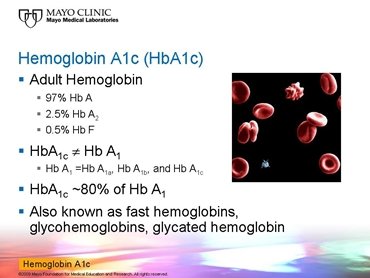
Haemoglobin A1C is a component of the red pigment (haemoglobin A; HbA) present in the blood to carry oxygen from the lungs to the various organs in the body. The HbA1c can be measured as a percentage of all the haemoglobin present with a variety of laboratory methods. HbA1c consists of HbA combined with glucose by a chemical link. The amount of HbA1c present is directly proportional to the average blood glucose during the 120-day lifespan of the HbA-containing red blood corpuscles in the circulating blood.
It is the most successful of all the tests so far developed to give an index of diabetes control. The blood glucose tests, which we have used for many years, fluctuate too erratically with injections, meals and other events for an isolated sample taken at one
clinic visit to provide much information about overall control.
HbA1c averages out the peaks and troughs of the blood glucose over the previous 2 to 3 months.Normal values vary a little from one laboratory to another and this can be a source of confusion as results from different clinics cannot be compared directly without the normal range known for each particular laboratory.
Normal values usually run between 4.5% and 6.1%, but you must check the normal range for your own laboratory. In someone with poorly controlled diabetes, or in whom diabetes is recently diagnosed, the value of HbA1c may be as high as 15%, which reflects a consistently raised blood glucose over the preceding 2 to 3 months. On the other hand, in someone with perfect control, the HbA1c will be in the normal range of 4.5–6.1%, while in someone who runs blood glucose levels too low owing to taking too much insulin, the value will be subnormal, i.e. below 6%
Recently HbA1c has replaced HbA1 as the preferred terminology. It refers to a subcomponent of HbA1, which most closely represents the indicator of average blood glucose level over two months.
I’ve just had a fructosamine test but I didn’t like to ask what this was for. What is this test?
Fructosamine is the name of a test that is similar to that for HbA1c in that it is an indicator of the average level of glucose in the blood over a period of time, in this case the 2 to 3 weeks before the test is done (compared with the preceding 2 to 3 months for HbA1c). It measures the amount of glucose linked to the proteins in the blood plasma (the straw-coloured fluid in which the red cells are suspended): the higher the blood glucose concentration, the higher will be the fructosamine. Its advantages are that it is usually quicker and cheaper for the laboratory to do. The normal values may vary from one laboratory to Monitoring and control another depending on the way the analysis is performed; in general, a value of less than 300 micromol/litre is a typical laboratory’s normal value. In order to make sure you don’t get confused, we suggest that you pay particular attention to what is done in your clinic; please don’t hesitate to ask and make quite sure you do know what is going on!
Will this test have to be done regularly?
Like HbA1c there is no point in doing them too often; we normally recommend doing one routinely at the time of each clinic visit. If metabolic control is under close scrutiny and treatment is being adjusted, for example in pregnancy, then it may be sensible to do one more often to check that things are going according to plan.
I am 25 years old and have had diabetes since I was 15. I have been attending the clinic regularly every 3 months and do regular blood glucose tests at home with my own meter. At my last clinic visit, the doctor I saw said that he did not need to see me again for a whole year because my HbA1c was consistently normal – why did he do this?
It sounds as though your specialist has great confidence in you and your ability to control your diabetes. As long as you can keep it this way, he clearly feels that seeing you once a year is sufficient. He can then spend more time with other people who are not as successful as you are.
I am treated only by diet. I find it very difficult to stick to my diet or do the tests between the clinic visits but I am always very strict for the few days before I am seen at the clinic and my blood glucose test is usually normal. At my last clinic visit my blood glucose was 5 mmol/litre but the doctor said he was very unhappy about my control because the
HbA1c was too high at 10% – what did he mean?
Your experience demonstrates the usefulness of HbA1c testing, because you have been misleading yourself as well as your medical advisers about your ability to cope with your diabetes.The HbA1c has brought this to the surface for the first time. Because the HbA1c reflects what your blood glucose has been doing for as long as 2 to 3 months before your clinic visit, your last minute attempts to get your diabetes under control before you went to the clinic were enough to bring the blood glucose down but the HbA1c remained high.
My recent HbA1c was said to be low at 6%. Blood glucose readings look all right, on average about 5 mmol/litre. The specialist asked me to set the alarm clock and check them at 3.00 am – why is this?
A low HbA1c suggests that at some stage your blood glucose levels are running unduly low. If you are not having hypoglycaemic attacks during the day, then it is possible that they are occurring at night and you are sleeping through them. By doing 3.00am blood glucose tests you should be able to determine whether this is so. Incidentally, you will only have to do these middle-of-the-night tests until you have established whether or not you are having hypos at night – they are not going to be a permanent part of your routine!
My diabetes is treated with diet and gliclazide tablets. By strict dieting I have lost weight down to slightly below my target figure and all my urine tests are negative. My HbA1c test, I am told, is still too high at 9% and does not seem to be falling despite the fact that I am still losing weight. I could not tolerate metformin and am very strict over what I eat. At the last clinic visit the doctor said that I am going to have to go on to insulin injections. I have been dreading these all my life – is he right?
The high HbA1c means that your average blood glucose result is not well controlled and it sounds very much as if you have reached the stage where you need more than gliclazide and diet to keep your diabetes under good control. You could try an additional tablet such as rosiglitazone but, if this fails, you will need Monitoring and control to move on to the next stronger form of treatment, which is insulin injections. You have been given sound advice and we are sure that it will not turn out to be as bad as you imagine. Once you have got over the initial fear of injecting yourself, which most people manage very quickly, you will probably feel a great deal better and it will all have been worthwhile.