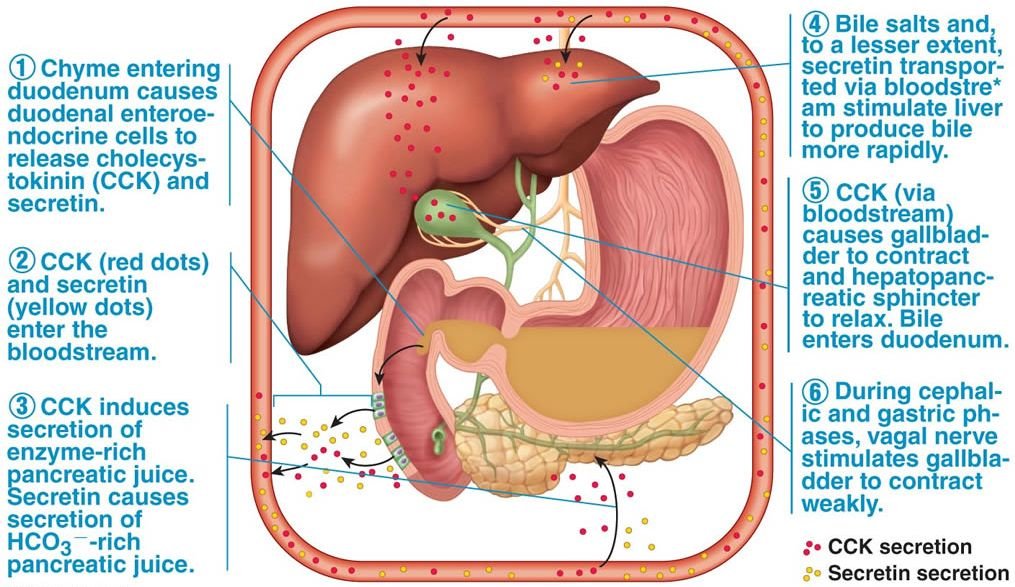
Most Digestion and Absorption Occur in the Small Intestine
The small intestine is a long, narrow, coiled chamber in the abdominal cavity. The “small “in “small intestine “refers to its diameter, not its length, which accounts for about 20 of the 23 feet of the GI tract. It consists of three segments-duodenum, jejunum, and ileum-and extends from the pyloric sphincter to the beginning of the large intestine.
The first segment, the duodenum, is approximately 10 inches long. The second area, the jejunum, is about 8 feet long, and the final region, the ileum, is about 12 feet long. The small intestine is actually the primary organ for digestion and absorption within the human body. The small intestine has tremendous surface area compared with the stomach, and its digestive secretions do most of the work when it comes to breaking down food into absorbable nutrients. Both mechanical and chemical digestion occurs in the small intestine. Mechanical digestion occurs through peristalsis, segmentation, and pendular movement. You already know that peristalsis is a mechanical, muscular movement that helps propels the contents through the GI tract.
Segmentation is a “sloshing” motion that thoroughly mixes the chyme with the chemical secretions of the intestine. Pendular movement is a constrictive wave that involves both forward and reverse movements and enhances nutrient absorption. Together, these three actions move the chyme through the small intestine at a rate of 1 centimeter per minute.12 Depending on the amount of food and the type of food consumed, the contact time in the small intestine is about 3 to 10 hours.13 Chemical digestion in the small intestine occurs as enzymes in intestinal secretions continue to break down nutrients to prepare them for absorption. All macronutrients-carbohydrates, fats, and proteins-are broken down into their component parts by their specific enzymes.
Vitamins and minerals are absorbed intact. This process of chemical breakdown and absorption can be interrupted. For example, the weight-loss drug orlistat, sold over the counter as Alli, interferes with the chemical digestion of fat. The interior of the small intestine is covered with thousands of small projections called villi. The villi increase the surface area of the small intestine’s lining and mix the partially digested chime with the intestinal secretions. Each individual villus is adjacent to a cluster of blood capillaries, lymph vessels, and nerve fibers.
The villi are covered by even smaller projections called microvilli, which provide additional surface area through which nutrients are absorbed into the blood and lymph. The lining of the small intestine is also arranged in unique, circular folds, which further increase the absorptive surface area. The circular folds cause the chyme to spiral forward through the small intestine, rather than merely move in a straight line.
There are more microorganisms than human cells in your body, and many of them are located in your large intestine.
The Large Intestine Absorbs Water and Some Nutrients
Once the chyme has passed through the small intestine, it comes to the ileocecal sphincter, which serves as the gateway to its next digestive destination, the large intestine. The primary purpose of the ileocecal sphincter is to prevent backflow of fecal contents from the large intestine into the ileum. In general, this sphincter is quite strong and resists reverse pressure. About 750 milliliters (approximately 3 cups) of unabsorbed residue enters the large intestine each day. The slow entry of this residue from the small to the large intestine enables the body to maximize nutrient absorption.
By the time food enters the large intestine, it has been digested and the majority of the nutrients have been absorbed. But the large intestine serves some important functions, including the absorption of water, production of a few vitamins, absorption of important electrolytes, and the formation and storage of fecal material.
The large intestine is about 5 feet long and 21⁄2 inches in diameter. It looks and acts much differently than the small intestine in that it does not contain villi or microvilli, and is not tightly coiled. Further, the large intestine does not secrete or use digestive enzymes and hormones. Rather, the chemical digestion that takes place in the large intestine is due to the efforts of bacteria.
The large intestine produces mucus that protects the cells and acts as a lubricant for fecal matter. The cells of the large intestine absorb water and electrolytes much more efficiently than do the cells of the small intestine.
Final organ of the GI tract. It consists of the cecum, appendix, colon, and rectum. There are three segments of the large intestine: the cecum, colon, and rectum. The cecum is a small, pouch like area that has the appendix hanging from one end. The middle section, or colon, is the largest portion of the large intestine.
(Note that though the terms “colon” and “large intestine” are often used interchangeably, they’re not technically the same thing.) The colon includes the ascending, transverse, descending, and sigmoid regions. These regions are relatively long and straight.
Most of the vitamin production and absorption of water and electrolytes occur within the first half of the colon. The last half of the colon stores fecal matter. The colon receives about l liter (about 1 quart) of fluid material each day from the cecum, consisting of water, nondigested or unabsorbed food particles, indigestible residue, and bacteria. It slowly and gently mixes these intestinal contents and absorbsthe majority of the fluids presented to it. The colon gradually produces a semisolid material that is reduced to about 200 grams (about 7 ounces) of fecal matter (stool, or feces). The intestinal matter passes through the colon within 12 to 70 hours, depending on a person’s age, health, diet, and fiber intake.
Bacteria in the colon play a role in producing some vitamins, including the B vitamin biotin and vitamin K.16 Bacteria also ferment some of the undigested and unabsorbed dietary carbohydrates into simpler compounds, including methane gas, carbon dioxide, and hydrogen. Similarly, some of the colon’s bacteria break down undigested fiber and produce various short-chain fatty acids.Amino acids that reach the colon are converted to hydrogen, sulfide, some fatty acids, and other chemical compounds.
As in the small intestine, the colon moves contents via peristalsis and segmentation. Peristalsis occurs within the ascending colon, but the waves of contraction are quite slow. The mixing motion of segmentation allows the organ to progressively absorb fluids.
The stool is propelled forward until it reaches the rectum, the final eight-inch portion of the large intestine, where it is stored.When stool distends the rectum, the action stimulates stretch receptors, which in turn stimulate the defecation reflex. This causes nerve impulses of the rectum to communicate with the rectum’s muscles. The end result is relaxation of the internal sphincter of the anus. The anus is connected to the rectum and controlled by two sphincters: an internal and an external sphincter. Under normal conditions, the anal sphincters are closed. Periodically, the anal sphincters will relax, stool will enter the anal canal, and defecation will occur. The final stage of defecation is under our voluntary control and influenced by age, diet, prescription medicines, health, and abdominal muscle tone.
Terms:
Segmentation – A “sloshing” motion that thoroughly mixes chyme with the chemical secretions of the intestine.
Pendular movement – A constrictive wave that involves both forward and reverse movements of chyme and enhances nutrient absorption. villi Projections on the walls of the small intestine that increase the surface area over which nutrients can be absorbed.
Villi – are in turn covered with microvilli, which increase the surface area even more.
Ileocecal sphincter – Gateway between the end of the small intestine and the beginning of the large intestine. The sphincter prevents backflow of fecal contents from the large intestine into the small intestine.
Anatomy of the Large Intestine
By the time chyme reaches the large intestine, most of its nutrients have been absorbed. However, water and some electrolytes are absorbed in the colon. The final waste products of digestion pass out of the body as stool through the anus.
Tinkering with Your Body’s Digestive Process If you’re like a lot of people, you may have considered using a weight-loss aid at some point. One of those aids, Alli, has popped up in many drugstores in recent years. How does this drug work, and will it help you lose weight? Is the potential for weight loss worth the side effects and costs?
Let’s find out. Alli (pronounced al-eye) is the first Food and Drug Administration (FDA) approved, over-the-counter drug containing orlistat. When taken with a meal, orlistat helps prevent some dietary fat from being absorbed into your body.
Orlistat works its magic by preventing enzymes in the intestines from breaking down dietary fat. If the fat isn’t broken down, your body can’t absorb it, and it will pass through the GI tract and be eliminated in stool. Alli blocks the absorption of about 25 percent of the fat at a meal. If you are taking Alli and eat a slice of pepperoni pizza containing 189 calories from fat for lunch, you will only absorb about 140 of them.
Since fat-a hefty source of calories-isn’t absorbed by your body, your body can end up with significantly fewer calories to potentially store as body fat. Unfortunately, because this unabsorbed fat has to be eliminated from your body, there may be some not-so pleasant side effects, including oily spotting, gas with discharge, the feeling of having to go to the bathroom immediately, fatty/oily stools, and frequent bowel movements. Interestingly, because these side effects are so unpleasant, they may actually help an individual adhere to a well-balanced, low-fat diet (approximately 30 percent of calories from fat) when taking the drug. Orlistat taken with a very high-fat meal will make these side effects more pronounced.
Orlistat also reduces the absorption of some fat-soluble vitamins as well as beta-carotene. Consequently, individuals taking the drug are advised to take a supplement that contains the at soluble vitamins A, D, E, and K and the antioxidant beta-carotene. According to the FDA, Alli is indicated for obese individuals or for people who are overweight and have other risk factors such as diabetes, high cholesterol, and elevated blood pressure. However, taking the drug won’t let you off the hook when it comes to managing your weight. If you replace the unabsorbed fat calories with excess nonfat calories, such as from sweets, pretzels, and soda, or with hefty snacks between meals, you’ll end up getting nowhere fast. There is also a cost factor. A month’s supply of Alli costs approximately $50.
There isn’t any quick fix when it comes to weight loss. Although Alli has been approved to help those who are obese, in the long term, eating healthfully, changing eating habits and behaviors, and exercising regularly are still, and always will be, the cornerstones and the least expensive methods of long-term weight management-for everyone.