Latest Information on Chemotherapy
How does radiation affect the skin on my breast? Will these changes be a turnoff to my partner?
Radiation therapy may cause redness, dryness, thickening, contractures, or changes in skin colors or texture. Expert sources at WebMD suggest that it is normal for the redness and sensitivity to persist for up to 1 year after therapy.
In addition to being uncomfortable, these changes can affect a woman’s body image and desire to have her breasts caressed during sexual activity. A woman should tell her partner if her breast(s) is uncomfortably sensitive and that she is not avoiding his or her caress.
Some women assume that skin changes will be a turnoff to their partners and thus avoid sexual play that involves nudity and/or touching of the breasts. Remember to explore openly, and never assume a partner’s reaction to breast skin changes. Also, a woman may overestimate the negative impact of skin color and texture changes on her partner’s sexual desire.
Conversely, if skin changes adversely affect the ongoing body image and sexual desire of either partner, the couple can address this in therapy. Your radiation oncologist can suggest medical intervention to lessen the irritation.
Will radiation in the nipple area decrease sensation and arousal?
Each woman reacts uniquely to radiation therapy. During therapy, some women might experience slight stinging and flakiness in the nipple. Some complain of nipple hypersensitivity, whereas others experience hyposensitivity. Communicate with a partner about any changes in nipple sensitivity. Remember that how the nipples feel immediately after radiation therapy may be different after time has passed.
If after recovery you have experienced decreased sensitivity in the nipple area, some sexual interventions can be used. Dr. Krychman and Dr. Kellogg Spadt have implemented Zestra Feminine Arousal Fluid (Semprae Laboratories), which increases sensual sensation after it is applied. Apply this fluid daily to the nipples to improve sensitivity and feeling. Excellent clinical results have been seen. Understanding what feels good and what doesn’t are also important.
Maintain your intimate connection to your body. Sexual exploration, even after treatment, is important. Your sexual experience may be always changing.
Magnolia Myrick:
I find the nipple on the breast where I had surgery is more sensitive, and not necessarily in a good way. The breast itself is more sensitive and a little painful at times, and I ask my partner to be very gentle there. When I asked a doctor about it-this was about a year after diagnosis and surgery-he said it might be because of nerves that were cut during surgery, etc., etc., and then he said, “It’s always going to bother you.” And somehow knowing that makes it bother me less because I’m not as paranoid about every little twitch.
I also restrict my caffeine intake, which I have done since being diagnosed with fibrocystic breasts in my 20s. Caffeine aggravates fibrocystic breast tissue in some women, and I’m one of them. De-caffing definitely helps here. Can’t wait to try Zestra on nipples. Woo-hoo!
When I am receiving radiation therapy, am I radioactive? Is it dangerous to be near my partner?
Women and/or their partners may have unfounded concerns regarding being “radioactive” after radiation therapy. You cannot “catch” radiation, nor is a person “radioactive” after having undergone radiation. Maintain open communication with your partner. Sometimes the silence can be deafening. Often, cancer and its therapies can lead to miscommunication and misinterpretation.
Women and/or their partners may have unfounded concerns regarding being “radioactive” after radiation therapy.
What are the side effects of chemotherapy?
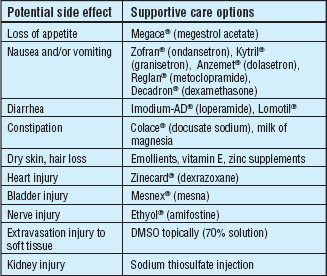
Many agents can cause nausea, diarrhea, and mucus membrane irritation and induce premature menopause (no menstrual periods for 12 months) including hot flashes and vaginal dryness or atrophy. Loss of hair on the head, eyebrows, eyelashes, and hair on the genitals may be distressing and may affect a female’s perception of sexual attractiveness. A smooth genital area is often looked on as prepubescent and unattractive-nonsexual. Chemotherapy-induced early ovarian failure from surgical removal of the ovaries or from adjunctive radiation therapy can cause menopausal symptoms. Hot flashes sleep instability, vaginal dryness, and mood problems also affect desire and arousal. Vaginal dryness can lead to painful intercourse or penetration. Many of these direct and indirect effects from chemotherapy can affect the sexual response cycle.
Healthcare providers are getting better at dosing chemotherapy. Premedication’s can decrease nausea and vomiting; thus, many women who are undergoing chemotherapy do not feel ill, and many want to maintain sexual intimacy even in the face of disease.
Chemotherapy-induced vaginal dyspareunia or chemotherapy-induced painful sex can be a result of certain medications. The chemotherapy drugs kill rapidly dividing cells, including the vaginal lining; thus, some women who are receiving active chemotherapy treatments may suffer from painful sex as a result. Minimally absorbed local vaginal estrogen products, moisturizers, and lubricants may be helpful. Discuss with your healthcare team the best healthcare treatment plan.
Terms:
Menopause -The lack of menstrual cycles for one year; the permanent end of a woman’s menstrual cycle.
Vaginal dyspareunia – Pain in the vaginal area during intercourse.