How to Cool Down and Stretch after a Workout For Dummies
Why should athletes warm up before and cool down after exercise?
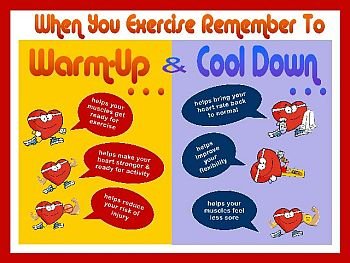
Warming up before exercise and cooling down after exercise are imperative to an athlete, helping to reduce injury, enhance performance, and promote recovery.
Many athletes overlook these stages of exercise, as they do not feel that they have the time or even understand the benefits of warming up or cooling down. To profit from a thorough warm-up and cool-down, an athlete must spend at least 10 minutes before workout and 5 minutes after workout stretching the major muscle groups and joints of the body.
There are two methods of warming up: dynamic and specific.
1. A dynamic warm-up should consist of ten minutes of light exercise that involves the entire body, using both major and minor muscle groups. The warm-up should commence with five minutes of light jogging, stationary cycling, or jumping jacks, followed by dynamic muscle movements. These movements can include walking lunges, backward running, lateral shuffling, one- and two-legged hops, and walking with alternating toe touches. The purpose behind the dynamic warm-up is to increase heart rate and blood flow to the working muscles and joints, raise muscle temperature, improve muscle elasticity and plasticity, and increase respiratory rate and change joint fluid viscosity. As muscle temperature increases, joint flexibility improves, helping to reduce the athlete’s susceptibility to injury.
2. A specific warm-up should consist of five minutes or more of sport-specific movements and stretches that simulate muscle and joint actions of the sport.
For example, a basketball or volleyball player would spend time on his or her shoulder and hip muscles and joints by doing light jumping, spiking, and layup and shooting drills, and a baseball player would concentrate on specific throwing and upper-torso rotational movements. The purpose behind a specific warm-up is to increase functional capacity, improving sport-specific performance. An athlete, whatever the sport, needs to take the time to work on sport-specific warm-ups to ensure maximal efficiency and injury reduction.
After an intense training session or competition, an athlete must take 5 minutes to cool-down properly. The cool-down phase should involve a gradual reduction in the intensity of exercise, followed by stretching (flexibility) exercises. For example, at the end of a workout, a runner should reduce his or her running intensity to a light jog and then to a walk to prevent blood from pooling in his or her lower extremities.
Light jogging and walking after exercise aid in venous return. Venous return promotes blood flow back to the heart and lungs because of the muscles contracting against the veins. This venous return helps the athlete to recover faster and reduces the potential for syncope (decreased blood flow to the brain), which can cause dizziness or fainting.
Athletes of all ages and abilities should take the time to learn and apply warm-ups and cool-downs to their training programs. A warm-up can help to reduce injury, improve performance, and ready the body for the rigors of the sport, whereas a cool-down can help the athlete recover faster and prevent the possibility of lightheadedness and fainting. Athletes need to ensure that the warm-up is not too intense, as it may interfere with their performance by causing premature fatigue. During the cool-down phase, an athlete should bring his or her heart rate down to less than 110 beats per minute to ensure proper recovery.
This is an example of a typical warm-up and cool-down for a baseball player:
A. Dynamic warm-up (10 minutes)
1. Light jogging-100 meters
2. Light jogging with giant forward arm circle-100 meters
3. Light jogging with giant backward arm circles-100 meters
4. Side shuffle with lateral arm raises-100 meters
5. Carioca-100 meters
B. Sport-specific warm-up (5 to 8 minutes)
1. Walking lunges with alternating upper body twists (can use 2- to 4-pound medicine ball)-1 for 50 yards
2. In-place two-legged hops-1 for 30 seconds
3. Opposite leg to opposite hand kicks-1 for 50 yards (switch legs)
4. Light medicine ball (2 pound) throws with partner or wall -1 for 30 seconds (each arm) C. Cool-down (5 to 8 minutes)
1. Very light walking or jogging-2 to 3 minutes
2. Seated hamstring stretches-3 for 20 to 30 seconds each
3. Shoulder stretches-3 for 20 to 30 seconds each
4. Groin stretches-3 for 20 to 30 seconds each
5. Thigh stretches-3 for 20 to 30 seconds, each leg
Terms:
Venous return – The transportation of blood from the cells through the veins back to the heart.
Syncope – A sudden drop in blood pressure that causes dizziness and possible fainting.
After an intense training session or competition, an athlete must take five minutes to cool-down properly.