Smoking Kills (The Bryan Curtis story) – Don`t Smoke
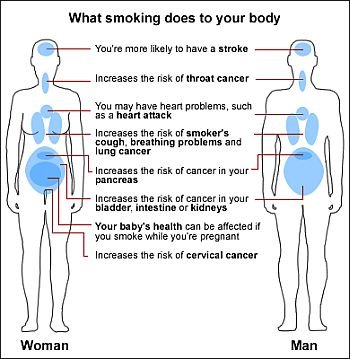
What are my chances of recovery from smoking-related diseases such as cardiac disease, lung cancer, chronic pulmonary disease (including emphysema), and stroke?
It is important to remember that all of these diseases can occur independently of whether or not someone smokes. These diseases are age related, and diet, activity, and exposure to other environmental toxins can contribute to their development.
Never having smoked is no guarantee one will avoid these diseases. Therefore, quitting smoking is no guarantee of avoiding them either. Smoking merely increases the risk and accelerates the course of the disease once someone has developed it. With that in mind, quitting smoking certainly lowers one’s risk and slows down the progress of disease. So the real issue is whether or not quitting lowers the risk back to nonsmokers’ levels.
Cardiovascular Diseases: These are diseases of the heart or blood vessels (arteries and veins). Heart disease kills more Americans than cancer. A six-year follow-up study of people older than 55 years, who were smokers, found that the death rate was significantly higher among smokers who continued to smoke than among those who had quit. It takes anywhere between 5 and 15 years after one quits smoking to lower one’s risk back to that of a nonsmoker.
Lung Cancer: Smoking cessation reduces lung cancer risk by 30% to 50% 10 years after quitting. The risk that you will develop lung cancer decreases with further years of abstinence. The risk of lung cancer is always a possibility though when compared to someone who has never smoked. For example, approximately 50% of all lung cancers are diagnosed in ex-smokers.
Chronic Obstructive Pulmonary Disease, Including Emphysema:
Chronic obstructive pulmonary disease (COPD) is a term for a group of lung conditions that restrict airflow, making breathing difficult.
The conditions include:
• Emphysema: breathlessness caused by damage to the air sacs (alveoli) causing them to become less elastic.
• Chronic bronchitis: coughing with a lot of mucus that continues for at least three months.
Smoking is the most common cause of COPD and is responsible for 80% of cases. Approximately 90% of 1 pack/day smokers have some emphysema on postmortem examination, while more than 90% of nonsmokers have little or no emphysema on postmortem examination. COPD typically occurs after the age of 40, when lung function starts to decline anyway.
In smokers, the rate of decline in lung function can be three times the rate of nonsmokers. As the condition progresses, severe breathing problems can require hospital care. The final stage is death from slow suffocation, which is a progressive loss of the ability to oxygenate the body. The rate of decline may or may not revert to that of a nonsmoker. If lung damage has occurred due to smoking, the damage may never be completely repaired. This means that the lung function will still be diminished compared to someone who has never smoked.
Stroke: A stroke occurs when there is a rapid loss of brain function because of a disturbance in the blood vessels that carry blood to the brain. Strokes can be thought of as brain attacks in the same manner that people suffer heart attacks. The mechanism is the same, except the atherosclerotic buildup is located in the major arteries supplying blood to the brain as opposed to the heart. As a result, the risk of stroke follows the same general pattern as the risk of coronary artery disease. Within a few years after quitting smoking, the risk of having a stroke decreases. The risk of stroke is highest in smokers under age 55 and decreases with age. There is also a dose-response effect between the number of cigarettes smoked and risk of stroke. Researchers have found strong correlations between smoking and thrombotic stroke (slow decrease in blood supply), embolic stroke (sudden release of a blood clot), and subarachnoid hemorrhage (blood leaking from the vessels and pooling in the brain). The relative risk of subarachnoid hemorrhage was significantly higher than that of thrombotic stroke.