Participation as engagement at different levels and in different arenas
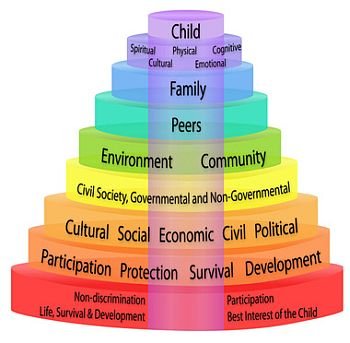
Participation takes place in a range of arenas and at different levels, from inclusion in individual decision making, such as in initial child protection conferences and reviews, to involvement in promoting organisational change at local, regional, national and international levels. The levels of participation involved in these arenas vary both in terms of power sharing between children and adults and with regard to the nature and context of the event. In both individual decision making and in organisational change the effectiveness of participation depends both upon the skills of the practitioners supporting them, and also on the culture and organisation of the officiating body. The two are, of course, interdependent.
Participation as achieving different outcomes
Participation is also aimed at achieving different outcomes, from personal empowerment in individual decision making to organizational change. In these diverse situations, as Sinclair, Wilson and Gibbs (2004) point out, the frequency and nature of the participatory activity will vary widely, as will the children and young people involved. For example, effecting the participation of looked-after children in reviews over a number of years is a very different process from involving children in schools in youth forums, and the outcomes to be achieved will also be different. A positive outcome of children’s engagement in their reviews could be increased self confidence. The outcome of a child’s involvement in a school council could mean that the play space is altered. Unpicking the difference between these participatory transactions and the skills involved is important if we are to understand the dynamics of relationships and organisations that endeavour to promote children’s participation, and to explore what gets in the way.
We use the terms ‘childhood’ and ‘children’ in the way defined by the law – as the period and stage up to age 18, the age of majority. We most commonly talk about ‘children’s’ participation, within which young people are subsumed. However, we are cognisant that there is, as James and James (2004) point out, a danger of using terms such as ‘childhood’, ‘child’, ‘children’, and ‘youth’ as a collective, since each child/young person is unique and his experiences and conditions hugely various. Government legislation and guidance for working with children is written as if these differences did not exist. They do, and they impact profoundly on practitioners’ skills and capacity to involve children in important decisions that affect them. Hopefully the content of these texts does address these issues and takes into account and reflects individuality. Of course, the question of where the boundary with adulthood should be drawn is a tricky one, particularly when considering children’s competence to take part in decision making. In determining their competence, three factors are key: age, ability and culture. For example, in considering whether or how to involve a child in a child protection conference, age is significant. On the face of it a 16-year-old may present her views clearly and be less disturbed by what she hears than would a 9-year-old because she is ‘more mature’. But this does not take into account her intellectual ability, emotional capacity, family support or background. Neither does it allow for consideration of other abilities, such as mobility or communication – not necessarily linked to age. Nor does it take into account the disadvantages engendered by cultural difference, such as language, gender and custom.
.Participation as taking part
Two of the dictates of social work today are working in partnership and promoting engagement in the process of change through direct work. Involving children in social work interventions is the basis of practice that is effective and empowering – of participatory practice. Indeed, children who have not taken part in the work or felt respected as individuals in their own right are unlikely to engage in the process of change at all. There are both process and outcome goals of empowerment. Braye and Preston-Shoot define empowerment as ‘the process of taking control of one’s own life’, of moving from a position of vulnerability or lacking power toward a position of enhanced power. Individual empowerment is thus about personal development where feelings of self worth, strategies for coping and the idea of choice is instilled. Those processes – and so the outcomes that depend uponthem – can only happen where the children take an active role in their social work.
To illustrate some of the ways in which children can be helped to take part in their social work I give an example of an intervention with young children. I have chosen to describe a group work activity with young children in order to demonstrate that:
• The age of the children does not preclude their capacity to take part or be empowered
• A variety of social work methods – in this case group work with puppets – can be employed to achieve engagement
• Engaging children in a social work intervention can have as its outcome behavioural change which is empowering.
The example here is of work with young children, aged from 4 to 10, taking part in a parenting programme devised by Webster Stratton (Webster Stratton and Hancock 1998). In this programme, group work is undertaken with young children with behavioural problems, alongside the groups where their parents are being taught parenting skills. Part of the task is to engage both groups in the group work process and to sustain that engagement in order to teach them new skills and strategies for managing their relationship and personal problems. For the children, the objectives are to teach them to manage their feelings, to make friends and to learn social and problem solving skills.
Here a 7-year-old boy describes his learning from the puppet, Tiny Turtle, and the technique he learned to manage his anger: ‘Stop – go into your shell [Tiny Turtle, the puppet’s shell] and do three deep breaths…going along, feeling angry – then, stop, go into your shell and take three deep breaths – feels better when he comes out of his shell…I did that when they were being nasty to me at school. And, yea, I will use it at other times – when I’m an adult. When I get into my car instead of smashing windows you go and ask them to move the car, don’t you.’ (Bell and Fisher 2004)
His participation in the work of anger management resulted in an important learning process which should enable him to better manage destructive emotions in the present, with all the positive knock-on and longer-term effects that skill could have for him in terms of his capacity to participate in wider issues and in later life.
Other studies, such as the evaluation of Sure Start by Williams and Churchill (2006) have also identified practices which encourage empowerment in young children, such as self help and mutual support. The effects on the confidence and learned skills of children, even young children, are clear from these studies, and the knock-on benefits in terms of the rights agenda will be explored in more detail later. However, the picture is not all rosy. There are a number of difficulties in seeking the views of children on personal matters. A recent review on the literature on children’s participation and focus group interviews conducted with children by Participation Works (Davey 2010) found that in the most personal decisions that affect them children’s views are often not sought. This study covers individual health care, private law proceedings, child protection investigations, the immigration and asylum-seeking process and school exclusion as being areas where children’s views are often not sought, and where, if they do appear, they often have little impact.
Turning to taking part in organisational change, participation has become a key target for organisations in both the voluntary and statutory sectors. Investing in Children (see Cairns and Brannen 2005) provides a good example of an organisation that has had some success in engaging children and young people from a range of backgrounds and in promoting their opportunities to contribute to political debate in County Durham. It is a multi-agency partnership, begun a decade ago, that has successfully completed a number of projects to improve public services. The ‘730+’ was one project run by children with diabetes who wanted to improve their treatment. They interviewed hospital staff, organised focus groups and produced a report which resulted in better facilities at the local hospital and greater understanding of their needs.
However, while some specific projects in this initiative achieved success, others, such as better access to community resources, did not impact upon the political agenda. Williamson (2003) conducted an evaluation of Investing in Children and concluded that many of the changes ‘require a change in attitudes or in mind sets’, and that the developments would be difficult to sustain over long periods of time. Sustaining the enthusiasm and commitment of young people in organisational change is a challenge, especially where the results are unclear to them. In Danso et al.’s study (2003), where children within the care system had been given the opportunity to express their views, they felt that they were not taken into account. Danso suggests there is ‘consultation fatigue’, and reports ‘What’s the point?’ responses from children when asked if they want to take part in yet another consultation exercise. A particular problem was that the deadlines for completing projects and tasks were too tight, resulting in disillusionment all round. Lightfoot and Sloper (2003) also found that disillusionment sets in quickly if the ideas of the young people are not implemented, or they feel that their ideas are fed back to adults rather than to them (a process common with children with disabilities) and they sense the process was tokenistic. Linked to this is that they needed evidence that any participatory processes they had been involved in had some positive outcomes. While anecdotal evidence is relatively easy to come by, rigorous evaluations were not often demonstrated. So, while taking part is an essential starting point for children’s participation, and the values, skills and commitment of adults to engagement are similar whatever the arena, openness, honesty and clear feedback about results and outcomes is necessary to ensure the children do not end up thinking their voices were sought but not heard, and that the process was tokenistic.