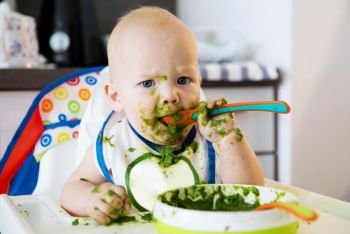
Mighty To Save – God’s Kids Worship
While many of the foods you offer your family may be a little heavy for your young baby, there is no reason why you can’t involve him in family meals, and purée some of the elements of every meal you prepare. Babies love to feel part of the crowd, and will enjoy eating the same food as everyone else.
My baby keeps reaching for food from my own plate; should I let her try?
There is no reason that your baby shouldn’t try the food on your plate, provided there is nothing there that could cause her to choke, or which may be inappropriate for babies. In fact, eating from mom and dad’s plate is a good way to introduce your baby to new flavors and tastes, and encourage her to join in with family meals from na early stage. If she particularly likes something, mash it up for her or give her a finger-food sized slice that she can manage herself.
We sometimes get take-out, and my baby always wants a taste; is this safe?
As long as it’s not too fatty or rich, or contains foods that are inappropriate for little ones, you can most certainly offer small tastes. There is plenty of research to indicate that children’s tastes are established in early childhood, and the more he learns to eat at an early age, the more varied his palate will be later on. If your baby has food allergies, you have to be particularly careful; takeout is often a source of hidden allergens.
Can I purée family food for my baby?
By all means. There are some foods that are inappropriate for babeis and you should offer only healthy foods to your little one-avoid salt and sugar. In the early stages, you will need to ensure that you make a puree that is liquid enough for your baby to slurp up from a spoon since she won’t have developed her chewing skills yet. It’s also a good idea to establish a few first foods on their own-several types of fruit, and several types of vegetables, for example, before moving on to fish, chicken, and meat. If you launch straight into family meals, it can be difficult to work out which foods are problematic, in the event that there is a reaction.
Remember that first foods are just tastes, too, and your little one won’t require a whole balanced meal for some months to come.
Should I offer snacks to my texture in this way. baby if she seems hungry between feeds?
Snacks are not really essential at this age, as your baby will be getting most of her calories and nutrition from milk. If she is hungry between feeds, you could try offering another small meal, with some puree and finger foods. You should also be sure that she is getting enough milk between “meals” to keep her going. Once again, first foods are about “tastes,” and not designed to fill your baby. If you are out and about, snacks can keep her going, but make sure they are healthy.
Soft ripe fruit such as nectarines or slices or chunks of banana and melon are a good start. Some little ones can manage toast fingers, pieces of bread, rice cakes, and even oatcakes. Be surre to keep an eye on her in case she chokes.
My baby refuses to eat meat; how can I tempt him?
It’s not surprising that many little ones are not keen on meat. It can be very dry if it’s not cooked properly, and difficult to chew if it has not been pureed properly. I would recommend cooking meat or chicken with root vegetables, such as chicken with sweet potato and apple, or beef with carrots and dried apricots. See the delicious recipe on the opposite page too. You can also try offering little batons of chicken for him to gnaw on, as he may enjoy helping himself rather than being spoon-fed, and he’ll become accustomed to the taste.
At what age is it appropriate to serve dessert to my baby?
Dessert is something that most children (and adults!) look forward to, in order to round off a meal. It is not necessary, but it does provide some incentive for finishing the main course! There is no reason why your little one can’t have a healthy dessert, such as fresh fruit puree (see page 80 for Peach, apple, and pear puree), a healthy homemade cookie or muffin, some dried fruit, or a yogurt or fresh fruit popsicle at the end of a meal.
While every single expert insists that you should never offer a reward for eating a meal, there is no doubt that the prospect of something a little special will tempt children to have one taste or one more bite of their main meal. The secret is to create desserts that are as healthy as their main courses, but with enough sweetness or flavor to make them special. A baked apple with a little maple syrup and raisins would provide a treat for the whole family and can be pureed or mashed for your baby.
6–9 months
* Eating out
Babies can be adventurous eaters, and will probably be happy to pick at lots of things on your plate. If in doubt, give him plain pasta with a little cheese, bread, vegetables, mashed potatoes, well-cooked scrambled eggs, risotto, and any fresh, ripe fruits, mashed until smooth. If there are no concerns about food allergies, and the food isn’t too spicy or salty, feel free to offer your baby tastes of sauces too.
Quick fruit purées
PREPARATION TIME 3 –5 MINUTES
EACH RECIPE MAKES 1 BABY PORTION
It can be difficult to provide healthy, homemade food for your baby on vacation. These simple, no-cook purées can be prepared in just a few minutes with basic tools and your baby’s feeding bowl.
Avocado and banana or pear
Scoop out the flesh from 1⁄4–1⁄2 small, ripe avocado and mash with a fork.
Mash 1⁄4–1⁄2 small, ripe banana or pear.
Beat into the avocado until smooth.
Banana and mango
Peel 1⁄4–1⁄2 small, ripe mango, remove the flesh, and mash with a fork.
Mash 1⁄4–1⁄2 small, ripe banana into the mango and beat well until smooth.
Banana and peach
Pull the skin off 1 small, ripe peach with the help of a knife.
Remove the pit and mash the flesh.
Mash 1⁄4–1⁄2 small, ripe banana into the peach and beat well until smooth.
Cantaloupe melon
Scoop out the seeds from 1 small slice of ripe melon, then cut off the skin.
Cut the flesh into small pieces.
Mash with a fork, then beat until smooth.
Pear (or pear with peach)
Peel 1 small, ripe pear (or 1⁄2 small, ripe pear and 1⁄2 small, ripe peach).
Cut in half and remove the core (or pit).
Cut the flesh into small pieces and mash with a fork, then beat until smooth.
6–9 months
PREPARATION TIME 15 MINUTES
COOKING TIME 40 MINUTES
MAKES 5–6 BABY PORTIONS
Sweet potato and squash purée
Babies’ taste buds tend to be tuned into sweet flavors, so naturally sweet fruits and vegetables are popular early foods. Orange fruits and vegetables like butternut squash and sweet potato are naturally sweet and they are also high in beta-carotene, which is the plant form of vitamin A.
1 small or . large butternut squash, peeled, seeded, and cut into 1in cubes
1 sweet potato, peeled and cut into
1in cubes
1 tbsp olive oil
2 tbsp water
A little breast milk or formula
1. Preheat the oven to 400°F.
2. Lay a large piece of foil on a baking sheet and spread out the squash and sweet potato on the foil. Drizzle the olive oil and water over the top.
Cover with a second large piece of foil and scrunch the edges of the two foil pieces together to form a parcel. Bake for about 30 minutes or until the vegetables are tender.
3. Cool the vegetables slightly, then transfer to a blender (including any liquid). Blend to a smooth puree. Thin the puree with breast milk or formula to the desired consistency. (If you are going to freeze the puree, add the milk after thawing.)
4. Freeze in individual portions. When needed, thaw for 1–2 hours at room temperature, then microwave or reheat in a small pan until piping hot. Stir and allow to cool before serving.