Medical & Health Questions : About Side Effects of Contraceptive Pills
Pre-eclampsia and future pregnancy
I had pre-eclampsia in my first pregnancy. Am I likely to get it again?
About 1 woman in 50 with mild pre-eclampsia in a first pregnancy and about 1 in 10 of those who had it severely go on to get severe pre-eclampsia in their second pregnancies. About one-third of all women who had pre-eclampsia in their first pregnancies (regardless of whether it was mild or severe) get mild preeclampsia in their second. Or, looking at it the other way, two thirds of those with severe and nearly three-quarters of those with mild pre-eclampsia have no problems with raised BP in their second pregnancies. I had eclampsia in my first pregnancy and was very ill. I would like to have another baby but I’m scared that it will happen again.
What are the chances that I will get eclampsia next time?
Eclampsia is rare. Of the 10 women who had it in the largest research study so far reported, none had eclampsia in their second pregnancy, eight had normal BP and two had mild preeclampsia.
If you developed kidney failure because of your eclampsia, then it would be worth asking your doctor to check your kidney function – this will involve doing a 24-hour urine collection test and having an ultrasound scan to check the size of your kidneys. There are also blood tests that check for a clotting disorder or disturbance in special antibodies (antiphospholipid antibody syndrome) that can influence your risk of recurrence of severe pre-eclampsia. If these tests are normal, your risk of getting eclampsia or severe pre-eclampsia are small. You will be advised to see a specialist obstetrician early in a future pregnancy and you may wish to ask for a pre-pregnancy visit to discuss the risks before embarking on a further pregnancy.
I’ve heard that taking aspirin can prevent pre-eclampsia. I had pre-eclampsia in my first pregnancy, so should I start taking aspirin now that I’m pregnant again?
No, for two reasons. The first (and more obvious) is that self-medication can be dangerous. The second is that a number of clinical trials addressing this question have shown conflicting results. A large review of all of the studies testing the value of aspirin in preventing pre-eclampsia has suggested that the risk of developing pre-eclampsia is reduced by 15% as is the risk of death of a baby (this is a much smaller benefit than was initially anticipated). These potential benefits may be important, but aspirin was only started at around 12 weeks of pregnancy in these studies and the safety of aspirin at earlier stages of pregnancy has not been demonstrated. It is important, therefore, that you wait until the stage of your pregnancy is confirmed and that you take aspirin only under medical supervision. New information becomes available all the time and you may want to discuss it further with your doctor. There are newer studies suggesting that additional supplements of vitamin C and E may reduce the risk of pre-eclampsia, but again there are concerns about fetal safety as the doses used were quite high. Further evaluation is required and you should not take any medication in pregnancy, even over-the-counter drugs (from a pharmacy or supermarket), without discussing it first with a well informed GP or obstetrician.
Blood pressure after pregnancy
I was put on BP-lowering drugs in pregnancy for the first time. How long will I need to continue with treatment?
This will vary according to how high your BP was in pregnancy and how much BP-lowering medication you needed. Some women will see a rapid fall in their BP over several days following delivery. This may allow you to stop all drugs before discharge from hospital. In other women it is more gradual and you may require ongoing medication for up to 6 weeks following delivery, although the amount is usually reduced over time as your BP comes down. If you had been started on methyldopa during pregnancy, this will be changed to a different drug immediately after delivery, as it can lead to a lowering of mood and symptoms of depression. Occasionally with pre-eclampsia, you may need to start BP-lowering drugs for the first time following delivery or require further increases in your medication, as some women show signs of deterioration immediately after delivery before they start getting better.
Will I still need to visit my obstetrician for BP checking after I have had my baby?
Your obstetrician and the midwives will monitor your BP while you are still in hospital. They will hand over your care on discharge usually to your GP and community midwife. You will need to have ongoing BP measurements at regular intervals until your BP has returned to normal off all medication. If your BP continues to be high after 6 weeks, you are probably demonstrating a natural tendency to high BP and will receive ongoing care from your GP. Your GP will also take your BP into account when advising you on contraception. If you had very severe pre-eclampsia you may be asked back to the hospital for a postnatal visit at 6 weeks to discuss the events in your pregnancy, to evaluate the risk of problems in future pregnancies and to arrange further tests if you are found to have a kidney disorder or clotting problem.
My doctor thinks I will need to continue BP-lowering drugs after pregnancy. I would like to breastfeed for as long as possible – will this be safe for my baby?
The same issues arise for breastfeeding as were discussed for drug treatment in pregnancy (see the section on High BP and planning a pregnancy). Very few drugs have ever been evaluated by trials that included breastfeeding women, and most of the information available is from indirect studies and reporting of bad outcomes (adverse event reporting). In general terms, most drugs pass into breast milk in small amounts (the same is true for passage of drugs across the placenta to the unborn baby).
The safest approach is to take BP-lowering drugs that are considered suitable for pregnancy. The exception is methyldopa, which can be associated with symptoms of depression and is usually discontinued after delivery. If your BP has been well controlled with a beta-blocker or a calcium-channel blocker (usually nifedipine), you can be reassured that this can be continued after pregnancy with a very low risk of any untoward
consequences for your breastfed baby. For other drugs you will need to weigh up the benefits of breastfeeding with the risks to your baby of receiving small amounts of the drug in your breast milk. You will be offered expert advice in this situation.
Contraception
I have been on a combined form of the contraceptive pill for several years. Will this increase or decrease my BP?
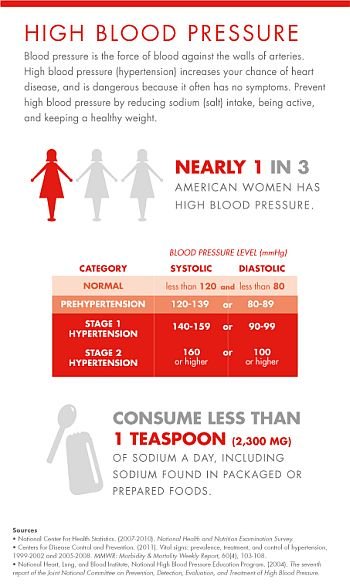
Combined oral contraceptives (COCs), are the form of the pill that contain two different hormone preparations – oestrogen and progesterone. There is consistent evidence that shows use of COCs increase BP by about 5/3 mmHg on average. In a small proportion (less than 1%) of women taking COCs, much higher BP may be triggered. Unfortunately this response is difficult to predict. It is not possible to tell which women are susceptible to high rises in BP, and these sharp rises can occur many months or years after initial treatment with COCs.
The small rise in BP is seldom recognized in practice, because the COC is mainly used by young women with systolic and diastolic pressures so low, often around 100 mmHg systolic, that even a rise of 10 or 20 mmHg of systolic pressure remains well below levels that will attract attention from most doctors or nurses.
There are many different contraceptive pills available. Are there any differences in terms of their effects on BP?
There is no difference in terms of different formulations of the COC and high BP. The ‘pill scare’ a few years ago relates to the risk of venous thromboembolism (blood clots in the leg that can travel to the lung) when different progestogen formulations in second- and third-generation COCs were compared. Some studies have shown that newer, third-generation pills, containing the progestogens either desogestrel or gestodene, are associated with a slight increase in the blood clots when compared with older, second-generation pills containing levonorgestrel. These differences in absolute terms are very small, being 15 per 100,000 women per year of use in second-generation COCs compared to about 25 per 100,000 per year of use in third-generation COCs.
When the risk of stroke and heart attacks were comparedbetween second-and third-generation pills, no differences could be found.
I have heard that there is a risk of heart attack or stroke with the contraceptive pill. Is this risk increased if I take the combined oral contraceptive?
There is a small increase in risk of heart attack or stroke associated with COC use. It is for this reason that a regular check of your BP – usually every 6 or 12 months – should be made. In women with pre-existing cardiovascular disease, the COC is not recommended because of the overall increase in such disease.
I have been put on the mini-pill. Does this increase BP?
The progestogen-only pill (POP), otherwise known as the mini pill, is not associated with an increase in BP. The POP is most commonly used in two situations: firstly, in those women who have taken the COC and who have developed high BP; secondly, in women who already have high BP and who do not want to use non-hormonal methods of contraception. I already have high BP.
Will I be allowed to use an oral contraceptive pill?
If your BP has ever been high enough to cause concern, you should not use COCs. Although the COC is not absolutely forbidden, other choices, such as non-hormonal forms of contraception, should be tried, particularly if you have other risk factors for coronary heart disease – smoking, obesity, high cholesterol, or family history of disease.
In women for whom other forms of contraception are not acceptable, changing to a POP with careful monitoring of BP is recommended. It should be remembered that the POP is a less effective contraceptive than the COC. In younger women (aged under 35 years), who are more fertile and in whom the risk of pregnancy-associated heart attack or stroke is greater than COC-related risk, then the issue of continuing with a COC or changing to a POP is more finely balanced.
I should still like to go on to the pill. How can I minimize my risk of having a stroke or heart attack?
Nobody should consider starting the pill without a BP check. You should also have a clinical history and examination performed, focusing particularly on family history of stroke and heart disease, BP recording and examination of your heart. In women with no personal history of breast and gynecological conditions, pelvic and breast examination is not necessary. Secondly, you should make sure that your other cardiovascular risk factors are minimized – most often this means stopping smoking. Lastly, most women begin to consider other methods of contraception by about 35 years of age, usually either in the form of the POP or non-hormonal methods of contraception.
How often should BP be checked in women on the contraceptive pill?
Recommended practice is once every 6 months, although many women who have normal readings have a BP check only every 12 months. The best arrangement is to have BP checked each time a repeat prescription is collected.