What is targeted therapy?
Mary Ann’s comment:
I am presently receiving targeted therapy in a clinical trial. Three years ago, my right upper lobe was removed as it contained a malignant stage 1, no small cell tumor. I was fortunate in that there was no metastasis at that time, and, after careful consideration and several medical opinions, it was agreed that I did not need adjunct therapy of any kind.
I was free of cancer-or so I thought.
For 2 years I diligently had my
I began taking 50 mg daily of this trial drug. My skin became very dry and I had a great deal of trouble with my intestines. The dosage was lowered to 40 mg and my skin improved except for a yeast infection under my breasts.
This was handled with medication and flares occasionally. (I have to state that I’ve had this problem before I began the target medication as I am a large woman.) Eventually the dosage was moved to 30 mg, and I was given medication for my intestinal problems, which still persist. Around 5 months, I experienced some hair loss-ironically only the silver hair, and people thought I had colored my hair! I had a thick head of hair so most people don’t notice the loss-I have to admit I do and I never realized how vain I was about my hair. I have to remind myself how lucky I am to be experiencing such minor side effects.
Within 6 weeks of taking this trial medication, the small growth on the pancreatic tail was no longer visible (and later referred to as “calcified”). At the 6-month mark, the small tumors in my right lung also seem to have responded favorably and are no longer visible.
It is my understanding that I will take this medication for the rest of my life. Isn’t that a wonderful phrase, “the rest of my life”? Targeted therapy has given me hope that there is a long life ahead.
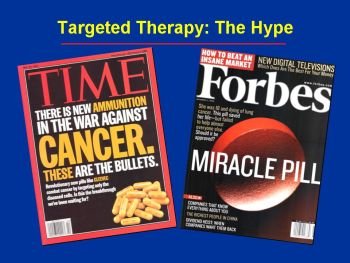
When treating cancers, doctors must now consider not only the origin of the cancer but also its biology. Recent laboratory research has helped us understand the complex biologic pathways in the cell that cause cancers to develop, grow, and spread. Targeted therapy works by blocking specific biologic pathways. There are several classes of targeted therapies; each blocks a specific pathway.
Here are examples from each class:
Tyrosine kinase inhibitors
Tarceva (erlotinib)
Glivec (imatinib)
Herceptin (trastuzumab)
Angiogenesis inhibitors
Avastin (bevacizumab)
Proteosome inhibitors
Velcade (bortezomib)
Targeted immunotherapy
Rituxan (rituximab)
Targeted therapy treatment affects only the cancer cells, having minimal effect on normal cells. As an example of how targeted therapies work, angiogenesis inhibitors block the formation of new blood vessels.
Cancer cells secrete proteins that promote the growth of new blood vessels, allowing the cells to multiply and spread. By blocking the formation of new tumor blood vessels, angiogenesis inhibitors prevent the cancer from growing, and the cancer cells are destroyed.
Targeted therapy works by blocking specific biologic pathways in the cell.
Targeted therapy treatment affects only the cancer cells, having minimal effect on normal cells.
What types of biologic therapies are used to treat cancer?
Biologic therapy, also called biotherapy or immunotherapy, includes a wide variety of approaches that use the immune system to treat cancer. The immune system consists of special cells and chemicals with the ability to recognize and destroy foreign or abnormal cells, including cancer cells. Biologic therapy introduces human-made immune substances into the body. These substances can destroy the cancer cells, make the cells more vulnerable to destruction by the body’s immune system, or strengthen the ability of the immune system to destroy the cancer cells. Most biologic therapies are still experimental.
They include:
• Monoclonal antibodies: These antibodies can recognize a specific abnormal protein on the surface of cancer cells, travel directly to these cells, and attack them. Examples of monoclonal antibodies used in cancer treatment are rituximab, trastuzumab, gemtuzumab, and alemtuzumab. These antibodies may be linked to chemotherapy or radioactive isotopes (unstable elements that emit radioactivity as they decay). The antibodies carry them to the site of cancer so the chemotherapy or radioactive isotopes can destroy the cancer cells. Because of their ability to differentiate between cancer cells and normal cells, monoclonal antibodies are a type of targeted therapy. An example of a monoclonal antibody linked to a radioactive isotope is ibritumomab tiuxetan.
• Cytokines: These chemicals can attack cancer cells or stimulate the immune system. Examples of cytokines used in cancer treatment are interferon, interleukin, and tumor necrosis factor.
• Vaccines: These are made from cancer cells that have been inactivated. Vaccines stimulate the immune system to make antibodies to destroy the cancer cells.
Term:
Radioactive isotopes – Unstable elements that emit radioactivity as they decay (break down); used to take diagnostic images or to treat cancer.
What types of hormonal therapies are used to treat cancer?
Hormones are chemicals produced by endocrine glands in the body. Cancer of the prostate and some cancers of the breast can be stimulated by specific hormones in the body. The hormones bind to receptors on the cancer cells’ surface and stimulate the cells to multiply, causing the cancer to grow. Hormonal therapies stop the body from producing the hormones or block their activity. The goal is to stop the cancer cells from dividing or to destroy them.
The male hormone testosterone, produced primarily by the testicles, stimulates prostate cancer to grow, and so hormonal therapy is one treatment for prostate cancer. Some medications, such as leuprolide and goserelin, stop the production of testosterone by the testicles. These medications, given by injection usually once a month or every 3 months, eliminate most of the testosterone in the body. Other medications given orally (e.g., flutamide, bicalutamide) may be given in addition to the injections to block the receptors on the prostate cancer cells, inactivating any remaining testosterone that is circulating.
Alternatively, the testicles may be surgically removed (orchiectomy) to prevent testosterone production, or the patient may be given female hormones (e.g., diethylstilbestrol) to counteract the effects of testosterone.
Side effects of long-term hormonal therapy in men with prostate cancer may include hot flashes, breast swelling and tenderness, decreased sex drive, inability to have an erection, loss of bone mass (osteoporosis), fatigue, and metabolic changes leading to weight gain
and an increased risk of diabetes and heart disease. The female hormone estrogen, produced primarily by the ovaries, stimulates some types of breast cancer to grow, and hormonal therapy is therefore one treatment for breast cancer. The medication that has been used the longest is tamoxifen, an oral medication that blocks the receptors on the breast cancer cells. Other similar oral medications are raloxifene and toremifene. Fulvestrant, given by injection once a month, not only blocks the receptors; it also destroys them. Even after menopause, a woman’s body produces a small amount of estrogen; agroup of drugs called aromatase inhibitors (e.g., anastrozole, letrozole, exemestane) blocks the enzyme that stimulates this.
Alternatively, women may receive leuprolide injections to stop the production of estrogen by the ovaries, have their ovaries surgically removed, or be given the hormone megestrol. Side effects of hormonal therapy in women with breast cancer may include hot flashes, vaginal discharge or irritation, fatigue, visual changes, and an increased risk of developing endometrial cancer or ovarian cysts.