Smoking
I am a 16-year-old on insulin. I would like to know whether smoking low tar cigarettes could interfere with my diabetes. Would it cause any restriction in my diet?
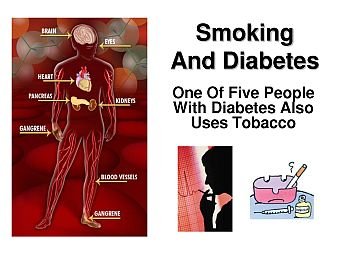
Smoking is unhealthy not only because it causes several cancers, particularly lung cancer, but because it leads to hardening of the arteries – affecting chiefly the heart, brain and legs. The proper advice to all people, especially teenagers, is not to smoke. Smoking will not directly affect your diabetes except, perhaps, by reducing your appetite.
When my doctor diagnosed diabetes, he told me to stop smoking. Could you tell me if there is a particular health hazard associated with smoking and diabetes?
The problem is made worse for me by the fact that I have to lose weight and, if I stop smoking, I will do just the opposite.
Smoking is a danger, both to the lungs and because of the risk of increased arterial disease affecting any smoker. Someone who has long-standing diabetes is also at risk of problems with poor blood circulation, and it is foolish to double this risk by continuing to smoke. If the discovery that you have diabetes has come as an unpleasant surprise, this is a good time to turn over a new leaf and alter your lifestyle, by eating less and giving up cigarettes. It may be a lot to ask, but many people manage to carry out this ‘double’. It will not kill you – on the contrary, you may live longer.
There is a lot of support available now for people who want to give up smoking and your doctor or practice nurse should be able to offer you advice on whom to contact. You may even find that they run an antismoking group or clinic. Some people find nicotine gum or patches useful, and we deal with these in a later question in this section.
Since my husband, who has had diabetes for 23 years, has stopped smoking, he has had high blood glucose tests. Why?
Your husband should be congratulated for giving up smoking. Most people who give up smoking put on weight, on average 4 kg (9 lb). This is because cigarettes suppress the appetite and make the body operating less efficiently, thus burning up more fuel (food). If your husband has put on weight, this explains his higher blood glucose levels. He should try to reduce weight to improve his diabetes. If he is already thin and his blood glucose levels are high then he will have to take tablets or insulin to get things under control.
My doctor has strongly advised me to give up smoking and suggested that I try nicotine patches. I was surprised to find that the information leaflet enclosed with the patches advised people with diabetes not to use the patches. Is this true?
It sounds as though the company is being overcautious. The main reason for giving up smoking is to reduce the damage that it does to the blood supply to the heart and legs. Each time someone has a cigarette, the nicotine that they inhale narrows the small blood vessels. This narrowing eventually becomes permanent, which explains why smoking increases the risk of such problems as heart attacks and gangrene. Nicotine patches have been shown to be a most effective way of helping people to stop smoking.
Nicotine has the same effect on the blood vessels whether from patches or from cigarettes. However, patches are no worse than cigarettes and, if they help you to give up smoking, the overall benefit will be enormous, especially with regard to your circulation. Don’t be afraid to try nicotine patches in the recommended dose. The same advice applies to nicotine chewing gum and the newer nicotine inhalerPrescription charges and Social
Security benefits
I believe that people with diabetes are entitled to free prescriptions. Please could you tell me how to apply?
One of the few definite advantages of having diabetes is exemption from payment on all prescription charges – even for treatment unconnected with the diabetes itself. People treated on diet alone are not exempt from prescription charges. You must obtain a form, called NHS prescriptions – how to get them free, from a chemist, hospital pharmacy or a Post Office.
Having filled in the form yourself, it must be signed by your family doctor or clinic doctor and sent to the local Family Practitioner Committee. The chemist should be able to give you the address. You will then receive an exemption certificate. Please remember to carry this certificate wherever you are likely to need a prescription, for example when going to the clinic or travelling in the
To what Social Security benefits are I entitled now that I have diabetes?
There are no special benefits given automatically to people with diabetes. You may claim Disability Living Allowance if you have a child with diabetes who is under the age of 12, and it may be possible to obtain this allowance for a child up to the age of 16 if you can prove that the child needs extra supervision and care. Diabetes UK Careline can provide you with information to help you complete the necessary forms.
For more information about benefits, we suggest that you contact either Diabetes UK Careline, or the Disability Alliance, or the Benefits Agency. The Benefits Agency is the organization that deals with Social Security benefits on behalf of the Department of Social Security, and youcan make enquiries either at their offices or by phone. You will find their addresses and telephone numbers (they have several freephone enquiry lines) in your local phone book under ‘Benefits Agency’.
Since developing diabetes I have found that my food bills have risen alarmingly. Are there any special allowances that I can claim to offset the very high cost of the food?
Most people with diabetes are not entitled to any special allowance and, indeed, there is no real need for them to eat different food from others. Special diabetic products are not necessary. Now people are encouraged to eat food that is high rather than low in carbohydrate, they do not have to fall back on expensive protein as a source of calories.
My mother has had diabetes for 12 years and is subject to crashing hypos for no reason. She needs someone to be with her all the time. Would we be eligible for an Attendance Allowance as she needs watching 24 hours a day?
If you have to provide a continuous watch over your mother, then you would be able to apply for an Attendance Allowance. Before admitting defeat, however, it would be better to try every means to prevent the hypos. Presumably your mother is having insulin, though you do not mention the dose or type of insulin. It would be worth checking with the local diabetes service if anything could be done to reduce the frequency of hypos. Changing to more frequent but smaller doses of insulin might solve the problem. You may have to spend time and energy getting to grips with your mother’s diabetes. It would do more for her self-confidence to abolish the hypos than to get an attendance allowance.
Miscellaneous
Is there any objection to my donating blood? I am on two injections of soluble insulin a day and my general health is fine.
There is no obvious reason why a fit person with diabetes should not be a blood donor. However, the blood transfusion authorities do not accept blood from people on insulin. They suggest that the antibodies to insulin found in all people having injections may, in some mysterious way, harm the recipient of the blood.
Is it true that someone with diabetes should not use an electric blanket?
It is perfectly safe for you to use an electric blanket, although most underblankets should be used only to warm up the bed in advance. The manufacturers usually recommend that under-blankets should be switched off before you get into bed. However, there are now underblankets that can be left on all night on a very low heat and these would be safe to use, provided that you follow the manufacturer’s instructions. Overblankets can be left on all night, but again you should always check the manufacturer’s instructions.
Hot-water bottles are rather more dangerous as their temperature is not controlled. People with a slight degree of nerve damage can fail to realize that a bottle full of very hot water may be burning the skin of their feet. This is a recognized cause of foot ulcers. It is better to be safe than sorry and avoid the comfort of a hot-water bottle. Bedsocks are a possible alternative for cold feet, or you could try one of the small electric heating pads now on the market. Again you need to be careful how you use these and follow the manufacturer’s instructions – not all of them are suitable for use in bed
My 10-year-old daughter has had diabetes for 3 months. She has started to lose a lot of hair and now has a bald patch. Is this connected with her diabetes?
Yes, it could be. There are three ways in which diabetes and hair loss may be connected.
• If your child was very ill with ketoacidosis at the time of her diagnosis, this could lead to a heavy loss of hair. In this case, her hair will regrow over the next few months.
• Alopecia areata is a skin condition, which is slightly more common in people with diabetes. This is the likely diagnosis if your daughter has a well-defined bald patch with the rest of her hair remaining a normal thickness. If the patch is on the top of her head there is every chance that her hair will regrow over the next 6 months. There is no way of encouraging growth and steroid ointments may even cause permanent skin changes and make matters worse.
• Myxoedema or lack of thyroid hormones may occur with diabetes. If this is the cause of your daughter’s hair loss, you will notice other symptoms such as mental slowing, weight increase and an inability to keep warm. All these symptoms can be corrected by taking thyroid tablets. Shortage of body iron may also cause hair loss although this is not connected with diabetes.
I recently enquired about having electrolysis treatment for excess hair. I was told that, as I had diabetes, I would need a letter from my doctor stating that my diabetes did not encourage hair growth. Could I use wax hair removers instead?
There is no objection to you having electrolysis. Diabetes does not cause excessive hair growth. It sounds as though the firm doing the electrolysis is being overcautious.
Many women find wax hair removers useful for the less sensitive parts of the body. Make sure that the wax is not too hotIs it safe for people with diabetes to use sunbeds and saunas?
As safe as for those without diabetes. Exposure to ultraviolet radiation is known to increase the risk of skin cancer. Make sure that you can recognize a hypo when you are hot and sweaty. Keep some means of treating a hypo with you – not with your clothes in the changing room.
I have diabetes but would dearly love to have my ears pierced but, when I asked my doctor about this, he said there was a chance that my ears would swell. Please could you advise me if there is a great risk of this happening?
Anyone who has their ears pierced runs a small risk of infection until the wound heals completely. The risk in a well controlled person is no higher than normal. If your ears do become red, swollen, and painful, you may need an antibiotic.
Is there any connection between vertigo and diabetes? I have had diabetes for just over 2 years controlled on diet alone.
Vertigo, in the strict medical sense, describes that awful feeling when the whole world seems to be spinning round. It is usually due to disease of the inner ear or of the part of the brain that controls balance. This is not connected with diabetes in any way.
However, simple dizzy spells are a common problem with many possible causes, which may be difficult to diagnose. If dizziness occurs when you move from sitting down to the standing position, it may be the result of a sudden fall in blood pressure. This can sometimes be due to a loss of reflexes from diabetic neuropathy. There are no other connections between diabetes and vertigo.
My husband’s grandmother is 84 and has diabetes. Although she is fiercely independent, she cannot look after herself properly and will have to go into a residential home. Can you let me know of any homes that cater especially for people with diabetes?
Because diabetes becomes increasingly common in the elderly, most nurses in these homes are experienced in looking after diabetes. The staff of the home will probably be happy to do urine tests, ensure that diet is satisfactory and that she gets her tablets and, if necessary, insulin injections. If your grandmother-in-law is too fit and independent to accept a residential home, she may be a suitable candidate for a warden-controlled flat.
My wife, who developed diabetes a few weeks ago, is about to return to work. I feel that she should wear some sort of identity disc or bracelet showing that she has diabetes but she is reluctant to wear anything too eye-catching. Have you any suggestions?
It is very important that all people with diabetes, especially those on insulin, should wear some form of identification. Accidents can and do happen and it may be vital that any medical emergency team knows that your wife has diabetes.
Medic-Alert provide stainless steel bracelets or necklets which are functional if not very beautiful. They can also be obtained in silver, gold plate, and 9 carat gold.
SOS/Talisman produces a medallion, which can be unscrewed to reveal identification and medical details. These can be bought in most jewellers and come in a wide range of styles and prices, including some in 9-carat gold. Other products are always coming on to the market, and Balance, the magazine produced by Diabetes
Could you tell me what ointment to use for skin irritation?
The most common cause of skin irritation in people with diabetes is itching around the genital region (pruritus vulvae). The most important treatment is to eliminate glucose from the urine by controlling diabetes. However, the itching can be relieved temporarily by cream containing a fungicide (e.g. Nystatin).
I have recently been given a foot spa and was surprised to see a caution on the side of the box that it is not suitable for people with diabetes. Is this true?
If you have neuropathy (nerve damage), you should check with your diabetes team before using the spa. If you don’t have neuropathy, make sure that you check the temperature of the water carefully and don’t soak your feet for too long!