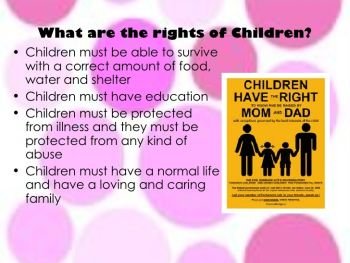
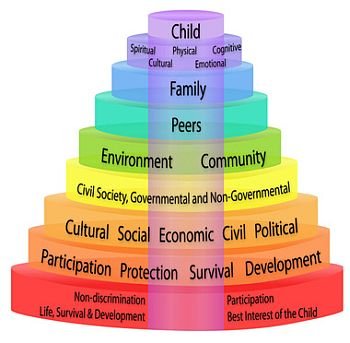
We ask for our Rights (Children’s Rights to Education and Health) (Video)
Participation at different levels
Levels of active engagement can helpfully be seen in terms of the degrees of power sharing between adults and children. The earliest conceptualization of these aspects of power was delineated by Arnstein in 1969. In describing planning processes in the United States, she constructed a ladder of participation which delineated three levels of power sharing, from degrees of tokenism to degrees of citizen power.
Level 1 – Manipulation and tokenism: On the lowest rungs were manipulation and tokenism – both non-participant, the aim being to cure or educate the participants. The response of young people in the UK to Anti-Social Behavior Orders (ASBOs) provides a good example of how a policy intended to gain young people’s engagement in change, to ‘cure’ their bad behavior, has been experienced as tokenistic, and has been unsuccessful in achieving either their co-operation or a change in their behavior.
Level 2 – Informing, consulting and placation: At the second level, informing, consulting and placation are seen as legitimate steps. Providing information, for example in relation to how an assessment will be carried out, is an essential beginning to engaging young people in the social work process from assessment to review.
And information and feedback about what has happened are key aspects of motivation and engagement. Children’s participation at all levels depends upon the information that is made available to them at the outset, as well as whether their views are taken into account as an outcome. Consultation is also a key part of gaining the views of children, for example about their wishes in cases of parental contact. However, those processes can also involve degrees of tokenism. If a child is consulted but her views not taken into account the process is tokenistic and can result in a loss of trust between the practitioner and the child. Placation, also, can be tokenistic – for example, where selected ‘worthies’ are voted onto committees, or where, in individual work, children are assured that ‘everything will be all right’, when this cannot be guaranteed.
Level 3 – Partnership to citizen control: Finally the last three rungs of Arnstein’s ladder comprise degrees of citizen power which include partnership. Partnership comprises a redistribution of power – from delegated power through to citizen control. The redistribution of power is central to the process. Participation without redistribution of power is an empty and frustrating process for the powerless. It allows the power holders to claim that all sides were considered but makes it possible for only some of these sides to benefit.
Arnstein did not, of course, have children and young people at the centre of her conceptualization of power sharing. As we have already indicated, there are particular issues relating to adults’ ability to share power with children, and vice versa, which have more recently become central to the consideration of children’s participation. However, despite the fact that other writers have subsequently modified or adapted Arnstein’s ladder to reflect a process rather than a hierarchical view, all models do contain essentially the same components and are applicable to children and young people.
In considering social workers working in partnership with families in child protection Thoburn reduced the levels of partnership to three: information provision, consultation and active participation. At this time, following the publication of The Challenge of Partnership in Child Protection which outlined 15 principles for working in partnership with children and families, research commonly focused on unpicking social work practice to analyze what, within the client–worker relationship, promoted the empowerment of clients. Bell analyzed the transactions between professionals and 83 families involved in initial child protection conferences; Marsh and Fisher explored the relationship between social workers and service users in Bradford. While the detail of the analysis focused on social work practice – for example, the need for explicit consent and the use of negotiated agreement between client and worker – the conclusions of Marsh and Fisher were broader based in turning the focus from social workers’ practice skills onto organizational issues, in particular culture.
Users can play a key role in informing the development of policy and practice…but that belief in the value of partnership contrasts with the low recognition of users’ views. Staff may resist change towards participation, openness and information because they ‘do this already’.
Interest in refining conceptualizations of participation and partnership continued. Hart’s ‘ladder of participation’ also comprises eight rungs, each rung describing different aspects of power sharing from nonparticipation – manipulation and tokenism – to degrees of participation.
The bottom three rungs continue to comprise manipulation, decoration (for example, where children wear T-shirts promoting a cause), and tokenism, where children’s views are heard but not acted upon (for example in some court proceedings). The remaining five rungs all include some genuine participation, up to the top rung where children initiate processes and share decisions with adults. These are situations where ‘children initiate their own project’ and where ‘they should be allowed to direct and manage the project.
Hart’s ladder is thus very similar to Arnstein’s although the discourse – reflecting the increasing concerns about children’s rights and children’s disempowerment – involves children as well as adults. Again, the structure is hierarchical and based on power, although Hart differs somewhat in where he draws the line between non-participation and degrees of participation. On Hart’s ladder the lowest three rungs are all non-participant.
Following this, the validity of the hierarchical concept of the ladder or pyramid, with the objective of striving for the top rung, was further questioned. In New Zealand Treseder developed a circular model to demonstrate how children and young people can be involved to varying degrees in project decision making. This model recognizes that in certain areas, such as schools and councils, children’s involvement will never result in children and young people completely controlling the decision that is made although they have contributed to it.
Treseder’s circular model takes into account the wide range of activities in which children are participating and the context in which decisions are made. His definition continues to be used. Participation Works base their review of children’s participation in home, family and school on an adaptation of his definition: ‘Participation is a process where someone influences decisions about their lives and this leads to change.’
An interesting dimension here is the association of participation with the ‘successful’ outcomes of influence and change, since this implies that, if change does not happen the process has not been participatory. Certainly, as will become clear when we look at the research on children’s experiences, the relationship between process and outcome is not straightforward. Children can feel they have participated, as they do in some of the family group conferences even if the outcome is not what they hoped for. The outcome the child is endeavoring to achieve may be different from the outcome the parent or social worker is aiming toward. So, although the outcome in terms of the decision made will be determined differently in terms of ‘success’ by the actors involved, the process can be empowering for the children because they have felt included. It is now more generally accepted that different levels of involvement and different mechanisms will be appropriate for different tasks and will also depend upon the outcomes to be achieved. Shier adapts the ladder to enable practitioners to determine which of five levels of participation is best, from listening through to sharing power. He also advocates organizations to think in terms of ‘openings, opportunities and obligations’.
Williams further develops the process view by stressing that the process is not a hierarchy where the ‘aim’ is to reach the top of the ladder. Kirby’s model is also circular, nonhierarchical and process based Certainly, this shift in the conceptualization of process, from Arnstein’s steps on the ladder to Treseder, Kirby and Williams’ notions of circularity, does allow us to see children’s participation in both individual decision making and in organizational issues as progressive and nuanced. While some engagements may be experienced by a child as tokenistic, others may be fruitful, depending upon a wide range of factors. For example, the Participation Works survey of organizations and participation workers suggests that the age of the children was critical to their engagement. Secondary-school-aged children were more likely to be involved in decision making than primary-school-aged children. For example, children at Park View secondary school in Tottenham elect their own year representatives to take their views to the youth forum where decisions about catering, safety in school and saving for charities is discussed. From a girl in Year 8: ‘I’d like to make the school a happier and safer place and make sure everyone has a say.’