What is a heart block?
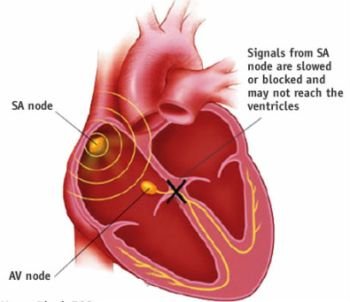
A heart block (atrioventricular or AV block) is an interruption of the heart impulses from the atria (commonly the sinus node) to the ventricles. This interruption results from a conduction block that occurs within the AV node and other conduction pathways (e.g., the His bundle and other branches). Although the conduction interruption can be either partial (incomplete) or complete, discussion deals with complete heart block because of its clinical importance.
In complete heart block, all heart impulses from the atria are blocked, and none of them reach the ventricles. Consequently, a “backup pacemaker” (usually the AV node or the ventricles themselves) stimulates the ventricles. Thus, the heart rhythm in a heart block is very slow and unstable (a rate of 25-40 beats per minute). Heart block often produces various symptoms such as light-headedness, a fainting spell (syncope), and weakness. In addition, heart block may cause CHF or may worsen preexisting CHF. An artificial pacemaker is needed for persisting heart block.
Term:
Complete heart block – disturbance of normal conduction from the atria to the ventricles preventing electrical impulses from traveling through the heart muscle and conduction system, causing a very slow heart rhythm.
What is sick sinus syndrome?
Sick sinus syndrome (SSS) is a disorder in which the sinus node (the natural pacemaker) fails to produce sufficient heart impulses. That failure leads to an unstable and slow heart rhythm. At times, slow heart rhythm may be mixed with rapid heart rhythms (e.g., in AF or ventricular tachycardia). That combination of slow and rapid heart rhythm is called the bradycardia-tachycardia syndrome.
Various symptoms (almost the same as those in a heart block) may be observed in advanced SSS. An artificial pacemaker is needed to treat advanced SSS, and additional medications may be necessary to treat the tachycardia (rapid rhythm) part of this disorder.
What is ventricular tachycardia?
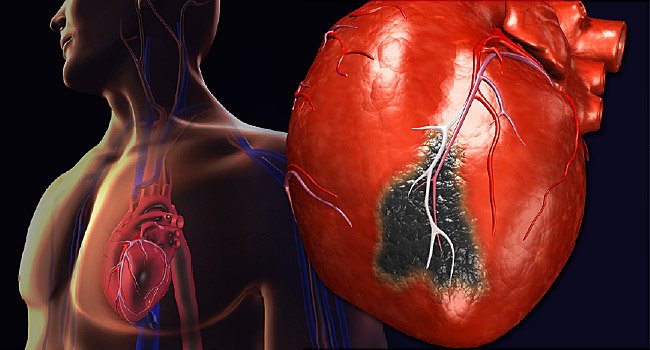
Ventricular tachycardia (VT) is a rapid and regular heart rhythm (140-180 beats per minute) with bizarre (broad) QRS complexes. The impulses arise from the ventricles (lower heart chambers), commonly in an area of the heart muscle damaged by a heart attack. VT may occur suddenly for a short period and may stop without treatment.
However, VT often lasts for a long time, especially in the setting of an acute heart attack. It may deteriorate into a more serious arrhythmia: ventricular fibrillation. VT may cause a variety of symptoms, such as light-headedness (near-syncope), fainting (syncope), shortness of breath, weakness, chest pain, and a feeling of impending death.
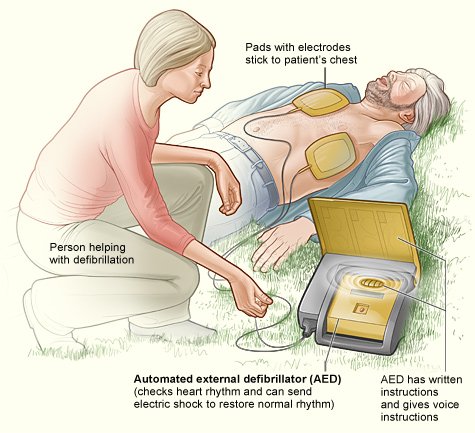
A physician would use various medications (e.g., lidocaine, amiodarone, procainamide, and the like) to treat and prevent VT. In some cases, when drug management is not effective, a physician might resort to the use of electrical shock treatment (direct-current shock).
When VT persists or recurs, an electro physiologic study can determine the exact nature of VT, and then the physician can arrange for more effective management. Selected cases may require an implantable cardioverter-defibrillator to control recurrent and serious VT.
Term:
Direct-current shock – electric shock for rapid heart rhythm.
What is ventricular fibrillation?
Ventricular fibrillation is an uncoordinated, irregular, and very rapid heart rhythm arising from multiple sites within the ventricles. VF is the most serious and life threatening arrhythmia because it prevents any pumping action. Consequently, it stops any blood circulation in your entire body, and you lose consciousness instantly. Death follows within a few minutes unless emergency treatment restores your normal heart rhythm. Such emergency treatment can include CPR, electrical cardiac defibrillation, and the like.
When emergency treatment is delayed for more than 4 minutes, damage to the brain may become permanent, even if a stable heart rhythm is restored later. Thus, immediate emergency treatment for VF is essential.
Term:
Implantable cardioverter-defibrillator (ICD) – small electronic device implanted in the chest to deliver an electrical shock automatically when ventricular fibrillation or tachycardia develops.