How much salt is bad for your heart? (Video)
The Deadly Truth About Salt
For centuries, the expression the salt of the earth has been used as a catch-all phrase to describe something as good and essential. Yet nothing could be more wrong. That harmless product that you shake on top of your food every day may actually bury you!
Consider these startling facts on salt:
1. Salt is not a food! There is no more justification for its culinary use than there is for potassium chloride, calcium chloride, barium chloride or any other harmful chemical that is used as a food seasoning.
2. Salt cannot be digested, assimilated or utilized by the body. Salt has no nutritional value! It has no vitamins! No organic minerals! No nutrients of any kind! Instead, it is positively harmful and can cause trouble in the kidneys, bladder, heart, arteries, veins and blood vessels. Salt may waterlog the tissues, causing water retention.
3. Salt may act as a heart poison. It also increases the irritability of the nervous system and the body.
4. Salt robs calcium from the body and attacks the mucus lining throughout the gastrointestinal tract.
The Myth of the “Salt Lick”
Is a low-salt diet a nutritionally deficient diet? Don’t we need plenty of salt in our diets to keep us in top physical condition? This is a popular notion, but is it true? People will tell you that animals will travel for miles to visit so-called salt licks. The one chemical property all of these sites commonly known as salt licks had in common was complete absence of sodium chloride (common salt)! There was absolutely no organic or inorganic sodium at the salt licks! But theses soils had an abundance of organic minerals and nutrients which the animals naturally craved.
It’s a little known fact that about 80% of sodium we eat comes not from salt we add at the table or during cooking, but from processed, packaged foods. – Tufts University Nutrition Letter
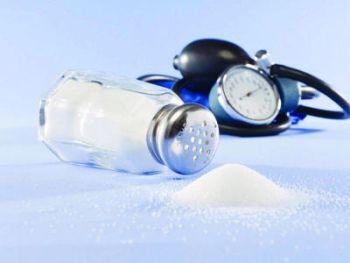
Salt Affects Your Blood Pressure
What causes high blood pressure? Medical Science recognizes many causes: tension, strains, stress, toxic substances such as cigarettes and gasoline, food additives, insecticide sprays, etc. and the side effects of drugs and industrial toxins are all suspect. What can you do to protect yourself from these injurious agents? You would do well to exclude as many of these harmful factors from your environment and life as soon as possible!
However, there is one cause of high blood pressure which can be easily avoided. Sodium chloride (common table salt) is the major cause of high blood pressure! Up to now, we have been talking about causing high blood pressure in the normal person. But how about the effects of salt on those millions suffering from our country’s most prevalent and preventable ailment – excess weight? This is a prime area for research because obesity is known to be frequently accompanied by high blood pressure. Medical researchers proclaim a link between high blood pressure and salt intake in obesity.
Salt is Not Essential to Life
It is frequently claimed that salt is essential for life. However, there is no scientific basis to this belief. The truth is that entire primitive populations today use absolutely no salt and have never used it (most have no arthritis, cancer, etc.). If salt were essential to life, these people would have disappeared long ago. The proof salt is not needed is they are not only alive, but have better health than most Americans! Seems the false necessity of salt is mostly a money-making, harmful product.
Salt is Not Necessary to Combat Heat
There has been a great deal of propaganda in recent years about using salt in hot weather. The claim is made that the body loses a great deal of salt via perspiration and that this loss must be compensated for by consuming additional amounts of salt. Otherwise, according to this theory, great weakness and inability to continue normal activities will result. Hence factory workers are advised to take salt tablets in hot weather. We have watched many factory workers take these salt tablets, and we have also seen many of them become quite ill afterward. In fact, toxic reactions frequently follow the use of salt tablets. Vomiting and indigestion appear to be the 2 most common side effects and – as far as enabling one to stand the heat better is concerned – these dangerous supplements have no effect.
Death Valley Hike Proved Salt Dangerous
To prove definitely to my dad that he did not need salt during extremely hot weather, he went to Death Valley, California, one of the hottest spots in the entire world during July and August. On his first test he hired 10 husky young college athletes to make the hike in Death Valley from Furnace Creek Ranch to Stovepipe Wells, a distance of approximately 30 miles.
The boys had salt tablets and all the water they could drink . . . and a station wagon filled with plenty of food that contained salty foods like bread, buns, crackers, cheese, luncheon meats and hot dogs. They each ate, drank and took as many salt tablets as they desired. Dad had no salt and fasted during the 30 mile hike. They began the hike on a sweltering July morning. The higher the sun rose, the hotter it became! Up went the heat until at noon it stood at 130 degrees – a dry, hot heat that seemed to want to melt and defeat these hikers!
The college boys gobbled the salt tablets and guzzled quarts of cool water. For lunch they drank cola drinks with ham and cheese sandwiches. They rested a half hour after lunch and then continued their rugged hike across the red hot blazing sands. Soon things were beginning to happen to those strong, husky college boys.
First, 3 of them got violently ill and threw up all they ate and drank for lunch. They got dizzy, turned deathly pale and weakness overcame them. They quit the hike immediately and were driven back to the Furnace Creek Ranch. The hike went on with 7college athletes continuing.
The desire for salty foods is an acquired taste. Your taste buds can be retrained to appreciate the true flavors of foods. – Neal Barnard, M.D., Food for Life.
The Only Non-Salt User Finished Hike
As the hike progressed, the athletes drank large amounts of cold water and took more salt tablets. Then suddenly 5 of them got stomach cramps and became deathly ill. Up came the water and their lunch. These 5 had to be driven back. That left but 2 out of 10 hikers. It was now about 4 pm and the merciless sun beat down on them with great fury. Almost on the hour, the last remaining salt tablet-eating athlete collapsed under that hot sun and was rushed back for medical care.
That left only my dad on the test and he felt great! He was not full of salt tablets nor food because he was on a fast. The college boys wanted cold water, but Dad drank only unchilled, pure distilled water. He finished the 30 mile hike in good time and had no ill effects whatsoever! He camped out for the night. The next day he arose, and on distilled water only, hiked another 30 miles back to the ranch without food or salt tablets. The doctors examined him and found him to be in excellent physical condition with no ill effects from the hot climate and the strenuous hike.
Break the Deadly Salt Habit!
In our expeditions over the world we have met many primitive tribes in the tropics that use no salt. And while they are not bothered by the heat, salt-eating white people invariably complain about the hot weather. This seems to indicate that some commercial motive lies behind the eat more salt in hot weather campaign.
People undoubtedly would not add inorganic salt to their food if they were never taught to do so in the first place. The taste for salt is an acquired one. The craving for salt ceases a short time after it is eliminated from the diet. It is only during the first few weeks after the use of table salt is discontinued that it is really missed. After the initial period of abstinence there is little difficulty. In fact, many of our health students who have broken the deadly salt habit write us to say that now they cannot stand salted foods! When someone serves them salted foods, it gives them an abnormal thirst for liquids!