Sweet Solutions: The Best Sugar Substitutes
10 Artificial Sweeteners and Sugar Substitutes
What Are Sugar Substitutes and What Forms Can They Take?
Because eating too much sugar can be unhealthy, what’s a person with a sweet tooth to do? Americans have looked to sugar-free beverages and foods over the years to limit their sugar intake while satisfying their yen for sugar. Such items contain sugar substitutes that are as sweet as-or sweeter than-sugar but contain fewer calories.
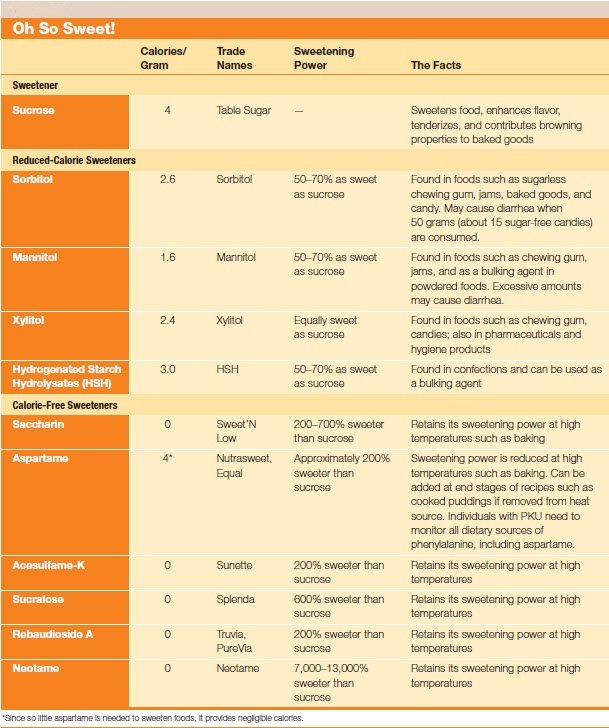
All sugar substitutes must be approved by the FDA and deemed safe for consumption before they are allowed in food products sold in the United States. Several sugar substitutes are presently available to consumers, including polyols, saccharin, aspartame, acesulfame-K, sucralose, rebaudioside A, and neotame.Alitame and cyclamate are two other sugar substitutes that are not yet approved for use in the United States but are on the horizon. Polyols don’t promote dental caries and cause a slower rise in blood glucose than sugar does. Saccharin, aspartame, acesulfame-K, sucralose, rebaudioside A, and neotame also won’t promote dental caries and have the added advantage of not affecting blood glucose levels. These sugar substitutes are a plus for people with diabetes, who have a more challenging time managing their blood glucose levels. All these sugar substitutes are either reduced in calories or are calorie free.
Polyols Are Sugar Alcohols
Polyols are often called sugar alcohols because they have the chemical structure of sugar with an alcohol component added. Whereas polyols such as sorbitol, mannitol, and xylitol are found naturally in plants, they are also produced synthetically and are used as sweeteners in foods such as chewing gum and candies. They can be used tablespoon for tablespoon to substitute for sucrose.
Sorbitol and mannitol are also less likely to promote dental caries because the bacteria on your teeth metabolize them so slowly. (Humans lack the enzyme needed to ferment xylitol.) Their slower absorption means that they do not produce a spike in blood glucose, which is a benefit for those with diabetes.
Chewing gums and candies that contain sugar alcohols can be labeled “sugar free” and boast that they don’t promote tooth decay. Keep in mind, though, that even though these products are sugar free, they are not necessarily calorie free. Even more importantly, because polyols are incompletely absorbed in your digestive tract, they can cause diarrhea. For this reason, they should be used in moderation.
Another type of polyol is hydrogenated starch hydrolysates (HSH), which are made by partially breaking down corn, wheat, or potato starch into smaller pieces and then adding hydrogen to these pieces. The end product is a wide range of polyols, including those that can be strung together and used commercially. HSH adds sweetness, texture, and bulk to many sugarless products such as baked goods and candies.
Saccharin Is the Oldest Sugar Substitute
Saccharin was first discovered in 1879, and during the two World Wars, when sugar was being rationed, it was used as a sugar substitute in the United States and Europe. Today, you probably know saccharin as those little pink packets often found on coffee shop counters or dinner tables. It has been used in foods, beverages, vitamins, and pharmaceuticals. Because saccharin is not metabolized in your body, it doesn’t provide any calories.
In 1977, the FDA banned saccharin due to reports from the research community that it could cause bladder cancer in rats. Congress immediately implemented an 18-month moratorium on this ban through the Saccharin Study and Labeling Act.
This allowed the continued commercial use of saccharin, but required that any saccharin-containing products bear a warning label stating that saccharin was potentially hazardous to your health, as it caused cancer in laboratory animals.
In 2000, the National Toxicology Program (NTP) removed saccharin from the list of substances that could potentially cause cancer. After extensive review, the NTP determined that the observed bladder tumors in rats were actually from a mechanism that wasn’t relevant to humans. The lesson learned from this is that though you can safely consume saccharin in moderation, you shouldn’t feed it to your pet rat. Saccharin is used in more than 100 countries in the world today.
Aspartame Is Derived from Amino Acids
In 1965, a scientist named James Schlatter was conducting research on amino acids in his quest to find a treatment for ulcers. To pick up a piece of paper in his laboratory, he licked his finger and stumbled upon a sweet-tasting compound. It was the “lick” that was soon to be “tasted” around the world. Schlatter had just discovered aspartame, a substance that would change the world of sugar substitutes.
Aspartame is composed of two amino acids: a modified aspartic acid and phenylalanine. Enzymes in your digestive tract break down aspartame into its components, and the amino acids are absorbed, providing 4 calories per gram. Consequently, aspartame has the potential to provide calories to foods as an added sweetener. However, as aspartame is 200 times sweeter than sucrose, only a small amount is needed to sweeten a food.
In 1981, the FDA approved aspartame for use in tabletop sweeteners such as Equal and Nutrasweet, and for various other uses, such as to sweeten breakfast cereals, chewing gums, and carbonated beverages. The majority of the aspartame that is consumed in the United States is in soft drinks. In 1996, the FDA gave the food industry carte blanche to use aspartame in all types of foods and beverages. It is currently used as a sweetener in more than 100 countries, and can now be found in more than 6,000 foods, as well as pharmaceuticals and personal care products, sold in the United States.
Aspartame has undergone continual, vigorous reviews to ensure that it is safe for human consumption. The FDA considers it one of the most thoroughly studied and tested food additives approved by the agency. The FDA has reevaluated the safety of aspartame more than 25 times since it first came on the market and each time has concluded that it is safe to consume.
Major health organizations such as the American Dietetic Association, the American Medical Association, and the American Diabetes Association all support aspartame’s use by healthy adults, children, and pregnant women in moderation as part of a well-balanced diet. The FDA has set an Acceptable Daily Intake (ADI) for aspartame at 50 milligrams per kilogram (mg/kg) of body weight. To exceed this ADI, a 150-pound person would need to consume almost sixteen 12-ounce cans of a “diet” (aspartame-containing) soda daily for a lifetime. Currently the general public consumes an estimated 4 to 7 percent of the ADI, or 2 to 3.5 mg/kg body weight daily.
Individuals with a rare, inherited disorder known as phenylketonuria (PKU) are unable to metabolize one of the amino acids in aspartame, phenylalanine, and must adhere to a special diet. PKU affects about 1 out of every 15,000 infants in the United States. It is usually the result of a deficiency of phenylalanine hydroxylase, an enzyme needed to properly metabolize phenylalanine.
People with PKU need to control all dietary sources of this amino acid, including aspartame as well as protein-rich foods such as meat, milk, eggs, and nuts. These individuals do not necessarily have to avoid aspartame, but they need to monitor it as an additional source of phenylalanine in their diet. Because of the seriousness of this disorder, the FDA mandates that all food products that contain phenylalanine carry a label declaring its content.
Neotame Is Also Derived from Amino Acids
Neotame, which the FDA approved in 2002, comprises the same two amino acids-aspartic acid and phenylalanine-as aspartame, but they are joined together in such a way that the body cannot break them apart. So, individuals with PKU can use neotame without concern.Neotame is completely eliminated in either the urine or stool. It has been approved as a sweetener and for a variety of uses, such as chewing gum, frostings, frozen desserts, puddings, fruit juices, and syrups.
Acesulfame-K Contains Potassium
While less than sweet sounding, acesulfame-K (the K refers to the potassium component) is about 200 times sweeter than sucrose. It is available as a tabletop sweetener, called Sunette, and is currently used in chewing gum, candy, desserts, yogurt, and alcoholic beverages. Your body does not metabolize acesulfame-K.
Sucralose Is Made from Sucrose
Sucralose was developed in 1976 by slightly changing the structure of the sucrose molecule. Unlike sucrose, sucralose isn’t absorbed by your body-it is excreted in your urine. In 1998, sucralose was approved as a tabletop sweetener, and it’s available commercially as Splenda.
Rebaudioside A Is Derived from the Stevia Plant
The newest addition to the world of sugar substitutes is rebaudioside A, which is a combination of a sugar alcohol with an extract from the stevia plant. Extracts from the stevia plant,which is native to Brazil and Paraguay, are currently used in Brazil and Japan as a table-top sweetener and in some products, such as teas and yogurt. This zero-calorie sweetener is approximately 200 times sweeter than sugar and is available under trade names such as Truvia, Sun Crystals, and PureVia. It doesn’t affect blood glucose levels, so it could be used by those with diabetes.
Message
Millions of Americans consume reduced calorie or calorie-free sugar substitutes. The FDA has approved polyols, saccharin, aspartame, acesulfame-K, sucralose, neotame, and rebaudioside A to be used in a variety of foods. These sugar substitutes do not promote dental caries and can benefit those with diabetes who are trying to manage their blood glucose.
Substituting sweeteners for sugar isn’t shaving off the pounds. Although the consumption of low-calorie sweeteners has tripled since 1980, the prevalence of overweight and obese Americans has increased by 60 percent
Foods and beverages that contain aspartame must carry a warning label that says phenylalanine is present.
Term:
Sugar substitutes – Alternatives to table sugar that sweeten foods for fewer calories.
According to the USDA, over 50 percent of Americans eat outside the home on any given day, with pizza being one of the most popular food choices.