Bipolar Disorders Journal – The International Society for Bipolar Disorders
International Journal of Bipolar Disorders
AN INTERNATIONAL JOURNAL OF PSYCHIATRY AND NEUROSCIENCES
What can I do if I have failed several forms of medication and therapy?
Unfortunately there are situations when bipolar disorder does not respond to conventional treatments available. This can be frustrating and certainly contributes to the morbidity of bipolar disorder. Sometimes it can be helpful to obtain a consultation by a different clinician to examine your treatment history and perhaps make some other suggestions. A lack of response to treatment might be due to inadequate dosing or duration of medication trials, or due to a missed diagnosis.
Comorbid conditions can make a bipolar illness more refractory to treatment. Conditions that may co-occur with bipolar disorder include anxiety disorders (panic disorder, generalized anxiety disorder, obsessive-compulsive disorder, social anxiety disorder), posttraumatic stress disorder (also an anxiety condition), attention deficit disorder, and substance abuse disorders. Further evaluation and treatment of other conditions may be necessary. Substance abuse treatment, for example, may need to be obtained in order for the bipolar condition to be adequately treated. Sometimes a refractory major depression is a missed bipolar depression, so careful reevaluation may be needed in this case as well.
Psychiatrists use guidelines in the treatment of refractory depression and recurrent mania. Often, different medication combinations have yet to be tried, and ECT may need consideration as well. Although all psychiatrists are trained in psychopharmacologic treatments, some individuals have a specific expertise in the field of psychopharmacology for bipolar disorder.
These individuals are typically associated with an academic institution, so that is a potential referral source. In addition, there are usually research protocols being conducted in association with academic institutions investigating newer medications. Participation in a research protocol usually involves a comprehensive evaluation during which other diagnostic possibilities are investigated as well.
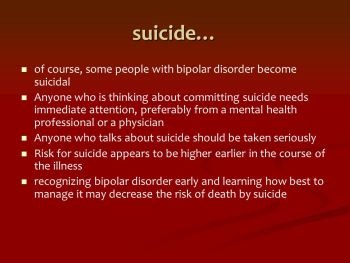
What is the risk of suicide when someone is diagnosed with bipolar disorder?
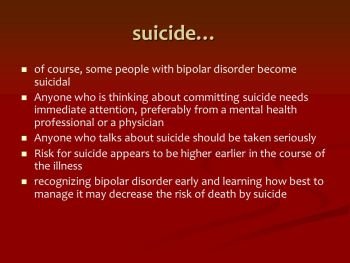
The overall mortality rate of bipolar disorder is two to three times higher than in the general population. About 10% to 20% of bipolar individuals commit suicide, and upward to one-third admit to at least one suicide attempt. The third with a history of suicide attempts have a number of additional risk factors. These risk factors include a family history of drug abuse and suicide (or attempts), a greater personal history of early traumatic stressors such as sexual and physical abuse, more hospitalizations for depression, a course of increasing severity of mania, more Axis I, II, and III conditions, and more time ill overall. Bipolar individuals with a history of suicide attempts experience more episodes of depression and react to them by having severe suicidal ideation. They demonstrate behaviorally an overall higher level of lifetime aggression and a pattern of repeated suicide attempts.
In addition, mania decreases impulse control. A person with mixed mania and depression is at an even higher risk of suicide attempts because he or she is generally irritable, dysphoric, anxious, energized, and behaviorally disinhibited. A person with poor impulse control may be more apt to attempt suicide because the time interval between the thought and the act can be instantaneous. Anyone with plans to kill him- or herself, or who has made an attempt, requires emergency psychiatric evaluation. In some situations, a family member finds out that someone has tried to kill him or herself but does not take him or her to an emergency room because of assurances to the family member that it was a mistake and that he or she will be okay. It is best, however, if a professional evaluates the situation to determine the most appropriate course of action.
Suicide is the most serious risk of bipolar disorder.
Clinicians assess suicide risk based on many factors, including the patient’s current mental status, personal history, family history, use of substances, and more. Suicidal thinking tends to fall on a continuum from morbid thoughts of death to passive thoughts of wishing to be dead to an actual plan to carry out the suicide, a continuum that is assessed by the clinician.
Clinicians will ask direct questions about suicidal thoughts. Direct questions do not put ideas in a person’s mind; rather, they invite the individual to speak openly about the issue. Most patients want help and want to let someone know how they are feeling. Also in this light, if you have reason to believe a family member is contemplating suicide, it is best to speak openly and frankly to that person about your concerns.
Doing so will not put new thoughts of suicide into the person’s mind; instead, it will give an opportunity to help him or her get the treatment that may be needed.
A family member committed suicide. I feel guilty that I missed something.
Suicide is the single most tragic outcome of patients suffering from mental illness. No matter how prepared someone thinks he or she is that a family member may eventually commit suicide because of his or her pain and suffering; it always feels unexpected and comes as a complete surprise. When it happens, everyone, including family, friends, and caregivers, feels shocked. Some are completely devastated with guilt about the loss. Small, seemingly insignificant events leading up to the person’s death, appearing at the time to be normal, take on a new and painful meaning in retrospect.
These events evolve into clear signs of the person’s commitment to the inevitable last act, thus heightening the feelings of guilt. There may be a sense of having let the person down, of saying the wrong thing, or not being there when he or she needed you most.
When looked at in retrospect, everyone asks himself or herself, “How could I have missed that?” These are perfectly normal feelings.
An exact science of predicting suicide is not presently established and probably never will be established. There are people who live their lives with chronic suicidal ideation and never act on their thoughts. There are people who engage in countless acts of cutting and overdosing without any significant physical harm to themselves. Alternatively, there are people who never think of suicide their entire lives until the moment they commit suicide. Despite the advances psychiatry has made in assessing and treating mental illness, it is only one of many risk factors that contribute to suicide.
Epidemiologists develop risk factors by looking at population aggregates of people who attempt or complete suicide and establishing the frequency that various factors correlate with suicide. But correlation does not mean causation. Although risk factors can help to assess someone who is at risk for suicide, they play little role in helping to predict if and when a person at risk will attempt or complete suicide. As a result, psychiatry is an inexact science at best, and the ability to predict suicide is worse than forecasting the weather. One can never underestimate the power of free will. Although guilt is a feeling one cannot control and is often a normal expected response under such circumstances, one is rarely guilty for another’s actions.
My son keeps going off his medication. He ends up back in the hospital and they keep him there for only a week or so before letting him out again. I am frustrated and angry. He needs long-term hospitalization. How can I get him that level of care?
The term noncompliance refers to a patient voluntarily stopping treatment against his or her physician’s recommendations. There are several reasons why noncompliance occurs. The most common reason is a failure to recognize that one has bipolar disorder. The second most common reason for noncompliance is having a personality disorder and/or an ongoing drug and alcohol problem. Other reasons that make compliance difficult include the number of medications one is taking and the number of health care providers one is seeing who are prescribing medications.
Once per day dosing is available for some medications and thus may improve compliance. Many medications have interactions, which further complicates matters because the interactions can lead to either increased side effects or loss of effectiveness. It is important to know the underlying reason and address it immediately to improve compliance.
Noncompliance in bipolar disorder reaches 66% and is the single biggest reason for relapse and rehospitalization, homelessness, and legal problems. The common denominator underpinning many of these reasons is the physician-patient relationship. In countries where respect for the physician’s authority remains high and relationships between physicians and patients develop over the years, rates of compliance are higher even when the patient denies having an illness. The critical factor is finding a physician who is able, available, and affable (the 3 A’s of a good physician). An able physician not only understands the research and complexity of psychiatric diagnoses and medications but also is capable of explaining that complexity in a manner that is simple and straightforward so that all the risks and benefits of being on or off the medications are clearly outlined. An available physician not only allows for timely appointments with adequate time during appointments but is also flexible with his or her time and can make time for urgent needs as well as urgent phone calls. An affable physician is warm and empathic, never arrogant or condescending. There are a lot of unknowns in medicine in general and psychiatry in particular. A good physician is one who admits ignorance and is willing to do the research to answer questions that he or she may not have immediate knowledge of at the time.
Finding a willing physician with the above qualities is the start of providing help to a family member developing compliance. Toward that end, becoming educated about bipolar disorder will help to develop realistic expectations and coping mechanisms for when things go wrong. Review “worst case scenarios” so that a crisis plan can be established. Instability is typically the rule at first because it is often very difficult to find the right medication or combination of medications that achieve stability without significant side effects.
During this time it is easy to become frustrated and discouraged. Frequent hospitalizations may occur and a lot of angry words can be exchanged between patient and family during this period. Educate and involve everyone in the family to improve the support system, which improves the odds of success. Everyone should know about the medications and their side effects, names of the health care providers and how to contact them, and even attend some appointments together.
Openness in communication is imperative. Bipolar disorder should be treated as you would treat any other medical condition. That means while a certain amount of respect for privacy should be maintained, issues of health, disability, or safety involve the whole family. Avoid health care providers who are unwilling to talk to family members and who hide under the old guise of psychotherapeutic privilege. This approach may be fine for the “worried well” patients, but for patients suffering from bipolar disorder it is generally the wrong approach to take. Family therapy can be useful toward that end. Getting involved with the local chapter of the National Alliance for the Mentally Ill (NAMI) to improve the support system available is also recommended.
Long-term hospitalization, for all intents and purposes, no longer exists, particularly for patients suffering from bipolar disorder. The seriously mentally ill have been increasingly cared for, supported, and treated in the community, with brief crisis hospitalizations occurring at local hospitals. The average length of stay, depending upon the geographic region, ranges from three to fourteen days with better than 90% of discharges occurring within the first five to seven days.
The purpose of these hospitalizations is primarily to reduce the risk of dangerousness or disability to a level that can generally be managed safely in the community. For most family members, this is generally a frustrating experience because their loved ones are usually still symptomatic. While you may disagree with the many ethical, social, and economic reasons for why this way of caring for the mentally ill occurs, it remains the current system of care. For this reason you must ensure the highest level of support is obtained in the community in order to achieve the highest level of success.
Toward that end, the local chapter of NAMI often becomes a repository for resource acquisition, and you should call upon it immediately to know what is available in your community.
Reasons for treatment noncompliance
- Failure to recognize one has bipolar disorder
- Comorbid personality disorder
- Ongoing drug and/or alcohol problem
- Fear of being labeled “crazy”
- Loss of the euphoria
- Fear of losing one’s creativity or personality
- A belief one has been cured
- Desire for more “natural remedies”
- Medication side effects
- Forgetfulness or loss of motivation due to depression
- Cost of medication
- Lack of access to health care and medication
Term:
Refractory depression – depressive illness that does not respond to a therapeutic intervention. The term is not typically applied unless such a lack of response occurred to several different interventions.