6 Metabolism Facts You Need to Know (If You Want to Lose Weight Faster)
HOW MUCH PROTEIN SHOULD YOU CONSUME?
CALCULATE YOUR RECOMENDED PROTEIN INTAKE!
How Much Protein Do You Need?
Healthy adults should consume enough dietary protein to replace the amount they use each day, whereas pregnant women, people recovering from surgery or an injury, and growing children need more protein to supply the necessary amino acids and nitrogen to build new tissue. Nitrogen balance studies have been used to determine how much protein individuals need to replace or build new tissue.
Healthy Adults Should Be in Nitrogen Balance
A person’s daily protein requirement can be estimated by using what we know about the structure of an amino acid.We know that 16 percent of every dietary protein molecule is nitrogen, and we also know that this nitrogen is retained by the body during protein synthesis. With this information, we can assess a person’s protein status by measuring the amount of nitrogen consumed and subtracting the amount of nitrogen excreted. The goal is to achieve nitrogen balance.
If the nitrogen intake from dietary protein is equivalent to the amount of nitrogen excreted (mostly as urea) in the urine, then a person is in nitrogen balance. Such an individual is consuming a balanced diet with adequate amounts of protein and excreting an equally balanced amount of nitrogen. Healthy, nonpregnant adults are typically in nitrogen balance.
A body that retains more nitrogen than it excretes is in positive nitrogen balance.
Rapidly growing babies, children or teenagers are all in positive nitrogen balance because their bodies use nitrogen to build new tissues that aid growth, build muscles, and expand the supply of red blood cells. They, therefore, excrete less nitrogen in their urine.When your mother was pregnant with you, she was in positive nitrogen balance because she was building a robust baby.
Negative nitrogen balance occurs when the body excretes more nitrogen than is consumed due to some physical impairment, such as a serious injury, infection, malnutrition, or other trauma, where the body cannot synthesize protein as quickly as it’s broken down. These situations all increase the body’s need for both calories and protein. If the calories and protein in the diet are inadequate to cover the increased demands, then proteins from tissues are broken down to meet the body’s needs.
While it is important to eat a sufficient quantity of protein to meet your needs, the quality of protein also matters.
Not All Protein Is Created Equal
A high-quality protein is digestible, contains all the essential amino acids, and provides sufficient protein to be used to synthesize the non-essential amino acids. Protein quality is determined by two factors: your body’s ability to digest the protein (the protein’s digestibility) and the types and amounts of amino acids (essential, nonessential, or both) that the protein contains. Proteins that are more easily digested and that contain both essential and nonessential amino acids are of higher quality.
Digestibility
The digestibility of proteins varies, depending on their source. In general, animal proteins are more digestible than plant proteins. Some of the plant proteins, especially when consumed raw, are protected by the plant’s cell walls and cannot be broken down by the enzymes in your intestinal tract. While 90 to 99 percent of the proteins from animal sources (cheese and other dairy foods, meat, poultry, and eggs) are digestible, only 70 to 90 percent of plant proteins, such as from chickpeas and other legumes, are typically digestible.
Amino Acid Profile
The second factor that affects protein quality concerns the types and amounts of amino acids that the protein contains, or its amino acid profile. A protein that provides all nine of the essential amino acids, along with some of the 11 nonessential amino acids, is considered a complete protein. A protein that is low in one or more of the essential amino acids is considered an incomplete protein. A complete protein is considered of higher quality than an incomplete protein. Protein from animal sources is typically the complete protein, whereas protein from plant foods tends to be incomplete.
Two exceptions to this generalization are gelatin and soy. Gelatin, an animal protein, is not a complete protein because it is missing the amino acid tryptophan. Soy, a plant protein, has an amino acid profile that resembles the protein needs in your body, making it a complete protein.
Any protein chain is only as strong as its weakest amino acid link. If a single essential amino acid is in low supply in your diet, and thus in your body, your ability to synthesize the proteins that you need will be limited. The amino acid that is in the shortest supply in an incomplete protein is known as the limiting amino acid. Imagine a jeweler trying to create a necklace. If the jeweler attempts to make a necklace using a diamond-ruby-emerald pattern with unlimited numbers of diamonds and rubies but only three emeralds, the emeralds are the limiting jewels in the pattern. After the third round of sequencing, the jeweler has run out of emeralds, and the necklace can’t be completed as designed. Because the full chain can’t be completed, the jewels have to be dismantled.
Similarly, when proteins are being synthesized in your body, all the amino acids have to be available at the same time to complete the protein. A half-synthesized protein can’t wait for the needed amino acids to come along to complete the process. Rather, the unfinished protein will be degraded, and the amino acids will be used to make glucose, be used as energy, or be stored as fat.
Does that mean that plant proteins are of less value in the diet? Absolutely not. When incomplete proteins are coupled with modest amounts of animal proteins or soy, which have all the essential amino acids, or combined with other plant proteins that are rich in the incomplete protein’s limiting amino acids, the incomplete protein is complemented. In other words, its amino acid profile is upgraded to a complete protein. You don’t have to eat the two food sources of the complementing plant proteins at the same meal to improve the quality of the protein source. As long as the foods are consumed in the same day, all the essential amino acids will be provided to meet your daily needs.
Once the digestibility and the amino acid profile of a protein are known, the quality of a protein can be determined.
Protein Scoring
The protein digestibility corrected amino acid score (PDCAAS), which is measured as a percentage, takes into account both the amino acid profile and digestibility of a protein to give a good indication of its quality. Milk protein, which is easily digested and meets essential amino acid requirements, has a PDCAAS of 100 percent. In comparison, chickpeas garner a PDCAAS of 87 percent, and wheat has a score of only 44 percent. If your only dietary source of protein is wheat, you are not meeting your essential amino acid needs.
The Food and Drug Administration (FDA) uses the PDCAAS to assess the quality of dietary proteins. On a food label, when protein is listed as a percentage of the daily value, this percentage is determined based on its PDCAAS.
You Can Determine Your Personal Protein Needs
There are two ways to determine protein intake in the diet. It can be measured as a percentage of total calories or as grams of protein eaten per day. The latest dietary recommendation, based on data from numerous nitrogen balance studies, is to consume from 10 to 35 percent of your total daily calories from protein. Currently, adults in the United States consume about 15 percent of their daily calories from protein, which falls within this range.
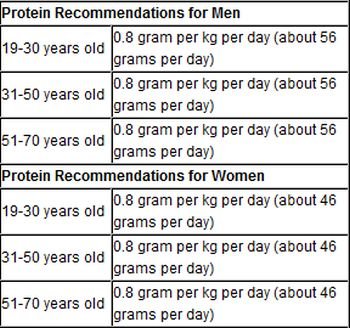
The current recommendation for the grams of protein that you need daily is based on your age and your weight. Adults age 19 and older should consume 0.8 gram (g) of protein for each kilogram (kg) of body weight. For example, a person who weighs 176 pounds (lb) would weigh 80 kg (176 lb / 2.2 = 80 kg) and should consume 80 kg x 0.8 g, or 64 g of protein a day. A person who weighs 130 lb should consume approximately 47 g of protein daily (130 lb / 2.2 = 59 kg x 0.8 g = 47 g). In the United States, men age 20 and older consume, on average, more than 100 grams of protein daily, while women of the same age consume, on average, 70 grams every day. As you can see, Americans are typically meeting and even exceeding, their dietary protein needs.
Even though most Americans consume more protein than they need, their percentage of daily calories contributed by protein (approximately 15 percent) falls within the recommended range. This is because they consume an abundant amount of calories from carbohydrates and fats, which lowers the percentage of their total calories coming from protein.
An overweight individual’s protein needs are not much greater than those of a normal-weight person of similar height. This is because the Recommended Dietary Allowance (RDA) for dietary protein is based on a person’s need to maintain protein dependent tissues like lean muscle and organs and to perform protein-dependent body functions. Because most overweight people carry their extra body weight predominantly as fat, not muscle, they do not need to consume significantly more protein than normal-weight people.
The American College of Sports Medicine, the American Dietetic Association, and other experts have advocated an increase of 50 to 100 percent more protein for competitive athletes participating in endurance exercise (marathon runners) or resistance exercise (weight lifters) to meet their needs. However, because of their active lifestyles, athletes typically have a higher intake of food and thus already consume higher amounts of both calories and protein. Protein supplements are not needed. Now let’s look at how you can meet your daily protein needs through a well-balanced diet.
Message
Protein quality is determined by the protein’s digestibility and by the types and amounts of amino acids (essential versus nonessential) it contains. Protein from animal foods is more easily digested than protein from plant foods. A complete protein, which is typically found in animal foods and soy, provides a complete set of the essential amino acids along with some nonessential amino acids. Plant proteins are typically incomplete, as they are missing one or more of the essential amino acids. Plant proteins can be complemented with protein from other plant sources or animal food sources to improve their protein quality.Adults should consume 0.8 gram of protein for each kilogram of body weight. In the United States, men, on average, consume more than 100 grams of protein daily, while women, on average, are consuming more than 70 grams in both cases, far more than is needed.
Terms:
Nitrogen balance – The state in which an individual is consuming the same amount of nitrogen (from protein) in the diet as he or she is excreting in the urine.
Protein quality – The measure of a protein’s digestibility and how its amino acid pattern compares with your body’s needs. Proteins that are more easily digested and have a complete set of amino acids are of higher quality.
Digestibility – A food’s capacity to be broken down so that it can be absorbed.
Amino acid profile – The types and amounts of amino acids in a protein.
Complete protein – A protein that provides all the essential amino acids that your body needs, along with some nonessential amino acids. Soy protein and protein from animal sources, in general, are complete.
Incomplete protein – A protein that is low in one or more of the essential amino acids. Protein from plant sources tends to be incomplete limiting amino acid. The amino acid that is in the shortest supply in an incomplete protein.
Complemented proteins – Incomplete proteins that are combined with modest amounts of animal or soy proteins or with other plant proteins that are rich in the limiting amino acids to create a complete protein digestibility corrected amino acid score (PDCAAS)
A score measured as a percentage that takes into account both digestibility and amino acid profile and gives a good indication of the quality of a protein.
Chickpeas are short of the limiting amino acid methionine. The addition of sesame seed paste, which has an abundance of methionine, completes the protein. Add garlic and lemon as seasonings for a completely delicious hummus.
Calculating Your Daily Protein
If You Are You Need
14–18 years old 0.85 g/kg
19 years old 0.80 g/kg
To calculate your needs, first convert your body weight from pounds (lb) to
kilograms (kg) by dividing by 2.2, like this:
Your weight in pounds: ______________ lb _ 2.2 _ ______________ kg
Then, multiply your weight in kilograms by 0.8 or 0.85:
Your weight in kilograms: ______________ kg _ 0.8 g _ ______________ g/day
Protein Supplements
Protein Shakes and Powders
Sometimes used by athletes in the belief that they’ll help build muscle, or as meal replacers by those looking to lose weight. In both cases, they are expensive and unnecessary. Athletes and bodybuilders can obtain adequate protein through a healthy diet, and don’t need extra shakes to bulk up. In fact, excessive amounts of protein can be unhealthy and produce undesirable results. While dieters may lose weight using a high-protein meal replacer, the same results can occur with a calorie-controlled meal of whole foods.
When it comes to losing weight, it’s the calories that count.
Amino Acid Supplements
Including those for individual amino acids such as tryptophan and lysine, these are marketed as remedies for a range of health issues, including pain, depression, insomnia, and certain infections, even though there are conflicting results from research studies. The reality is that consuming too much of any one amino acid can impede absorption of other amino acids in the intestinal tract. Further, over consuming specific amino acids can lead to side effects, such as nausea, lightheadedness, vomiting, and drowsiness. Your diet can provide all the amino acids you need.
Digestive Enzyme Supplements
Useless because they are broken down in the intestinal tract, and thus made ineffective. Your body manufactures all the enzymes needed to efficiently aid in the digestion of your foods. Spending money on these items is literally akin to flushing your hard-earned money down the toilet. A variety of protein-related products is heavily marketed and sold to young adults as the key to building muscle, losing weight, or curing a host of health problems. With very few exceptions, purchasing and consuming these products is, at best, a waste of money, and at worst, potentially harmful.