11 Incredible Health Benefits of Folate
Folate
What Is Folate?
There are two forms of the vitamin folate: the naturally occurring folate in foods and the synthetic form, folic acid, which is added to foods (such as ready-to-eat cereals and grains) and found in supplements. (A very small amount of folic acid can occur naturally in foods. But, for practical purposes in this book, folic acid always refers to the synthetic variety.)
Functions of Folate
Folate Is Vital for DNA Synthesis
Folate is vital to making the DNA in your cells. If the synthesis of DNA is disrupted, your body’s ability to create and maintain new cells is impaired. For this reason, folate plays many important roles, from maintaining healthy blood cells and preventing birth defects to possibly fighting cancer and heart disease. Folate also helps your body use amino acids and is needed to help red blood cells divide and increase in adequate numbers.
Folate Prevents Birth Defects
Folate plays an extremely important role during pregnancy, particularly in the first few weeks after conception, often before the mother knows she is pregnant. Folate is needed to create new cells so that the baby can grow and develop. A deficiency during pregnancy can result in birth defects called neural tube defects. The neural tube forms the baby’s spine, brain, and skull. If the neural tube doesn’t develop properly, two common birth defects, anencephaly and spina bifida, can occur. In anencephaly, the brain doesn’t completely form so the baby can’t move, hear, think, or function. An infant with anencephaly dies soon after birth. In spina bifida, the baby’s spinal cord and backbone aren’t properly developed, causing learning and physical disabilities, such as the inability to walk. Folic acid reduces the risk of these birth defects by 50 to 70 per cent if consumed at least the month prior to conception and during the early part of pregnancy.
Research studies to date suggest that synthetic folic acid has a stronger protective effect than the folate found naturally in foods.
Folate Reduces Some Cancer Risks
Inadequate amounts of folate in the body can disrupt the cell’s DNA, potentially triggering the development of cancer, and adequate intake of folate has been shown to help reduce the risk of certain cancers, specifically colon cancer. Studies show that men and women taking a multivitamin supplement or otherwise consuming the recommended amounts of folate have a lower risk of developing colon cancer.
Other studies show an association between diets low in folate and an increased risk of breast and pancreatic cancers.
Daily Needs
Your body absorbs the synthetic folic acid more easily than it absorbs naturally occurring folate. In fact, synthetic folic acid is absorbed 1.7 times more efficiently than most folate that is found naturally in foods. Because of this, your folate needs are measured in dietary folate equivalents (DFE). Most adults should consume 400 micrograms DFE of folate daily. While the foods in your diet analysis program database list the micrograms of folate as DFE, the Nutrition Facts panel on the food label doesn’t make this distinction. To convert the micrograms of folic acid found on the food labels of foods with folic acid added, such as enriched pasta, rice, cereals, and bread, to dietary folate equivalents, multiply the amount listed on the label by 1.7: 100 μg x 1.7 = 170 μg DFE
Because 50 per cent of pregnancies in the United States are unplanned, women at risk of becoming pregnant should consume 400 micrograms of synthetic folic acid daily from fortified foods or supplements, along with a diet high in naturally occurring folate. Women with a family history of neural tube defects should, under the guidance of their physicians, take even larger amounts.
Food Sources
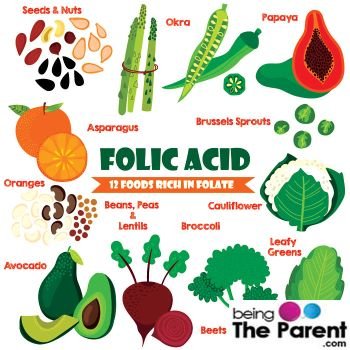
Since 1998, the FDA has mandated that folic acid is added to all enriched grains and cereal products. This enrichment program has reduced the incidence of neural tube defects by more than 25 per cent. Enriched pasta, rice, bread and cereals, legumes (dried peas and beans), leafy green vegetables (spinach, lettuce, collards), broccoli, asparagus, and orange juice are all good sources of this vitamin.
Too Much or Too Little
There isn’t any danger in consuming excessive amounts of naturally occurring folate in foods.
However, consuming too much folic acid, either through supplements or fortified foods, can be harmful to individuals who are deficient in vitamin B12. A vitamin B12 deficiency can cause anaemia and, more dangerous, crippling and irreversible nerve damage.
Too much folate in the diet masks the symptoms of B12- deficiency anaemia. Though the folate can correct anaemia, the nerve damage due to the vitamin B12 deficiency persists.
This delays a proper diagnosis and corrective therapy with vitamin B12. By the time the person is given the vitamin B12, irreversible nerve damage may have occurred. While, as you read, low folate intake may be associated with increased cancer risk, studies suggest that folate consumption double the DRI or even higher may increase the risk of cancer.
When it comes to folic acid, some is essential, but more may not be better.
A folate deficiency can also result in abnormally large and immature cells known as megaloblasts (megalo = large). These megaloblasts develop into abnormally large red blood cells, or macrocytes, that have a diminished oxygen-carrying capacity. Eventually, macrocytic anaemia causes a person to feel tired, weak, and irritable and to experience shortness of breath. Because folate acts with vitamin B12 to produce healthy red blood cells, a deficiency of either vitamin can lead to macrocytic anaemia.
An upper level of 1,000 micrograms has been set for folic acid from enriched and fortified foods and supplements to safeguard those who may be unknowingly deficient in vitamin B12.
Table Tips
Fulfil Your Folate Needs
Have a bowl of cereal in the morning.
Add chickpeas to your salad.
Enjoy a tossed salad with your lunch.
Add fresh spinach leaves to your sandwich.
Have a handful of crackers as a late afternoon snack.