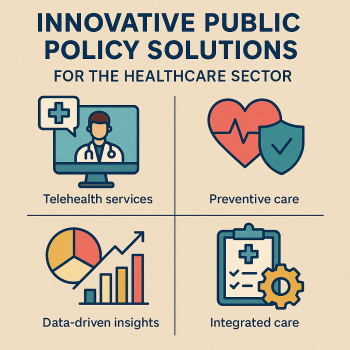
The healthcare sector is crucial for the well-being of any society. Developing innovative public policy solutions is essential to improve healthcare systems and ensure accessibility, efficiency, and quality.
Here are ten tips that can help shape effective healthcare policies.
First, prioritize prevention over treatment. Many health issues can be prevented through education and early intervention. For instance, public health campaigns promoting vaccination and healthy lifestyles can significantly reduce the incidence of diseases like diabetes and heart disease.
Second, encourage community-based healthcare. Implementing policies that support local health initiatives can promote better health outcomes. For example, setting up community health centers can provide essential services to underserved populations, ensuring they receive necessary care close to home.
Third, increase funding for mental health services. Mental health is often neglected in public policies. Increased funding can help expand services and reduce the stigma surrounding mental health, making it easier for individuals to seek help.
Fourth, utilize technology effectively. Telemedicine gained considerable traction during the COVID-19 pandemic, showcasing how technology can improve patient access to care. Policies that support telehealth can provide more options for patients and help reduce the burden on physical healthcare facilities.
Fifth, focus on workforce development. A skilled healthcare workforce is vital for an effective system. Policymakers should invest in education and training programs to ensure that healthcare professionals are well-prepared to meet the needs of their communities.
Sixth, promote collaboration among different sectors. Healthcare does not exist in a vacuum; factors like education, housing, and transportation also affect health. Policies that encourage collaboration between healthcare providers, government agencies, and community organizations can result in holistic solutions.
Seventh, ensure transparency in healthcare pricing. Many patients find it challenging to understand healthcare costs, leading to financial stress. Policies that promote price transparency can empower patients to make informed choices and drive competition among providers.
Eighth, address health disparities. Different segments of the population experience healthcare inequities based on factors like race, ethnicity, and socio-economic status. Targeted policies that aim to eliminate these disparities can lead to overall improved health in communities.
Ninth, incentivize research and innovation. Supporting new research initiatives can lead to groundbreaking advancements in healthcare. By funding research in areas such as vaccines and treatments, public policies can help drive innovation that enhances patient care.
Finally, involve community members in policy development. Engaging those affected by healthcare policies in the decision-making process ensures that their needs and preferences are considered, ultimately resulting in more effective policies.
In conclusion, the healthcare sector faces many challenges, but innovative public policy solutions can pave the way for a more efficient and equitable system. By prioritizing prevention, leveraging technology, and ensuring transparency, policymakers can create a more robust healthcare environment that benefits everyone.
References:
Narath Carlile, Robin Williams, Kathrin Cresswell, and Aziz Sheikh. “Journal of Medical Internet Research – Accelerating Innovation in Health Care: Insights From a Qualitative Inquiry Into United Kingdom and United States Innovation Centers.” www.jmir.org, 25 Sep. 2020, https://www.jmir.org/2020/9/e19644/.
Sherry, Raphael, Wittenberg, and Avi. “Research in government and academia: the case of health policy | Israel Journal of Health Policy Research | Full Text.” ijhpr.biomedcentral.com, 01 Dec. 2018, https://ijhpr.biomedcentral.com/articles/10.1186/s13584-018-0230-3.
Kathryn, Bonell, Jane, Chris, Lorenc, Oliver, and Tinkler. “Understanding the unintended consequences of public health policies: the views of policymakers and evaluators | BMC Public Health | Full Text.” bmcpublichealth.biomedcentral.com, 01 Dec. 2019, https://bmcpublichealth.biomedcentral.com/articles/10.1186/s12889-019-7389-6.
Isahaque Ali, Azlinda Azman, RB Radin Firdaus, Maslina Mohammed Shaed, Kang Chao, and Md Nazirul Islam Sarker. “Big data-driven public health policy making: Potential for the healthcare industry – PMC.” pmc.ncbi.nlm.nih.gov, 31 Aug. 2023, https://pmc.ncbi.nlm.nih.gov/articles/PMC10558940/.
Jamie F Chriqui, and Ross C Brownson. “Understanding Evidence-Based Public Health Policy – PMC.” pmc.ncbi.nlm.nih.gov, 01 Sep. 2009, https://pmc.ncbi.nlm.nih.gov/articles/PMC2724448/.
Unknown Author. “Untitled.” www.sciencedirect.com, https://www.sciencedirect.com/science/article/pii/S0168851018306341.
Stewart Alford, Linda Fraser, Tracey Silvester, Jennifer Kosiol, and Helen Cooper. “Revolutionising health and social care: innovative solutions for a brighter tomorrow – a systematic review of the literature – PMC.” pmc.ncbi.nlm.nih.gov, 12 Jul. 2024, https://pmc.ncbi.nlm.nih.gov/articles/PMC11241933/.
Margaret Chustecki. “Interactive Journal of Medical Research – Benefits and Risks of AI in Health Care: Narrative Review.” www.i-jmr.org, 18 Nov. 2024, https://www.i-jmr.org/2024/1/e53616.