VIDEO
High Blood Pressure Tips & Treatments : Exercising to Achieve Target
Non-pharmacological treatment
Exercise
If I start an exercise programme now, what will that achieve?
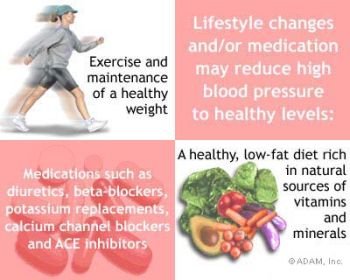
Although the immediate effect of exercise is to raise BP, the longterm effect of regular exercise is to reduce BP by about 5/3 mmHg (i.e. 5 mmHg systolic and 3 mmHg diastolic BB). Regular exercise also reduces a wide range of important risk factors for coronary heart disease and stroke: it reduces harmful LDL and VLDL blood cholesterol (see the section above on cholesterol), raises protective HDL blood cholesterol, and reduces the blood clotting factor fibrinogen. It reduces bodyweight by increasing energy output, and helps you to keep to a healthy diet by raising morale. In the same way, regular exercise often helps people to stop smoking.
Exercising more helps to reduce your coronary heart and stroke risk by between 20-40% compared with those people who live sedentary lives. Their risk of cardiovascular disease would be lowered by increasing their levels of activity. High levels of exercising are associated with about 3 extra lives saved per 1000. The benefits of exercise can be seen significantly on a long-term basis.
I do some brisk walking. How much would benefit me?
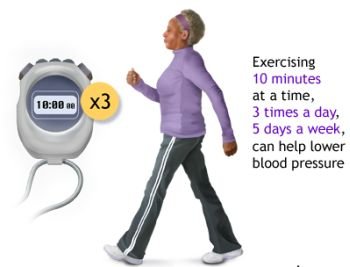
There have been many studies assessing various type of exercise including walking/jogging, cycling, swimming or combinations of exercise. The ideal time is about half an hour to an hour, three times per week. These levels of activity reduce BP levels in both people with high and normal BP. The size of benefit in exercising compared to non-exercising groups is a lowering of BP in the region of 5 mmHg systolic and 3 mmHg diastolic BP.
There is some evidence that exercise is of greater benefit in people with higher initial BP readings. How hard and often should I exercise?
A lot depends on how much you exercise now. We would not recommend that you start taking vigorous exercise when you have previously been living a sedentary life. However, even moderate exercise, equivalent to brisk walking, helps towards improved fitness, wellbeing and reduction in BP. Our advice is that, if you’ve been leading a previously sedentary life, you should consult your doctor to make sure that you’re not overambitious
to start with. You should start moderate exercise for a minimum of half an hour, three times per week. You can then build up your exercise programme depending on how you feel. The first rule for all successful exercise programmes is for people to do what they want, what interests them. A serious problem for many people is that many forms of sustained exercise are boring. You are far more likely to establish regular Non-pharmacological treatment new habits and stick to them, if you enjoy what you are doing.
• Cycling is an excellent exercise for everyone except people with back problems, although even they can manage if they get a really wide, well-sprung seat and high handlebars.
• Swimming is an ideal form of exercise for older people or people with arthritis, because your body is weightless and movements may become almost painless when you are immersed in water. If you don’t know how to swim, ask at your local pool for beginners’ classes – most have then for all ages. Learning to swim properly will keep your head in alignment with your spine – swimming with your head out of the water can create neck problems.
People with established high BP should avoid extremely vigorous or competitive sports such as squash, and static exercises like weight-lifting and push-ups, all of which may raise BP for a short time to dangerous levels. Jogging, long-distance running and non-competitive cycling are all suitable forms of exercise providing you start slowly, train up gradually, and generally use some common sense. A local gym might be able to help you work out a suitable regimen for you.
Could I harm myself from too much exercise?
Muscular skeletal strains, sprains and other injuries are the commonest problems associated with people who have previously been sedentary. We recommend that exercise should be graded, started at a low level of intensity and built up over a period of time. There is a small risk of sudden death associated with strenuous activity but, in absolute terms, this is very rare. It happens in less than 1 per 10,000 person-hours of exercise. Sudden death is greatest among people who have been previously sedentary. Risk of suffering a heart attack is substantially greater in relative terms in people who were previously sedentary, so start slowly and gradually builds up your exercise programme.