VIDEO
The Importance of Good Sleep for Those with Bipolar Disorder
I can’t sleep and have racing thoughts. I thought I was just really anxious, but now wonder, could I have bipolar disorder?
Many symptoms people experience occur in a variety of conditions described in the DSM-IV-TR. Anxiety is a term that connotes a feeling of psychic discomfort.
It often includes a sense of fear of impending doom that may or may not accompany a clear sense of its source and feels out of proportion to whatever is causing the anxiety. There are several types of anxiety disorders: panic disorder, agoraphobia, specific phobia, social phobia, obsessive-compulsive disorder, posttraumatic stress disorder, acute stress disorder, and generalized anxiety disorder.
Anxiety disorders may be associated with physical symptoms along with psychological discomfort. When the physical discomfort becomes extreme, anxiety is often referred to as panic. Physical symptoms associated with panic include shortness of breath, light-headedness, numbness and tingling (paresthesias), chest pain, palpitations, stomach upset, and diarrhea.
Psychological symptoms are more difficult to characterize, but they include such feelings as worry, fear, dysphoria, distress, and agitation or irritability, along with a sense of impending doom. Distressing thoughts often go along with those feelings. The thoughts usually center on whatever the worrisome issue is, such as deadlines for accomplishing tasks, concerns regarding performance, and fears of impending bad outcomes resulting from recent decisions (such as financial, personal, health, or career ruin).
Some of these fears can be reality based though they are usually grossly distorted. The worries are often ruminative in nature and can be quite distracting. They are particularly bothersome when the mind is unfocused, which occurs most often at night when trying to fall asleep. These nagging worries often snowball into other worries at that point in time, leading to insomnia and the subjective feeling that one’s thoughts are racing. This can in turn lead to physical agitation and hyperactivity. One can have a short fuse from lack of sleep and lowered frustration tolerance, leading to frequent arguments with others.
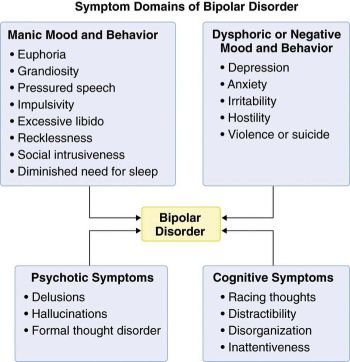
When comparing the symptoms of some anxiety states with manic states one is immediately struck by a number of similarities-insomnia, “racing thoughts,” irritability, distractibility, and lowered frustration tolerance.What looks like hyperactivity to others may actually be a subjective feeling of restlessness. Anxiety and mania both can be precipitated by stress. Although stress can be an ill-defined concept, everyone can appreciate what it means when a stressful life event occurs. Most initial reactions to stress are accompanied by anxious and irritable feelings.
Anxiety and mania have some important differences, however. Mania can be associated with predominant irritability, but it is more typically experienced as euphoria with the irritability occurring when one feels that his or her goals are being frustrated by others. Anxiety, on the other hand, is distinctly dysphoric.
The nature of insomnia in the two disorders is also different. Manic patients just don’t feel they need to sleep, nor do they want to sleep. They are certainly not distressed by their lack of sleep. In fact, they have too many things they need to accomplish to worry about getting sleep. Additionally, their racing thoughts are not unwanted or distressing but instead filled with wonderful ideas of things to accomplish. Their thoughts are generally ego-syntonic.
Those with anxiety, alternatively, desperately seek sleep in order to escape their thoughts and worries. They want their minds to turn off and plead for something to stop their racing thoughts because such thoughts are psychologically painful, or ego-dystonic. As a result, although patients with anxiety may appear hyperactive and agitated, they subjectively feel exhausted and greatly desire escape from their feelings in the form of sound, uninterrupted sleep.
Clinical studies have also demonstrated high comorbidity between bipolar disorder and panic disorder, obsessive-compulsive disorder, social phobia, and posttraumatic stress disorder. In a recent study, more than half of bipolar patients had a comorbid anxiety disorder. Those with the combination of the two conditions usually had a younger age of onset, functioned more poorly, and had a greater likelihood of attempting suicide, in addition to having a poorer chance of recovery. Increasingly, evidence is demonstrating that anxiety associated with any psychiatric condition increases the risk of attempting suicide several fold.
Thus it is critical to have anxiety properly treated in addition to the mood instability. Psychobiological mechanisms that may account for these high comorbidity rates likely involve a complicated interplay among various neurotransmitter systems and their response to environmental stimuli that are perceived by the organism. These neurotransmitter systems include norepinephrine, dopamine, gammaaminobutyric acid (GABA), and serotonin. Moreover, certain antimanic medications clearly have antipanicproperties and may have anxiolytic or anti-anxiety properties as well (e.g., Equetro (carbamazepine), Depakote (sodium valproate), and possibly antipsychotics).
Some anxiolytics (e.g., gabapentin and benzodiazepines other than alprazolam) as well can be particularly useful in treating acute mania in bipolar patients who also suffer from anxiety.
Terms:
Paresthesias – presence of numbness and tingling in limbs. Often a symptom in anxiety disorders.
Dysphoria – an emotional state of feeling unhappy or unwell.
Ego-syntonic – that which is acceptable to the self (ego).
Ego-dystonic – that which is unacceptable to the self (ego).
Comorbidity – the presence of two or more mental disorders, such as depression and anxiety.
Recovery – achievement of baseline, premorbid functioning after successful treatment for a mental illness. Recovery is the term used after a time period of six months symptom free. Up to that point the term used is remission.
Anxiolytic – a substance that relieves subjective and objective symptoms of anxiety.
Antipsychotic – a drug that treats psychotic symptoms, such as hallucinations, delusions, and thought disorders. Antipsychotics can be used to treat certain mood disorders as well.