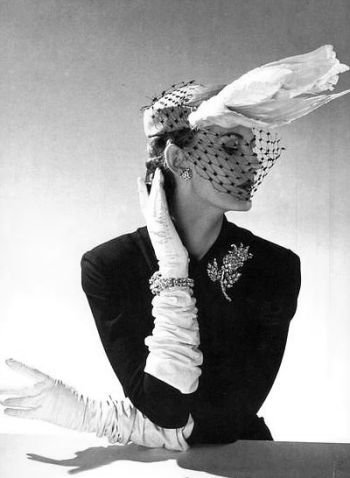
Jacques Fath 1951
Evolution of the ready-to-wear designer
In her 1937 book Clothes Line, the British fashion journalist Alison Settle wrote that the interconnected nature of the Parisian haute couture industry was crucial to its success. Fabric, dress, and accessory designers and makers were in close contact with each other, and could respond to developments within each field. Trends were therefore identified quickly and integrated into couturiers’ collections, allowing Paris to maintain its position at the forefront of fashion. Settle was also impressed by how embedded fashion was within French culture, with people of all social classes interested in clothing and style. As Settle noted, couturiers ‘forecast fashion by observing life’, and this approach was particularly significant in the evolution of the ready-to-wear fashion designer. Couturiers realized that many women wanted to buy clothes that were not just in line with contemporary styles, but which were made by a fashionable name.
From the early 1930s, designers began to create less expensive collections, which could reach out to this wider audience. Lucien Lelong, for example, started his ‘Lelong E´ dition’ line, selling readymade dresses at a fraction of the cost of his couture collection. Couturiers continued to work on readymade clothes; for example, in the 1950s, Jacques Fath designed a successful line for American manufacturer Joseph Halpert. However, when Pierre Cardin launched a ready-to-wear collection at Parisian department store Printemps in 1959, he was briefly expelled from the Chambre Syndicale de la Haute Couture, which regulates the couture industry, for branching out in this way without seeking permission. At the same time, Cardin was exploring the potential market in the Far East, in his quest for global success. These moves, when considered in relation to his bold, modern style, were part of a shift in emphasis in French fashion, as couturiers strove to maintain their influence in response to the increasing success of ready-to-wear designers. In 1966, the launch of Yves Saint Laurent’s Rive Gauche boutiques chimed with popular culture and recognized women’s changing roles with trouser suits and vividly coloured separates. Saint Laurent showed that couturiers could set fashions through their ready-to-wear collections too.
In a 1994 interview with Alison Rawsthorn, one customer, Susan Train, described his new line as ‘so exciting. You could buy an entire wardrobe there: everything you needed.’ However, the 1960s is generally viewed as a key moment when mass-produced, youthful ready-to-wear began to lead fashion in a way it never had before. American designers such as Bonnie Cashin, British names, for example Mary Quant, and Italians, including Pucci, were all asserting their fashion influence at different levels of the market and shaping the way fashion was designed, sold, and worn.
While ready-to-wear clothes had been developing independently of Parisian haute couture since the 17th century, it was not until the 1920s that they were designed and marketed principally on their fashion values, rather than their price or quality. In Paris, this meant couturiers spent the following decades making agreements with department stores internationally to sell versions of their couture garments, as well as evolving their own lines. In America, manufacturers, including Townley, and stores such as Saks Fifth Avenue were quick to employ designers to work anonymously to develop fashion lines.It were in the 1930s that these designers began to emerge from anonymous back rooms and have their names included on labels.
In New York, Dorothy Shaver, vice-president of specialty store Lord & Taylor, began a series of campaigns promoting American ready-to-wear and made-to-order designers alongside each other.
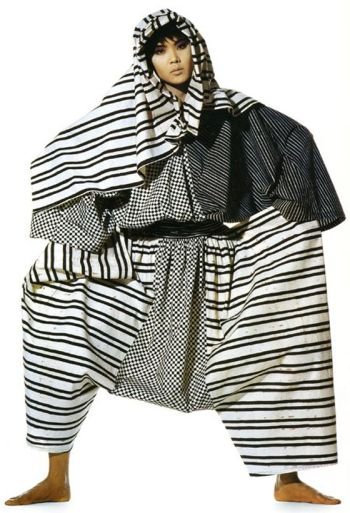
Window and in-store displays included photographs of named designers shown with their fashion collections, encouraging a cult of personality that had previously been reserved for couturiers. This was partly an attempt to encourage homegrown talent while the hardships of the Great Depression made trips to Paris to source fashions too costly. It was also symptomatic of fashion designers’ need to group together in order to promote the status of their own fashion capitals. While Paris maintained its place at the heart of fashion, by the 1940s, in the absence of French influence during the war, New York had begun to assert its fashion status. Subsequently, cities across the world have followed the same process, investing in design education, holding their own fashion weeks to promote their designers’ collections, and seeking to sell both domestically and internationally. The role ofthe fashion designer is vital to this process, once again providing creative impetus combined with recognizable faces that could be used as the basis for promotional campaigns. In the 1980s, Antwerp and Tokyo each demonstrated their ability to develop distinctive fashion designers, with the rise of names such as Ann Demeulemeester and Dries Van Noten in Belgium, and Rei Kawakubo of Comme des Garc¸ons and Yohji Yamamoto in Japan.
By the early 21st century, China and India, amongst others, were also investing in their fashion industries and cultivating their own seasonal shows. The way designers are trained influences their approach to creating a collection. For example, British art colleges emphasize the importance of research and individual creativity. This stress upon the artistic elements of the creative process produces designers, such as Alexander McQueen, who are inspired by history, fine art, and film. His collections have been staged on themed sets, with models writhing in a huge glass box, or sprayed by a mechanical paint jet as they turn slowly on a rotating platform. His models are styled as characters, part of a narrative that is told through clothes and setting. His cinematic approach was apparent in his spring 2008 collection, which was inspired by the 1968 film They Shoot Horses Don’t They? This prompted a Depression-era dance marathon theme, choreographed by avant-garde dancer Michael Clark. Models slid across a dance floor, dressed in fluid tea dresses and worn denims, their skin glistening and eyes glazed as if they had been dancing for hours, half-carried, half-dragged by male dancers. McQueen’s promotion of fashion as spectacle underpins the success of his label and testifies to his creative appeal.
In contrast, colleges in the United States tend to encourage designers to focus on creating clothes for a particular customer group and to keep business considerations and ease of manufacture at the forefront of their minds. They use industrial design as a model to promote an ideal of democratic design that aims towards the greatest number of potential consumers. The work of designers such as Bonnie Cashin from the 1930s to 1980s is a good example of how this approach can lead to measured collections that aim to address women’s clothing needs. Her designs looked streamlined, while demonstrating close attention to detail, with interesting buttons or belt buckles to enliven their plain silhouettes. In 1956, Cashin told writer Beryl Williams that she believed that 75% of a woman’s wardrobe comprised ‘timeless’ pieces, and stated that ‘all those clothes of mine were perfectly simple . . . they were simply the kind of clothes I liked to wear myself ’. She designed lifestyle clothes for work, socializing, and leisure time, while promoting herself as the embodiment of her easy-to-wear styles. This type of design has come to characterize American fashion, but its simplicity can make it difficult to define a distinct image for a label. Between the late 1970s and late 1990s, Calvin Klein used controversial advertising campaigns to gain publicity for his clothing and perfume lines.
Imagery such as the photograph of a teenage Kate Moss, nude and androgynous for Obsession in 1992, provided him with an edgy, contemporary image that belied the conservative styling of many of his designs. While these designers have relied on the idea of the individual as fashion originator, many fashion houses employ whole teams of designers to produce their lines. For this reason, Belgian designer Martin Margiela refuses to give individual interviews, and avoids having his photograph taken. All correspondence and press releases are signed ‘Maison Martin Margiela’. In 2001, in a faxed interview with fashion journalist Susannah Frankel on Maison Margiela’s alternative approach to fashion, the choice to use non-professional models was explained as part of this overall strategy: ‘We have nothing against professional or ‘‘top models’’ as individuals at all, we just feel that we prefer to focus on the clothes and not all that is put around them in and by the media.’
His labels are blank or stamped with the number of the collection a garment comes from. This deflects attention from the individual designer and suggests the collaborations necessary to make a fashion collection, while acting to distinguish his work. For other designers, the emphasis is placed more on their celebrity customers, who add a glamorous aura to their collections. In the early 21st century, American designer Zac Posen benefited from young Hollywood stars, including Natalie Portman, wearing his dresses on the red carpet. The coverage that stars receive at such events can boost sales for new designers, as well as established fashion houses, as shown by Julianne Moore’s successful championing of Stefano Pilati’s designs for Yves Saint Laurent.
Menswear designers have also risen to the fore during the 20th century, although they do not command the same level of attention as women swear designers. Designs tend to focus on suiting or leisurewear, and menswear is perceived as lacking the spectacle and excitement attached to women swear. However, designer names began to emerge in the 1960s, with, for example, Mr Fish in London and Nino Cerruti in Italy. Both exploited the more flamboyant designs of the decade to the full, with vibrant colours and pattern and unisex elements included in their designs.
Michael Fish evolved his style while working within the elite environment of Savile Row, before opening his own boutique in 1966. Meanwhile, Cerruti’s sleek designs evolved out of his family’s fabric business, launching his first full menswear collection in 1967. Parisian couturiers also branched out into menswear design, including Yves Saint Laurent in 1974. In the 1980s, designers continued to explore the parameters of menswear design, focusing on adaptations of the traditional suit. Giorgio Armani stripped out its stiff underpinnings to create soft, unstructured jackets in wools and linens, while Vivienne Westwood tested the limits of gender boundaries in fashion, adding beading and embroidery to jackets or putting male models in skirts and leggings.
Since the 1990s, the rich colours and textures of Dries Van Noten’s collections, and the innovative fabrics in Prada’s designs, for example, have shown that menswear design can attract attention for subtle details. The growth of male grooming and fitness culture has added to interest in the field. In the early 21st century, designers such as Raf Simons, and especially Hedi Slimane, who designed for Dior Homme from 2000 to 2007, developed a skinny silhouette for men, which was very influential. Slimane’s narrow trousers, monochrome palette, and tightly fitted jackets required a youthful physique that was androgynous and uncompromising.
The speed with which celebrities and rock stars, as well as high street stores, adopted this look demonstrated the power and influence that confident menswear design could have. One of the strongest reference points in menswear collections since the 1960s has been subcultural style. From the narrow suits worn by sixties Mods to the pastel leisurewear of eighties Casuals, street style balances individuality and group identity.
It therefore appeals to many men’s search for clothing that acts as a kind of uniform, while simultaneously allowing them to add their own personal touches. Members of subcultures in many ways design themselves through their style, by customizing garments or breaking mainstream rules about how clothing should be worn or combined. In the late 1970s, this DIY ethos was epitomized by Punks, who adorned their clothes with slogans and safety pins, ripping the fabric and creating their own individual interpretations of classic leather biker jackets and T-shirts. While since the mid-1990s Japanese teenagers of both sexes have made their own clothes, combining them with elements of traditional dress such as obi sashes to create a wide variety of styles, united by their love of exaggeration and fantasy. By referring to these practices, fashion designers can add a seemingly rebellious edge to their collections.
Indeed, since the 1990s, fashion consumers have increasingly sought to individualize their look by customizing garments and mixing designer, high street, and vintage clothes. This enables them to act as designers themselves, if not always of individual garments, then of the look and image they wish to convey. The idea of the ‘fashion victim’ of the 1980s who wore complete outfits by one designer has led many wearers in reaction to seek to express their own creativity through the way they adapt and style themselves, rather than relying on designers to construct an image for them. This approach mimics both subcultural style and the work of professional stylists. It reflects a developing knowingness amongst certain consumers, and their wish to be both part of fashion yet above its dictates. While the 20th century undoubtedly saw the establishment of the designer name as the guiding force in fashion, this has not gone unchallenged.
The 1980s was perhaps the apex of the cult of the designer, and while many labels are still revered, they must now compete both with a wider number of global rivals and with many consumers’ desire to design themselves, rather than unquestioningly obey fashion trends.