Andy Warhol – The Complete Picture
Art
Andy Warhol’s Diamond Dust Shoes of 1981 shows a cluttered array of bright, jewel-coloured women’s pumps set against an inky-black background. Based on a photographic screen print, the shoes are shot from above, the viewer seemingly looking down on a wardrobe floor, crowded with odd shoes. A vertiginous tangerine stiletto presses up next to a more demure, tomato-red rounded toe; while a brocaded midnight-blue evening slipper lies next to a salmon-pink, bow-adorned court shoe. The colours are overlaid onto the image and produce a cartoonish pastiche of the multitude of styles and shapes of shoes available.
The picture is cropped to give the impression that the pile of shoes is limitless, glimpses of the pointed tip of a lilac boot, for example, peek in at the edge of the frame. The image is carefully composed; despite the apparent jumble, each shoe is artfully displayed, with just enough inner labels visible to reinforce their high fashion status. It evokes the fashion image and the shoe shop, and thus refers to the combination of visual and literal consumption so fundamental to fashion. Warhol’s painting is slick with the shine of polymer paint, an effect enhanced by the fact that the whole surface of the image is scattered with ‘diamond dust’, which glitters and dazzles the viewer as it catches the light. Its shimmering surface makes explicit reference to fashion’s glamour and ability to transform the mundane.
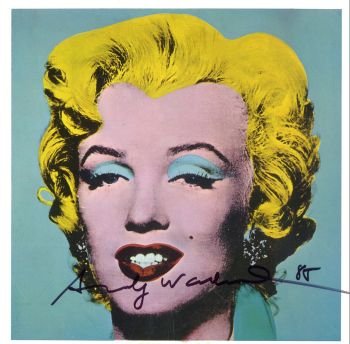
In the late 1950s, Warhol had worked as a commercial artist, with clients including I. Miller shoes. His drawings for them were sinuous and light, graphically evoking shoes’ seductive appeal. His alliance to commerce and love of popular culture meant that fashion was a perfect subject for him. It featured in his screen prints and other artworks, and he continually used clothing and accessories, including his famous silver wigs, to alter and play with his own identity. In the 1960s, he opened a boutique, Paraphenalia, selling a mix of fashionable labels such as Betsey Johnson and Foale and Tuffin. Paraphenalia’s launch included a performance by the Velvet Underground, and therefore united the varied strands of Warhol’s entrepreneurial artworks. He understood the alliance between fashion, art, music, and popular culture that was crystallized during this decade. The marriage of avant-garde pop music with throwaway, experimental clothes that relied on brightly coloured metals, plastics, and clashing prints did not merely express the creative excitement of the period, it helped to define its parameters. For Warhol, there was no hierarchy of art or design forms. Fashion was not condemned for its commercial imperative, or its transience.
Instead, these inherent qualities were flaunted in his work, as part of his fascination with the fast pace of contemporary life. Thus, the dazzling surface of Diamond Dust Shoes celebrated fashion’s focus on outer appearance and spectacle, while his boutique brought attention to the commercial transactions and consumerist drive at the heart of fashion, and indeed much of the contemporary art market. In Warhol’s art, fashion’s supposed flaws of ephemerality and materialism become comments on the culture that spawned it. For Warhol, elements of mass culture and high-end luxury could coexist, in the same way that they did in fashion magazines or Hollywood films. In his work, multiples and one-offs were given equal status, and he moved easily from one medium to another, fascinated as much by the possibilities of film as of screen printing or graphic design. Rather than feeling this limited his work, or that commerce should be excluded from art for it to be legitimate, Warhol embraced contradictions. In his 1977 book The Philosophy of Andy Warhol (From A to B and Back Again), he wrote of the blurred boundaries that drove his art: Business art is the step that comes after Art. I started as a commercial artist, and now I want to finish as a business artist. After I did the thing called ‘art’ or whatever it’s called, I went into business art. I wanted to be an Art Businessman or a Business Artist. Being good in business is the most fascinating kind of art.
Since the mid-19th century, fashion had increased in pace, reached out to a wider audience, embraced industrial processes, and used spectacular methods to sell its wares. Art also went through this cycle of change; art markets grew to embrace the middle classes, mechanical reproduction altered ideas of exclusivity, and institutional and private galleries re-thought the way artworks were displayed and sold. There also existed a crossover in thematic concerns between the two disciplines, from issues of identity and morality, to concerns over the way the artist or designer was perceived within the wider culture, and a focus on representation of and play with the body.
Fashion is occasionally cast as art, but this is problematic. Some designers have appropriated aspects of art practice in their own work, but they remain within the structure of the fashion industry and use these borrowed methods to explore the nature of fashion itself. When, for example, in their early career, Viktor and Rolf decided just to stage fashion shows rather than produce any saleable clothes, their designs became one-offs, rare pieces that existed only as comments on the role of the show within the fashion system, rather than wearable garments. However, their work remained within the context of the fashion world, discussed and reviewed by fashion journalists. It seemed like evolving advertising campaigns for the collections they later showed, which were put into production. Their work also served to underline the differences between types of designers. Viktor and Rolf’s interpretation of fashion incorporated a fascination with the role of the show, and its potential to test the boundaries of spectacle and display. They slip between art, theatre, and film in the staging of their collections. For autumn/winter 2000, the designers slowly dressed a single model in layer upon layer of garments, until she wore the whole collection. This commented on the process of fitting clothes on the body, which lies at the core of traditional fashion design. The exaggerated scale of the final clothes she was swathed in seemed to turn her into an immobile doll, a living mannequin, and the plaything of the designers. In 2002/3’s show, all the clothes were bright cobalt, and acted like the blue screen used to shoot special effects in television and cinema.
Film was projected across the models’ bodies, which made their figures disappear and seem to flicker as images hovered across their surface. In Viktor and Rolf’s designs and presentations, artistic methods are used to comment on the practice of fashion, but this does not necessarily turn their fashion into art. Their work is shown in the context of the international fashion weeks, it is directed to a fashion audience, and addresses the way clothing and body interact. Even when they were not putting their clothing into production, they followed the fashion seasons, and importantly, they adhered to the fundamental elements of fashion: fabric and body.
Fashion is sometimes compared to art in order to give it greater validity, depth, and purpose. However, this perhaps reveals more about Western concern that fashion lacks these qualities than it does about fashion’s actual significance. A Balenciaga dress from the 1950s, when displayed in a pristine glass case in a gallery, may appear like a work of art. However, it does not need to be described as such in order to convey its value or the skill that went into its creation. Like other design forms, such as architecture, fashion has its own particular concerns that prevent it from ever being purely art, craft, or industrial design. It is, rather, a three-dimensional design form that incorporates elements of all these approaches. It is Balenciaga’s exacting eye for precise form that brings balance and drama to the drape and structure of the fabric, combined with the craft skill of his atelier workers that turns it into an exceptional piece of fashion clothing. It does not need to be called art in order to validate its status, and this term ignores the reason, beyond his desire to create and test the parameters of fashion design, that Balenciaga’s dresses were brought into being: to clothe a woman, and, ultimately, to sell more designs. This should not be seen to diminish his achievement, but to help to understand the way he has worked to exploit these ‘limitations’ to create fashions that can inspire the viewer as much as the wearer.
Fashion should be understood on its own terms, and this makes its interactions with other aspects of art and culture more interesting. It opens up the way art, design, and commerce connect and overlap in some practitioners’ work. Indeed, one of the things that makes fashion so fascinating, and for some, so problematic, is the fact that it continually appropriates, reconfigures, and tests the boundaries of these definitions. Thus, fashion can highlight tensions concerning what is valued in a culture. Designers and artists as diverse as Andy Warhol and Viktor and Rolf produced work that played upon cultural contradictions and attitudes. In fashion’s case, focus on body and cloth, and the fact that it is, usually, designed to be worn and sold, distinguishes it from fine art. However, this does not prevent fashion from being meaningful, and the art world’s continued fascination with fashion underlines its cultural significance.
Portraiture and identity
Perhaps the most obvious connection between fashion and art is the role clothing has played within portrait painting. In the 16th century, the Reformation’s impact in Northern Europe led to a decline in commissions for religious paintings, and artists therefore turned to other subject matter. Since the Renaissance, humanist interest in the individual added to many members of the nobility’s desire to be portrayed by artists. The growth of portraiture established a relationship between artist and sitter, and between fashion and representation. Holbein’s paintings of the royal court and nobility of Northern Europe explored the visual effects that can be conveyed in paint, and suggested the tactile differences between, for example, satin, velvet, and wool. Holbein’s precision is apparent in the detailed drawings that he undertook in preparation for his portraits. Jewellery was sketched in all its intricacy, and the delicate layers of muslin, linen, and stiffening that woman’s headdresses comprised were explored with as much care as sitters’ faces and expressions. Holbein understood the role fashionable dress played in conveying his clients’ wealth and power, as well as their gender and status. These attributes were made manifest in his paintings, and turned into mementoes not just of past clothing styles, but of fashion’s role in constructing an identity that could be read and understood by contemporaries.
His portraits of Henry VIII portray the period’s visual excess, with padded layers of silk and brocade to add size and grandeur to his figure. Gold and jeweled trimmings and accessories increased this effect, and fabrics were slashed to reveal further lavish garments beneath. His portraits of women were equally rich in detail. Even his sombre 1538 painting of Christina of Denmark wearing mourning dress revealed the fabric’s richness. The soft shine of her long black satin gown is emphasized by the light falling on its deep folds and full, gathered shoulders. This is contrasted with the tawny red-brown fur that lines the gown, and the supple pale leather of her gloves. Holbein’s compositions, like those of artists across Europe at the time, placed focus on the sitters’ faces, while also giving great emphasis to displaying their clothing’s splendour.
This spectacle of fabric and jewellery is present in the work of artists from Titian to Hilliard. Even when, as in the portrait of Christina of Denmark, the dress is restrained and undecorated, the lushness of the materials plays a major role in establishing the sitter’s status. The significance of this display would have been easily comprehensible to contemporaries. Textiles were hugely expensive, and therefore greatly valued. The ability to purchase and wear an array of cloth of gold and silk velvets asserted the sitter’s wealth. Glimpses of white shirts and smocks, worn beneath the layers of outer garments, further reinforced sitters’ standing. Cleanliness was a mark of status, and servants were needed to keep linens laundered and white, and ruffs starched and properly pressed into their complicated shape.
Art did not merely serve to advertise royal and noble status; it also displayed character, taste, and the sitter’s relationship to fashion. While artists such as Holbein strove to paint contemporary fashions accurately, as part of the overall realist approach of his work, others used greater artistic licence. During the 17th century, Van Dyck and others often showed sitters in draped fabrics that curved around the body in impossible ways. They framed the body in allegorical dress, intended to evoke Greek muses or goddesses. Women were swathed in pastel satins that seemed to fly around the body and float over the surface of the skin. Men were shown in outfits that were part reality, part fancy dress.
While Van Dyck also painted fashionable dress, he frequently imposed his own unifying taste for light-reflecting surfaces and uninterrupted planes of colour. Thus, art mediated fashion, it was not just a record of what was worn and how, but of ideals of beauty, luxury, and taste.
Art’s relationship to fashion became more complex as fashions began to change seasonally during the 18th century, and some artists became uneasy about the effect of this on the status of their work. Some portraitists, such as Joshua Reynolds, wanted to strive for longevity and create a painting that would transcend its time. Fashion seemed to hamper these ambitions; it pulled a painting back into the time when it was created. As styles changed yearly, if not seasonally, portraits were precisely datable.
While for Van Dyck and his sitters classicized clothing was part of a playful interest in fancy dress, for Reynolds it was a serious attempt to break from fashion and propose an alternative way to guarantee the relevance of portraits for posterity. He therefore strove to erase fashion from his art, painting sitters in imagined swathes of fabric to relate the figure to classical drapery seen in ancient statuary. Fashion’s power to shape how body and beauty are perceived disrupted Reynolds’ intentions. Although the dress he often painted was plain, so was much of fashion in the last quarter of the 18th century, as was the long, narrow silhouette that he favoured. The sitter’s desire to be seen as modish also hampered his classicizing eye. Female clients persisted in wearing towering, powdered wigs, often topped with plumes of feathers. Their faces were also powdered white, with cheeks fashionably pinked.
This combination of the sitter’s wish to be seen as fashionable and the artist’s difficulty in breaking away from the dominant visual ideal of the day meant that it was almost impossible to paint a portrait that did not betray its date. In her book Seeing through Clothes, Anne Hollander proposed that: in civilised Western life the clothed figure looks more persuasive and comprehensible in art than it does in reality. Since this is so, the way clothes strike the eye comes to be mediated by current visual assumptions made in pictures of dressed people.
Hollander contends that it is not just the clothed body that is ‘learnt’ through its representation in art. She also argued that artists’ vision is trained by contemporary fashion and that even when a nude body is painted, the shape of the body and the way it is presented is tempered by prevailing fashionable ideals. The small, high breasts and low stomachs of Cranach’s nudes of the 15th century, Rubens’ full-bodied Three Graces of the 1630s, and Goya’s clothed and nude Maja of the early 19th century all bear witness to the impact of the fashionable silhouette on the way the body is portrayed. In each case, the shape of the clothed body, re-formed by corsetry, padding, and over garments, is imposed on the naked figure. Thus, the relationship between portraiture and fashion is deeply embedded, and demonstrates the interconnected nature of visual culture at any given time.
This interrelationship was to become more explicit in the 19th century, with artists such as Cézanne, Degas, and Monet using fashion plates as templates for their female figures and the clothes they wore. Since many people see fashion through imagery, whether paintings, drawings, fashion plates, or later photographs, the viewer, like the artist, is coached to understand the clothed bodies she sees around her in terms of these representations.
Indeed, Aileen Ribeiro has taken this idea further to suggest the materialism involved in commissioning and purchasing art was part of the same consumer culture that saw the growth of the fashion industry in the second half of the 19th century, and the comparably huge amounts charged by leading portraitists and couturiers such as Charles Frederick Worth. Ribeiro cites as evidence of this close alliance Margaret Oliphant’s observation in her book Dress of 1878 that ‘there is now a class who dress after pictures and when they buy a gown ask ‘‘will it paint?’’ ’.
Perhaps the most compelling example of this blurred line between fashion and its representation is the collection of over four hundred photographs taken by Pierre-Louis Pierson between 1856 and 1895 of Virginia Verasis, the Comtesse de Castiglione. She took an active role in the way she was dressed, styled, and posed. She therefore took on the role of artist herself, controlling both her presentation through fashion and her representation in the photographs. Her elaborately decorated dresses of the mid-19th century act like fashion photographs, while going beyond the remit of fashion imagery to construct an individual’s relationship to dress. Castiglione was aware that she was giving a performance in each image, and staged herself within a suitable environment, whether a studio setting or on a balcony. She demonstrated the power of ‘self-fashioning’, using dress to define and construct the way she was perceived and her body displayed. For her, the interconnections between fashion and art were a powerful tool to allow experimentation with various identities, since, as Pierre Apraxine and Xavier Demarge have argued: Castiglione’s use of her own body – the primary source of her art – and the way in which she orchestrated her public appearances [presaged] . . . such contemporary developments as body art and performance art.
Fashion’s significant role in visual culture, and the inextricable link between actual garments and their representation in art and magazines, meant artists tended to be ambiguous about its power.
While portraitists including Winterhalter and John Singer Sargent used their sitters’ fashionable dress to shape compositions and suggest the status and character of their sitters, others, most notably the Pre-Raphaelites, rejected fashion’s pervasive hold on ideals of beauty, style, and taste. By the 1870s, an Aesthetic dress movement had emerged which sought to offer an alternative to fashion’s restrictive definitions of the body, in particular the role of corsetry in moulding women’s bodies. Men and women turned instead to looser-fitting historicized styles. However, Aesthetic dress itself became a fashion, although it crystallized the idea that artists and those interested in fine art might dress in an alternative, anti-fashion style. While they might refuse contemporary trends, their studied indifference to their dress is implicit recognition of fashion’s role in shaping how they are perceived, and the power of dress in fashioning identity.