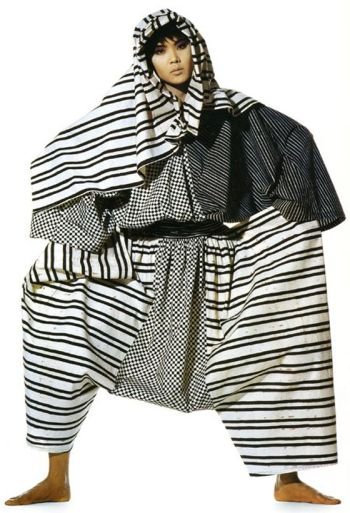
All fashion history in 140 seconds
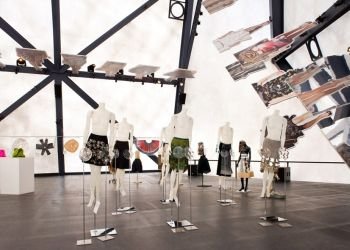
“Waist Down” , the splendid exhibition of skirts designed by Miuccia Prada
Collaborations and representations
During the 20th century, there were numerous cross-fertilizations and collaborations between art and fashion. Haute couture’s developing aesthetic sensibilities combined advanced craft skills with individual designers’ vision and pressure to create a strong business practice to ensure prolonged success. Couturiers sought to establish their design houses’ identities in relation to contemporary beauty ideals and this necessarily saw them look to modern art as a visual prompt and inspiration.
In Paul Poiret’s hands, this meant an exploration of notions of the exotic, and, like Matisse, he travelled to Morocco to find alternatives to Western approaches to colour and form. Poiret’s fantasy of rich planes of colour, draped harem trousers, and loose tunics contributed to an ideal of femininity that had been increasingly apparent in both popular and elite culture since the late 19th century. Poiret and his wife Denise were photographed in orientalized robes, reclining on sofas at their infamous ‘One Thousand and Second Night’ party.
When viewed in conjunction with Poiret’s designs, these images promoted his couture house as luxurious and decadent. Importantly, they also positioned him as uncompromisingly modern, despite the historical references that underpinned many of his garments. Poiret was aware that he needed to cultivate an image of himself that drew on notions of the artist as an individual creative force, while also producing designs that could successfully be sold abroad, particularly to America. His work, in common with other couturiers, had to balance between the demands of the one-off outfit for a single client, which had more in common with the authenticity of fine art, and the commercial imperatives of creating designs that could be sold to and copied by manufacturers internationally.
Although Poiret strove to maintain an artistic image, and drew upon such influences as the Ballets Russes, he also undertook promotional tours to Czechoslovakia and America to increase awareness of his designs amongst a wider audience.
Nancy Troy has written of this delicate relationship between fine art practice and haute couture in the first decades of the 20th century. She identified shifts in each discipline that were a response to the increasingly blurred line between popular and elite culture, and therefore also to distinctions between the ‘authentic’ original and the reproduction. As she noted, designers and artists tried ‘to explore, control, and channel (though not necessarily to stave off) the supposedly corrupting influence of commerce and commodity culture’.
Couturiers had varied approaches both to managing these issues and to incorporating influences from contemporary art into their designs. Poiret’s work flourished under the influence of vibrant, often clashing colour and emphasis on theatrical self-presentation.
It is therefore unsurprising that when he made direct collaborations with artists, it was in textile designs by Matisse and Dufy, for example. Such connections between leading avant-garde artists and their equivalents within fashion seem both natural and mutually beneficial. Each side was able to experiment, exploring new ways to think about and present their ideas. Each potentially benefited by the association with another form of cutting-edge contemporary culture to combine the visual with the material.
Elsa Schiaparelli staged more extensive collaborations, most famously through her work with Salvador Dali and Jean Cocteau. These connections produced clothes which gave life to Surrealist tenets, including Dali’s ‘lobster’ decorated dress. This brought the movement’s love of juxtapositions and complex relationship to notions of femininity into the physical realm, with Schiaparelli’s wearers turning their bodies into statements on art, culture, and sexuality.
For Madeleine Vionnet, an interest in contemporary art’s preoccupations was seen in her technical explorations of the three-dimensional planes of a garment, inspired by the fragmented representational style of Italian Futurism. Her work with Ernesto Thayaht showed a dynamic union between his spatial experiments and her concern for the relationship between body and fabric. His fashion plates of her designs made this link explicit, rendering her designs as Futurist ideals of femininity. The models’ bodies and clothes were fractured to show not just their three dimensions, but to suggest their lines of movement and their intrinsic modernity.
If Poiret’s association with art was through his desire for luxury and freedom in design expression, then Vionnet’s was part of a search for new methods to address the body and the way it was represented. Both couturiers were also widely copied, despite the intricacy of their designs. Their concern about manufacturers’ profligate use of their work exposed the contradictions inherent within modern fashion (and, indeed, art). As Troy has shown, what was at stake was not just ideals of artistic integrity; copying could also undermine their businesses and jeopardize their profits.
Given art and fashion’s growing push into the commercial world, it was inevitable that artists and designers would look to mass-produced ready-to-wear as another site for collaboration. Such projects brought tensions between the two disciplines, and their relationship to industry and finance to the fore. This could be through political belief in the power of art to change the lives of the masses, as seen in Russian Constructivist Vavara Stepanova’s designs of the 1920s. While most of her contemporaries shunned fashion for its ephemerality, she felt that, despite its problematic associations with capitalism and business, it was bound to become more rational, in the same way that she perceived ‘daily life’ in the Soviet Union to be. She therefore broke with her fellow Constructivists to state that: It would be a mistake to think that fashion could be eliminated or that it is an unnecessary profit-making adjunct. Fashion presents, in a readily understandable way, the complex set of lines and forms predominant in a particular time period – the external attributes of the epoch.
Fashion’s ability to connect more directly with the wider community has made it an ideal medium for artists who want to connect their work to the popular sphere. This might follow in the traditions established by Poiret at the start of the 20th century, as seen in the witty prints designed by Picasso, amongst others, for a series of American textile designs in the 1950s, and used by designers including Claire McCardell. In the early 1980s, Vivienne Westwood’s work with graffiti artist Keith Haring was closer in spirit to Schiaparelli’s collaborations with artists. In each case, their joint work represented a common interest and intent, in Westwood and Haring’s example in street culture and challenging accepted ideas of the body, which translated into clothes decorated with an artist’s drawings.
The commercial and consumer ethic at the heart of much collaboration between fashion and art became more manifest in the later 20th and early 21st centuries. While Rei Kawakubo’s rigorous intellectual approach to fashion is without question, it is interesting to see how successfully she has negotiated the potentially fraught relationships between artistic endeavour, fashion, and consumption. Peter Wollen has compared Japanese designers’ approach to these interconnections to that of Wiener Werksta¨tte artists, who sought to design clothes as part of a ‘total environment’. This environment includes, perhaps most significantly, the retail space, which for Comme des Garc¸ons has become a temple for Kawakubo’s design aesthetic and a site of continuing collaborations. Leading architects, including Future Systems, designed boutiques for her in New York, Tokyo, and Paris. Her interior displays ape iconic modernist works, such as the apparently haphazard design of her Warsaw guerrilla store, which made reference to Bauhaus designer Herbert Bayer’s ground-breaking presentation of identical chairs fixed to the walls in the German section of the Society of French Interior Designers annual exhibition of 1930.
Kawakubo, like other designers including Agne`s B, has taken this ambiguity between commercial retail space and gallery further, to hold exhibitions in her boutiques. In Comme des Garc¸ons’ Tokyo store, displays have included Cindy Sherman’s photography, which itself appropriates fashion practices. Such exhibitions are not new, for example New York department store Lord & Taylor held a show on Art Deco in the late 1920s, while Selfridges in London showed Henry Moore’s work in the 1930s. However, by the end of the century connections were more complex and links between the two areas more firmly embedded, especially within the work of artists and designers dealing with the body and identity.
At the start of the 21st century, the relationship between art and fashion remains as fraught as it is revealing of cultural values and subconscious desires. The lines between fashion in art and art in fashion became hazier, but so did the distinctions between the spaces in which each was shown. Shops, galleries, and museums employed similar approaches to display and fore grounded consumption of art, fashion, and the cultural kudos attached to each. For example, Louis Vuitton sponsored a party for the launch of its spring/summer 2008 collection of handbags decorated with prints by Richard Prince. The party was held at the Guggenheim Museum in New York, on the last night of Prince’s exhibition there, drawing comment from some areas of the press on the problems of commercial sponsorship and the status of fashion in the gallery. This demonstrated how art and fashion, although inextricably linked, can both gain and lose from comparisons made when they are brought into close proximity.
Miuccia Prada has been very active in examining these crosscurrents. In 1993, she established the Fondazione Prada to support and promote art. She also commissioned architects, including Rem Koolhaas, to design iconic ‘epicentre’ stores for her, which would provide a space for art exhibitions to be held alongside her clothing on the shop floor. This included huge photographic prints by Andreas Gursky at her store in Soho, New York. The fact that Gursky’s work has frequently critiqued consumer culture adds an ironic edge to Prada’s display of his photographs. Thus, architect, artist, and designer are presented as knowing and self-aware, creating fashion, art, and buildings, while simultaneously commenting on these practices.
Miuccia Prada’s complicated relationship with fashion and art was best expressed in her exhibition Waist Down: Miuccia Prada, Art and Creativity, which examined the evolution of skirt design within her collections. Designed by Koolhaas’ architectural team, the show travelled internationally, held in venues such as the Peace Hotel in Shanghai in 2005. The exhibition used experimental display methods; skirts hung from the ceiling on special mechanized hangers which spun them round, or were spread out and encased in plastic to look like decorative jellyfish. Prada’s financial acumen and global success enabled such innovative design to be possible, and her connections within the art and design world facilitated its realization.
However, Prada herself seemed intrigued by the ambiguity of these connections, and yet conflicted about how this linked fashion and touring exhibition Waist Down included creative displays of Prada skirts art. When the exhibition travelled to her New York boutique in 2006, she commented to journalist Carl Swanson that ‘shops are where art used to be’, but went on to demur over the status of her exhibition and the other works displayed at her epicentre store, stating that:
It’s a place for experimentation. But it’s not by chance that the exhibition is in the store. Because it started with the idea of putting more things to discuss, mainly about my work, in the store. It’s like an explanation of the work. It’s not at all anything connected with art. It’s just to make the store more interesting.
This contradiction lies at the heart of fashion’s relationship with art. Collaborations between artists and fashion designers can produce interesting results, but there can be discomfort from both sides about how such work is perceived. As important aspects of visual culture, fashion and art both represent and construct ideas about, for example, the body, beauty, and identity. Nevertheless, art’s commercial side is revealed by its closeness to fashion, and fashion can seem to be using art to provide it with gravitas. What is revealed by such crossover projects is that each medium has the potential to be both consumerist and conceptual, meaningful and about surface display. It is these similarities that bring fashion and art together, and which add interesting tensions to their relationship.