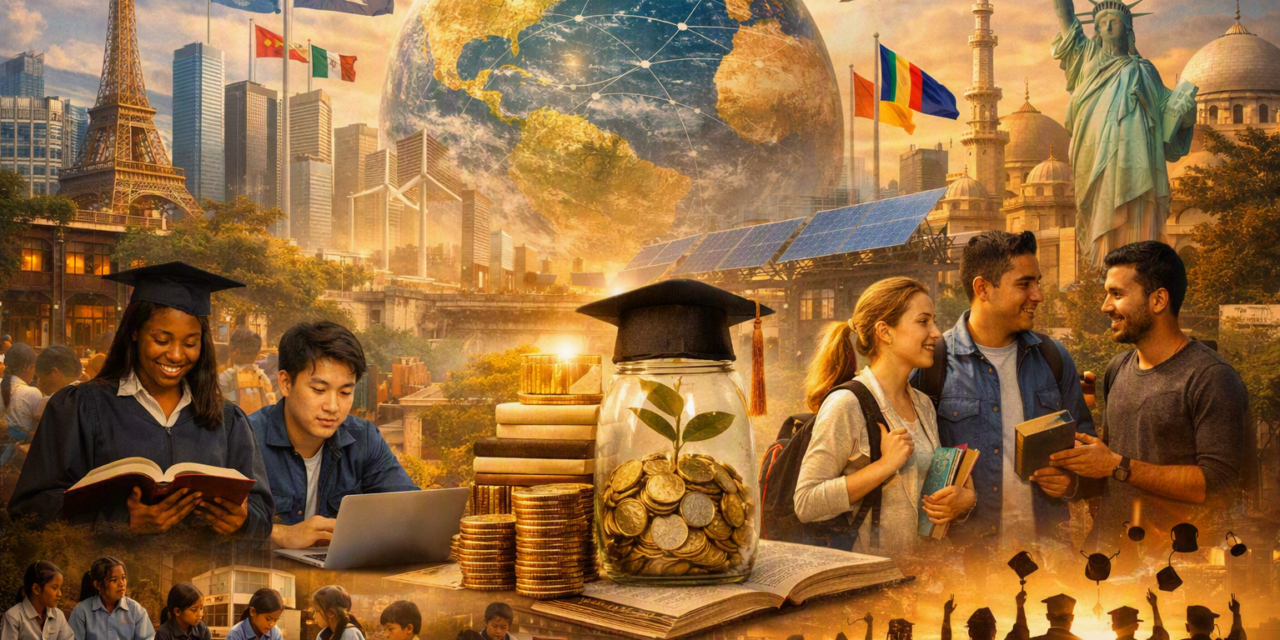
The idea of “free” education, especially at the university level, is a notion that is strongly supported in today’s debates on social justice, economic advancement, and personal opportunity. Often touted as a cure-all for society’s ills and a foundation for social mobility, this ideal promises to remove financial obstacles that would otherwise prevent ambitious people from attending college. But behind the surface of this apparently philanthropic pledge lurks a complicated nexus of political, social, and economic factors. The term “free education” itself simplifies things since no educational system runs without substantial financial investment, whether from the government, philanthropic organizations, or indirect mechanisms. The complex issue of who really profits from such educational models—the individual student who acquires knowledge and skills or the bigger educational and societal “system” that obtains its own unique advantages-will be examined in this essay. Looking at the economic effects, social repercussions, and systemic efficiency will help us to unravel the complex allocation of costs and benefits connected with “free” education, therefore hoping to offer a sophisticated perspective of this powerful policy.
Defining “Free” Education
It is vital to define what “free” education entails before starting an examination of who gains. In most situations, “free” when referring to higher education usually means there are no direct tuition fees for pupils. This doesn’t mean that the price of education delivery vanishes. The financial load is instead moved, usually to the government via taxation, or sometimes through donations, grants, or other non-tuition income sources. It is vital to distinguish between many forms of “free” schooling. Financed by general taxation, some nations provide all of their people with totally free college educatio. Others might provide free education just to certain groups—like low-income students or for specific courses considered vital for national development. In addition, there are systems where tuition costs are significantly subsidized, resulting in very low but not totally nonexistent prices. Though this is a less common and more comprehensive kind of public support, the idea of “free” could also cover living expenses, textbooks, and other related charges in addition to direct tuition. Because the character and degree of “freeness” directly affect the allocation of advantages and the associated expenses, grasping these differences is essential. In this essay, “free” education will mostly refer to programs in which direct tuition costs for tertiary education are removed or significantly lowered for the bulk of domestic students, with the expenses mostly covered by the public budget.
Benefits to the Student
Intuitively, the students themselves are the clear beneficiaries of “free” education. Eliminating direct tuition fees can significantly improve future opportunities and personal lives.
Increased Access and Equity
The main advantage for students is improved access to higher education. For those from lesser socioeconomic levels, the possibility of incurring a lot of student debt might be terrifying if not outright debilitating. “Free” education removes this financial barrier, thereby promoting democracy in university access. This can result in a more varied student body reflecting a broader spectrum of experiences and backgrounds. This improved equity is not simply a matter of fairness; it may also enhance the learning environment for all students by means of exposure to many points of view and ideas. Furthermore, for students who could have otherwise been compelled to skip university owing to financial limitations, “free” education creates possibilities for personal and professional development formerly unattainable. This might upset intergenerational cycles of poverty and restricted opportunity.
Reduced Financial Burden and Debt Aversion
In nations with high tuition costs, student loan debt is a major worry. Graduates typically have decades of debt to pay back, which might put off significant life choices including marriage, starting a family, or postgraduate studies. “Free” education frees pupils from this financial concern. With a clear financial slate, they can join the workforce and allocate their income to personal savings, investments, or immediate expenditure. This independence from debt might also enable pupils to follow professions like those in the non-profit industry or public service that could be less profitable but more personally satisfying or societally advantageous without the immediate burden of large loan payments.
Enhanced Social Mobility and Economic Opportunity
“Free” education has the potential to be a strong engine for social mobility by equalizing the playing field in terms of accessibility. Students whose socioeconomic background may have limited them to lower-paying jobs can gain the credentials necessary for better-skilled, better-paying occupations. This advances a more meritocratic society where ability and effort are recognized independent of inherited riches or rank, in addition to supporting the person. The rising number of university-educated people might also result in a more competent workforce, possibly fostering economic development and creativity, which in turn could open more doors for the next generations of students.
Focus on Learning and Personal Development
Students who are not worried about paying tuition fees or the possibility of going into debt may be able to focus more of their time and energy on their academics and personal growth. The scholarly environment might shift from being transactional to being more focused on intellectual curiosity and the pursuit of knowledge. Without the extra pressure of optimizing their perceived return on investment from their education, students may feel more motivated to experiment, investigate multidisciplinary subjects, or participate in extracurricular activities that promote holistic growth. This might result in a more sophisticated, richer university experience.
Broader Participation in Public Life
Usually thought to be crucial for a vibrant democracy and an active populace is a well-educated populace. Higher education, when made available to a larger population, can encourage more participation in civic life, informed debate, and community involvement. Graduates tend to be more involved in political activities, such voting, volunteering, and participating in political processes. Therefore, “free” education, by raising the number of educated people, can help to build a more vigorous and informed public discourse.
Benefits to the System
Although the benefits for students are direct and individual, the “system”—including educational institutions, governments, and society at large—also gains great advantages from “free” education models. Although less direct, strategic, and long-term, these advantages are nonetheless significant.
Enhanced Human Capital and Economic Productivity
From a larger viewpoint, “free” education can be seen as a calculated investment in human capital. Governments and businesses may boost productivity, encourage invention, and raise international competitiveness by expanding the pool of trained and educated workers. A greater pool of university graduates might spur developments in science, technology, arts, and culture. This results in a more vibrant economy overall as well as the growth of new businesses and better public services. The long-term financial benefits of a well-educated staff might much outweigh the initial public expenditure in education. Countries that give higher education top priority usually lead the way in terms of world creativity and economic expansion.
Social Cohesion and Reduced Inequality
By lowering one of the most important causes of inequality—unequal access to opportunity—”free” education can help to foster social cohesiveness. When education level is not dependent on money, it can lower social inequality and promote a feeling of common future. It can contribute to building a more fair and stable society by offering a route for advancement for people from all backgrounds. This might result in less social conflict, lower crime rates, and greater national cohesiveness. Investing in education as a public good can be seen as an investment in social stability.
Governmental Control and Strategic Planning
For governments, “free” education is a strong instrument for strategic planning and social engineering. Governments could steer talent toward fields judged vital for national growth by managing finance and, to a great extent, higher education access. For example, inside a “free” system, scholarships or focused initiatives might inspire students to seek degrees in STEM subjects, healthcare, or renewable energy. This enables proactive workforce development in line with national economic and social objectives, as opposed to depending only on market forces, which might not always yield the intended results.
Institutional Stability and Research Advancement
A publicly funded “free” education model can provide more financial stability and predictability for colleges and other higher education institutions than can systems much dependent on fluctuating tuition payments or donor support. This stability enables organizations to concentrate on their primary goal of teaching and research rather than constantly fundraising or negotiating unpredictable financial situations. Additionally, a steady stream of well-prepared pupils, independent of their financial background, may help to keep enrollment statistics high and ensure a dynamic intellectual community. This stability can also help create a good environment for long-term research projects, which are often funded by public grants, and lead to discoveries that benefit society as a whole.
Reduced Administrative Burden for Institutions
Although the funding approach varies, a system free or standard tuition might simplify administrative chores for institutions. Financial aid applications, loan processing, and tuition collection all rely on complicated equipment that can be simplified or removed. This can release resources and administrative personnel to concentrate on institutional development, student services, and academic support. Greater operational efficiency inside educational organizations might result from this simplification.
Strengths of Public Investment in Education
The case for “free” education as a public benefit usually depends on the idea that education creates positive externalities. An informed population offers advantages to society in the form of more innovation, better public health, lower crime rates, and a more involved populace beyond the individual graduate. Public investment can be seen as a way to make sure that society gets these broader benefits, which might not happen if education were left entirely to the private market and people’s ability to pay.
Challenges and Criticisms of “Free” Education
Though there are clear advantages, “free” education models have drawbacks and criticisms that also highlight who may not profit or who might suffer un unintentional burdens.
The Cost and Funding Dilemma
The most important criticism has to do with the price. “Free” education isn’t really free; taxpayers pay for it. This might strain public funds significantly, possibly redirecting resources from other vital public services like healthcare, infrastructure, or K-12 education. The viability of such a system is frequently questioned, particularly during economic downturns or demographic changes that raise the need for more education. If funding is not enough or regular, the quality of education could also suffer, resulting in bigger classes, underpaid teachers, and obsolete infrastructure. In the long run, this would hurt the students who are meant to profit.
Potential for Overcrowding and Reduced Quality
Universities could get overcrowded if access is significantly increased without a concomitant institutional capacity boost. This can result in bigger class numbers, less teacher-student contact, and a lowering of the overall educational quality. The strain on resources can also cause a decrease in the quality of instruction, research facilities, and student assistance services, therefore lowering the value of the degree acquired. Critics contend that under such circumstances, children could obtain a less demanding or less valuable education, and the “free” component becomes a meaningless vow.
Misallocation of Talent and Over-Credentialing
When higher education is free, there is a concern that people might go to college just because it’s available, even if they don’t have a clear idea of what they want to do or a real interest in learning. This can cause an oversupply of graduates in some fields and a deficit in others, therefore increasing unemployment or underemployment among degree holders. It may also result in “over-credentialing”, whereby a bachelor’s degree becomes the minimum criterion for roles that historically did not demand one, therefore devaluing the qualification and possibly raising competition for entry-level jobs. This can especially impact pupils who really need degrees for specialized occupations.
The “Sunk Cost” Fallacy and Student Motivation
Some critics contend that students might not appreciate education as much when it is free. Lower drive, increased dropout rates, or a less serious attitude to education might result from the lack of a personal financial commitment (the “sunk cost”). For others, the psychological benefit of having a financial interest in their education might encourage more engagement and diligence.
Regressive Taxation and Burden on Lower Earners
Although “free” schooling is sometimes presented as progressive, its financing source via general taxes might be regressive. If a large part of the tax income comes from broad-based taxes like sales tax, then lower-income people, who might not directly benefit from higher education, end up paying for the education of those who do. This can impose an unanticipated burden on the very people the policy hopes to help.
Brain Drain and International Competitiveness
There is a danger of “brain drain” in nations where education is free and of excellent quality. Highly educated graduates could be encouraged to look for better-paying jobs overseas, therefore depriving the country that invested in their education of qualified talent. On the other hand, should the caliber of “free” education suffer, domestic universities may find it difficult to draw foreign students or academics, maybe lowering their reputation worldwide.
Analyzing the Balance of Benefits
The issue of who gains most is not a clear dichotomy, but rather a spectrum where both pupils and the system profit, albeit in different forms and to varying degrees based on the particular execution.
The Student’s Immediate vs. Long-Term Gains
The advantages for the student are frequently instantaneous and concrete: alleviation from financial strain, greater access, and the possibility of improved job chances. But if the standard of education is lowered or the job market cannot handle the growing number of graduates, these advantages might be much diminished. A “free” degree from an under-resourced university might not provide the same long-term economic benefits as one from a well-resourced one. The quality and relevance of the education obtained determine the student’s ultimate advantage.
The System’s Strategic and Societal Gains
The advantages of the system are usually more strategic and dispersed. A government funding “free” education seeks to achieve long-term economic development, social stability, and a qualified labor force. These are vital for national prosperity but difficult to measure in the immediate term; they are societal consequences. Increased enrollment and stability help educational institutions, which might advance their research and academic goals. But in order for the educational institutions to maintain high standards, they must be properly financed and administered, which will enable them to achieve these systemic benefits.
The Interdependence of Benefits
Understanding the interconnections of these advantages is vital. Whether the system can reach its long-term objectives (like economic growth) depends on students getting a high-quality education that prepares them for the workforce. On the other hand, whether pupils actually gain from “free” education relies on the resources the system allocates to sustain and improve the caliber and capacity of its educational institutions. The major beneficiaries are decreased and the methodical advantages unlikely to show if the system neglects to offer excellent education. Likewise, the money the system invests is wasted if pupils do not make successful use of “free” education.
The Role of Implementation and Policy Design
The particular design and application of the “free” education program significantly affect the trade-off of advantages. Well-funded policies that incorporate quality assurance processes and are integrated with larger socioeconomic goals are more likely to yield significant benefits to both pupils and the system. On the other hand, inadequately funded, badly run “free” education programs could produce bad results, where neither the system nor students really benefit. For instance, a country could provide free tuition but neglect to invest in teacher training or research facilities, which would result in lower educational quality.
Considering Different Stakeholders Within the System
It is also critical to evaluate who inside the “system” gains. Governments gain from social capital and economic expansion. Reliable funding and enrollment help institutions. Though higher taxes might hurt individual taxpayers, taxpayers as a whole could gain from a more affluent country. Though educators would profit from better job security and more pupils, their advantages would be diminished if pay did not keep pace with inflation or workload. Thus, the benefits are not uniform even within the “system”.
Case Studies and Comparative Analysis
Looking at actual cases might help us to grasp the real-world distribution of advantages in various “free” education settings.
Germany: A Model of Public Funding and Quality
Many people consider Germany to be a good example of “free” higher education. For decades, German public universities have charged little to no tuition fees for undergraduate and graduate courses for both domestic and international students. Funded mostly by state taxes, this system has resulted in great attendance in higher education and a very competent workforce. The lack of tuition debt helps students concentrate on their studies and careers. The German economy profits from a steady stream of skilled workers, which fuels manufacturing strength and creativity. Significant public investment, rigorous quality assurance systems, and a tight connection between universities and business define the system. This comprehensive strategy has ensured that the advantages are fairly spread. Germany, though, has difficulties including capacity limits in well-liked programs and continuous disputes about the amount of public financing.
The United Kingdom: A Shift Towards Marketization
The UK, by contrast, has gone from a system of free or largely subsidized education to one with high tuition costs, capped but still substantial. Although this approach is not “free”, its high cost and dependency on student loans draw attention to the advantages the government gains in terms of lower direct public spending. But students carry the brunt of the financial load; many of them graduate with a lot of debt. Tuition payments provide universities with income that might fund research and infrastructure improvements, but this also creates a strong incentive to recruit students, which can raise questions about academic standards and “degree inflation.” The UK system shows how moving away from public funding can help the government financially in the short term, but it also puts more pressure on students and could change the incentives for institutions.
Nordic Countries: Universal Access and Social Welfare
Countries including Sweden, Denmark, and Norway provide mostly free higher education supported by progressive taxes. Usually, these countries have robust economies, great social mobility, and a will to provide public benefit. Students gain from debt-free education and universal access. Highly educated people contribute to innovation and a strong social safety net help the communities to thrive. Here, the “system” is one whereby education is seen as a crucial public benefit essential to the social compact. The people view the high tax rates needed to pay for these services as an investment in their common good.
Developing Nations and the “Free” Education Debate
The idea of “free” schooling is usually more aspirational in emerging countries. Although several seek to raise access, the financial limits are usually harsh. Providing really “free” higher education could call for either major international help or a major reallocation of public finances. The argument often hinges on whether a restricted but high-quality subsidized system or a more general but maybe poorer-quality free system is more advantageous. In these circumstances, national development would profit from a more educated workforce and increased enrolment, but the risk of jeopardizing quality from inadequate funding is particularly high, possibly resulting in degrees that are not globally accepted or respected.
Conclusion
The issue of who gains most from “free” education is complex and has no clear, universal solution. The student clearly benefits directly and personally: more access, freedom from crippling debt, and more chances for social and economic advancement. These advantages have the power to change life paths and unleash personal potential. Still, the advantages gained by the “system” are inherently related to and frequently dependent upon these student benefits.
For the system including governments, educational institutions, and society, the benefits are strategic and long-term. Governments have the ability to encourage social cohesiveness, promote invention, and develop a very talented staff. With consistent funding, educational institutions can attain more stability and follow their academic goals. Greater productivity, a more engaged populace, and less inequality may help society overall.
In the end, the allocation of benefits is not a natural result of “free” education; rather, it is the result of painstaking planning, strong financing, and efficient execution. Students and the system may prosper when “free” education is sufficiently funded, deliberately organized, and directed at preserving high-quality requirements. While the system benefits from human capital development and society advancement, students acquire significant credentials and chances. Conversely, neglected or mismanaged “free” education initiatives run the danger of degrading educational quality, burdening taxpayers, and failing to provide on the promise of greater opportunity for pupils. Therefore, the most important beneficiaries are probably those in systems where “free” education is seen as a major public investment, comprehended as a symbiotic connection in which the growth of the person directly drives the advancement of the collectivist. The best case is one in which the personal development of the student and the more general societal goals of the system are mutually reinforcing, so producing a virtuous cycle of advancement.
Bibliography
- UNESCO. Global Education Monitoring Report 2024: Inclusion and Equity in Education. UNESCO Publishing, 2024.
- OECD. Education at a Glance 2023: OECD Indicators. OECD Publishing, 2023.
- World Bank. World Development Report 2024: Education for Resilience. World Bank Publications, 2024.
- Sen, Amartya. Development as Freedom. Oxford University Press, 1999.
- Freire, Paulo. Pedagogy of the Oppressed. Bloomsbury Academic, 2020.
- Apple, Michael W. Education and Power. Routledge, 2012.
- Bowles, Samuel & Gintis, Herbert. Schooling in Capitalist America: Educational Reform and the Contradictions of Economic Life. Haymarket Books, 2011.
- Giroux, Henry A. On Critical Pedagogy. Bloomsbury Academic, 2020.
- OECD. Skills Outlook 2025: Learning for Life. OECD Publishing, 2025.
- UNESCO Institute for Statistics. Global Education Data Portal. Accessed August 2026.
References:
(2016). Who would benefit most from free college? | Brookings. www.brookings.edu. Retrieved from https://www.brookings.edu/articles/who-would-benefit-most-from-free-college/
(2022). Putting student loan forgiveness in perspective: How costly is it and who benefits? | Brookings. www.brookings.edu. Retrieved from https://www.brookings.edu/articles/putting-student-loan-forgiveness-in-perspective-how-costly-is-it-and-who-benefits/
(2026). Policies to Ensure Equitable Access to Well-Resourced Colleges and Universities – Ithaka S+R. sr.ithaka.org. Retrieved from https://sr.ithaka.org/publications/access-to-well-resourced-colleges-and-universities/
www.sciencedirect.com. Retrieved from https://www.sciencedirect.com/science/article/abs/pii/S0047272713001898
Marcelo Ruiz & Claudio Ruff & Alexis Matheu & Maria Teresa Gómez Marcos & Paola Juica (2023). Cost-free education as a new variable of mixed financing policies in Chilean higher education and its impact on student trajectory and social mobility – PMC. pmc.ncbi.nlm.nih.gov. Retrieved from https://pmc.ncbi.nlm.nih.gov/articles/PMC10395028/